

The military hardware America spent seventy years buying may not survive its first real engagement. A frozen front line in Ukraine teaches it. Anything big, slow, and heat-emitting that crosses the zone gets destroyed inside hours. The Artificial Intelligence (AI) the new war runs on is small, networked, and cheap. The budget does not need to shrink. The geometry moved; the inventory has not.
What is the transparent battlefield and why does it strand the inventory we just bought?
The transparent battlefield freezes the front and obsoletes the inventory built around big, slow, heat-emitting platforms. Tanks, armored personnel carriers, towed artillery are structurally vulnerable. The active fight has moved to the mid-strike zone. The Artificial Intelligence (AI) budget does not need to shrink. It needs to redirect.
Fifty days in a hole#
A soldier on the forward line in Ukraine stays underground for fifty days minimum. Three to four months is more typical. Food and water arrive by drone. Sticking a head above the dirt is fatal, because the other side’s drones are watching the dirt with enough density that the dirt is no longer cover.
This is for a defense planner, a procurement official, a congressional staffer, or an informed citizen wondering why a budget that keeps going up is buying inventory that may not survive its first engagement. The reader who has noticed that the line items and the geometry are pointing in different directions.
Across the front, the contested zone is wide, transparent, and largely frozen. Both sides have surveillance dense enough that movement above ground gets seen and killed inside hours. The frozen line is what happens when both sides arrive at the same answer. Neither side can mass force without being destroyed. Not at any cost the planner is willing to pay. Not at any speed the platform can hold.
Like a deer crossing a lit stadium floor at noon, anything that moves above ground is visible from every direction at once. The deer has no shadow to step into. The stadium has no cover. The deer’s only options are speed the deer does not have or stillness the deer cannot keep.
Ukraine has reported hitting a quota of roughly thirty-five thousand Russian targets killed per month for four months in a row. The scale dwarfs Vietnam-era American losses. The geometry produces that scale. The geometry, not any single weapon system, is what most armies still have not absorbed.
Most armies in the world have not yet absorbed what the transparency condition means for the inventory they spent seventy years buying. The geometry of war has already moved. The inventory has not. The question is whether the inventory follows.
What does not survive the new geometry#
Anything that moves above ground inside the drone envelope is destroyed. Tanks. Armored personnel carriers. Towed artillery. Most of what twentieth-century armies were built around. The list is not gentle. The conclusion is not gentle either. Same machines. Different war.
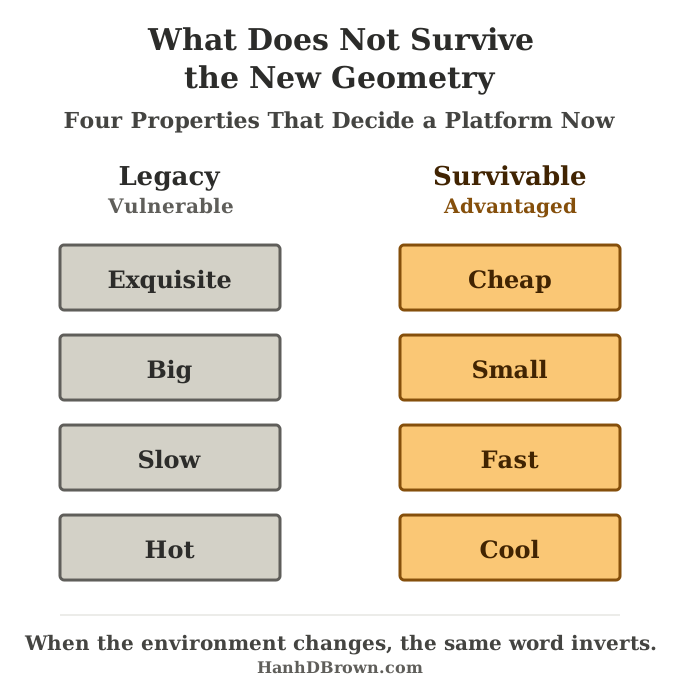
Every item shares the same diagnostic property. Exquisite. Expensive. Big. Slow. Hot. Each property is a drawback on a transparent field. Together they describe a structural mismatch between what the procurement system has been buying and what the next war will reward. The mismatch is not gentle.
One line item shows it plainly. The 155mm artillery piece is untargeted, has roughly fifteen kilometers of range, and costs about as much as drone alternatives that reach further and hit precisely. The procurement math has flipped on the line item that was the symbol of land warfare for a century.
A gun designed to throw a heavy shell at a distant grid square has been outpriced by a small machine that finds the grid square first. The supply truck hauling the shells is a target before the gun ever fires. The road behind the line is the new front.
There is a counter-position worth naming. The United States has not yet faced a peer with comparable drone density, and some of the inventory dismissed here performs well in lower-density environments. That counter is true and it is not a defense of the procurement cycle. The cycle bets on the lower-density environment as the default. The cycle should bet on the higher-density one.
American doctrine keeps a human in the lethal decision, and holding that line under peer pressure is the real work. The shift in platform is not a shift in decision authority. The platform automates the boring parts, and the decision stays where the rules of war say it stays.
Old inventory and new geometry point in opposite directions. The first cannot be fixed by upgrade. The first must be redirected by procurement.
The war moved to the mid-strike zone#
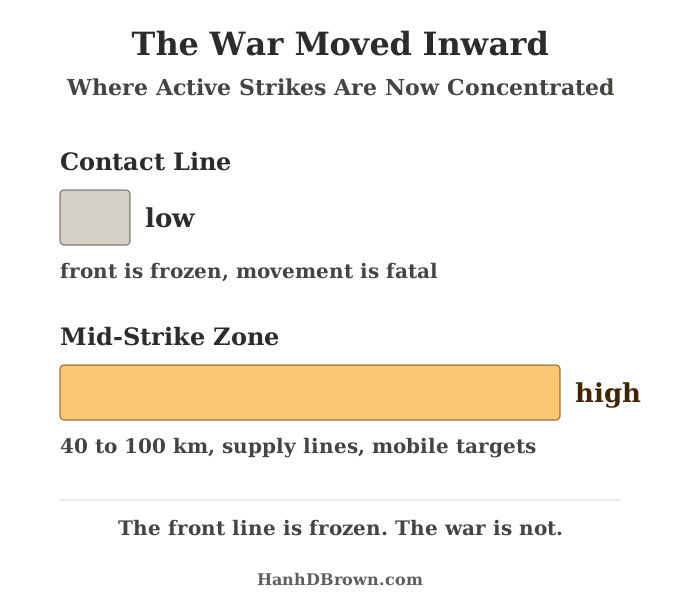
Fighting has moved off the contact line and into the mid-strike zone, roughly forty to one hundred kilometers behind it. That is where the supply lines run. That is where the bombing is. The front line is no longer where the war is decided.
What defeats most platform defenses is the coordinated 360-degree attack. Surround the target with ten cheap machines. Have them strike from all directions at the same moment. The math against most platforms is unwinnable, because most platforms were designed to handle one expensive threat at a time, not ten cheap ones at once. Not theoretical. Demonstrated.
Like a single bucket catching a hailstorm, a point defense built for one inbound threat at a time loses against a swarm. The bucket catches the first stone. The bucket misses the second through the tenth. The roof underneath the bucket is wet inside the hour.
Drones now operate without satellite positioning, and they communicate through electronic warfare rather than being defeated by it. The class is mature enough to assume a contested electromagnetic environment. The class is mature enough to make the older counter-drone playbook obsolete.
Five years ago, a jammer that turns off the swarm was the bet. The swarm now jams the jammer. The wire cuts both ways. The truck moving through the field is visible to the swarm long before the swarm is visible to anyone. Not the other way around.
Some genuine counter-drone breakthrough would change the geometry again. The honest read is that on a five-to-ten year horizon, none is visible at the scale required to restore the old inventory. The bet on the breakthrough is a bet against the available evidence. The bet against the breakthrough is a bet on the geometry already on the ground.
The war rotated inward. The defense of the supply line is the new job. The defense of the contact line is the job the inventory was bought for.
Redirect, not reduce#
This budget does not need to be smaller. It needs to be aimed at the configuration that survives transparency. Small. Networked. Autonomous. Swarming. Cheap enough to lose at scale, expensive enough not to be trivially jammed. Same dollars. Different bins.
A budget question and a doctrinal question can look identical from the outside and require completely different answers. The doctrinal question is which platforms survive. The budget question is what to spend the same dollars on. They share the same line items, not the same answer. The planner who treats one as the other is going to be wrong twice.
That transition does not produce fewer jobs. It produces different ones. The platforms shift, the families re-skill, the supply chain rotates around new factories and new parts bins.
Two parents, one on a hospital ward in Connecticut and one on a factory floor in Ohio, are looking at the same shift through two different windows. The household at the kitchen table reading the procurement headlines is being told one story about cuts and another about jobs. The two stories share the same dollars and disagree about the inventory those dollars buy.
Take a family that decides to drop one car payment and pick up a new school program. It is not spending less. The family is spending differently. The household has the same dollars and a different set of priorities at the kitchen table on a Sunday morning.
That political distinction matters, because the planner who reads the battlefield correctly and then asks for less money is going to lose to the planner who reads it incorrectly and asks for more. The right move is to read it correctly and redirect what is already there.
There is a real question about what happens against a peer that successfully blinds the drone fabric. On a five-to-ten year horizon, the question is theoretical. The geometry is not. The argument here is that the geometry already on the ground is the planning assumption that earns its place.
Twentieth-century courage on a beach in 1945 is real history, and that beach was the exquisite-platform era at its peak, which is exactly the shape the next war will not reward. The courage will still be needed. The platform will not. The doctrinal shift the next decade is going to run through will happen whether the procurement system catches up or not.
The exquisite platform is not coming back. The foxhole, the drone supply chain, the mid-strike shift, the coordinated attack. These are the geometry now. The right defense posture matches the geometry, not the inventory that preceded it.
The argument draws on Dr. Eric Schmidt, chair of the Special Competitive Studies Project (SCSP), in conversation with Tom Shanker, 2025.


