

The default question in 2026 is whether Artificial Intelligence (AI) takes your job. The question is wrong. The mechanism that decides what holds value when capability gets cheap is older than the technology and stranger than the headlines. The mechanism is comparative advantage. It rewards the five percent of your job that was always the real work.
How does AI productivity work when AI does ninety-five percent of the task?
AI productivity works like this: the five percent of your job AI cannot do gets leveraged twenty times. Doing five percent at twenty times the output is more than doing all of it at the old speed. Three categories of work hold their value. Human-centered, physical-world, domain-specific.
Five years from impossible to routine#
Five years ago, a computer could not write a one-page essay on a question. Could not analyze a video. Could not implement a feature in code from a description. Today, all three are routine.
Looking ahead, the next five years are likely to look as different from now as now looks from 2020. Back in 2020 a computer still could not do the three things it does routinely today, so that gap is the size of the change already behind us. The base rate of change is high. “What is possible” is a moving target.
Most career advice was written against a target that has already moved. The reader who follows the advice ends up running toward a square on the map that the game has already left.
This piece is for three readers. The reader who is younger and picking a path. The reader who is mid-career and unsure what to learn next. The reader who is building a company and unsure what to build into.
Intelligence is the output of a reaction. Data, compute, and model size go in. Intelligence comes out. The reaction has been working for years. The reaction is still scaling.
That base rate carries implications most career advice ignores. If the capability that was impossible last year is routine this year, then the work that was prestigious last year is becoming commodity this year. The prestige does not protect the work. The work was prestigious because it was hard. When the work stops being hard, the prestige stops covering for it.
Any reader who walks into the rest of this piece holding the old map is going to misread what comes next. The new map names a different geography. The first thing the new map shows is that ninety-five percent of most tasks just changed hands.
Five percent of a task, leveraged twenty times#
Most coverage frames it as binary. AI replaces work. Or AI fizzles. The mechanism is neither. The mechanism is comparative advantage.
When a human does five percent of a task and AI does the other ninety-five, the five percent does not vanish. The five percent gets enormously amplified. Doing five percent of a task at twenty times the output is more than doing all of it at the old speed.
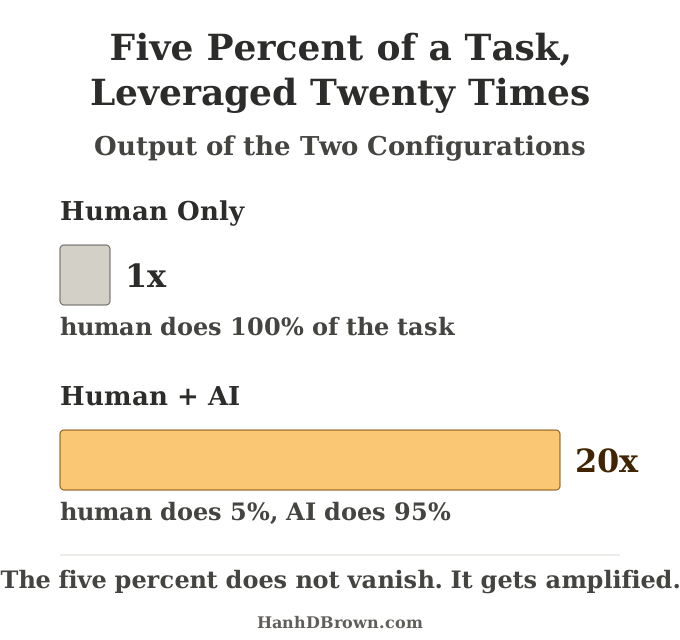
This is not a metaphor. It is the same economic mechanism countries have always used in trade. The party that focuses on the part it can do faster becomes more productive overall. Even if another party is better at every part.
Take a concrete case, widely cited. AI exceeded human radiologists at reading scans, yet the number of radiologists did not drop. The most technical part of the role moved to the machine. The human-touch part of the role did not move, and the role survived around exactly the part that stayed.
That radiologist case is a general pattern. Not a coincidence. The parts of work that do not move are the parts that hold value as AI scales. The question every reader of this article has to answer is which parts of their job did not move.
Replacement talk misses this. AI replaces work and AI levers work are not contradictions. They are the two halves of one mechanism. The public narrative collapsed them into a binary. The binary is the source of almost every wrong prediction about jobs in the last three years.
Picture the five-percent-leveraged-twenty-times move as a chef whose hand on the knife is five percent of the meal and the whole reason to eat. The chef does not cook every grain. The chef does not grow every herb. The chef makes the choices that decide whether the meal is dinner or food.
One kitchen with five sous-chefs and twenty diners gets through twenty plates a night. The same chef working alone gets through five. The five percent did not change. The other ninety-five did. The chef who refuses to use sous-chefs makes five excellent plates while the kitchen next door makes twenty.
The question is not whether you keep all the work you used to do. The question is whether the five percent of it that always mattered most is the part you still own.
The bottleneck moved from engineers to electricity#
Pull back to the industry level. The constraint that shaped software for thirty years was engineers. Companies that could attract more good engineers built more product, faster, than companies that could not. That constraint is gone.
Its replacement is electricity and data-center capacity. The capital race is physical for the first time in the technology era.
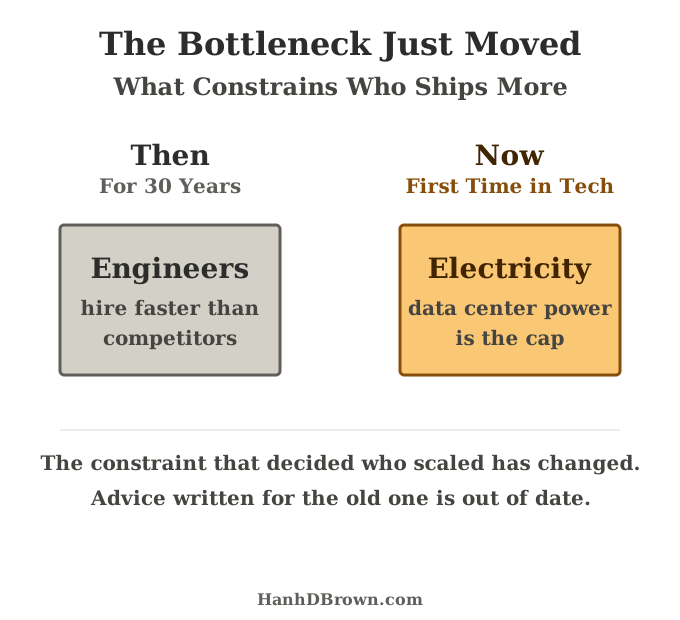
Two observations follow. One: the parts of the stack that depend on engineer scarcity are worth less. The ability to hire faster than competitors used to be a moat. The moat just got drained. Two: the parts that depend on physical infrastructure or domain access are worth more. The companies sitting on grid-connected land suddenly have an asset they did not know they owned.
A second constraint also moved. Deployment friction. Old enterprise software took two years and a million dollars to install. New AI works the first day. The demand was always there. The friction was capping it. When friction collapses, the demand that was waiting arrives all at once.
This is why a company can, in the example Amodei gives, go from nine million dollars to thirty billion dollars in revenue in six weeks. The growth is not magic. The growth is the demand that was always there finally being able to arrive.
See the bottleneck shift as a river that hit a dam and stopped looking like a river. Years passed. The dam broke. The river that had been waiting raced for the sea and reshaped the valley between. Anyone standing on the old bank wondering where the water went was looking at the wrong place. The water was in the valley, doing the work the dam had been holding back.
A constraint that has not yet moved is physical-world automation. AI has not reached parity in the physical world. Robots are not yet at scale. On a five-to-ten year horizon that gap is likely to remain a moat. The parts of work that live in the physical world inherit the time the robots have not yet paid for.
Most career advice points at the old constraint. The advice that points at the new constraint is rare. The reader trying to use the old advice on the new constraint overpays. Overpays for skills that just commoditized. And underpays for the ones that just became scarce.
The three categories that hold their value#
Three categories of work hold their value as AI scales. The list is short enough to remember. Concrete enough to invest against.
Human-centered. Relationships, judgment under ambiguity, roles where presence matters. The work that depends on being a person across a table from another person. The work where the trust is the deliverable.
Physical-world. Building, repairing, growing, caring for bodies. The work that lives outside a screen. The work where robots are not yet at scale and the human hand is still the cheapest tool.
Domain-specific. Knowing which problems in a field are worth solving. Knowing which questions are the right questions to ask the model. The work that takes a decade of practice to learn and cannot be downloaded.
For the founder building a company on top of an application programming interface (API), the same three categories define what a moat actually is. A wrapper is not a moat. A regulated industry, a channel relationship, a domain expertise that takes a decade to build, those are moats. A wrapper can pass for a moat in the founder deck until the model underneath gets smarter and the wrapper turns optional.
To the younger reader picking a path, AI is electricity. Learn it as a tool set. Apply it to a domain worth caring about. The tool gives leverage. The domain is the work.
Picture the choice as a builder who picks materials he can stand behind in twenty years while using every power tool the trade has. He does not choose his materials based on the tool. The tool gets faster every year; the materials still have to hold up the house.
Work that does not hold value compresses. Some of it disappears. The workers move to the categories that do hold value, or they do not. This is the adjustment the next decade is going to run through whether anyone names it or not.
Every parent watching a teenage daughter pick a major already feels the question. The household with a mid-career partner asking which retraining is worth the year already lives inside it.
Those three categories give the family a working answer. The career conversation at the kitchen table starts with the three. Is the work human-centered, physical-world, or domain-specific. If yes, invest in deepening it. If not, find the version of it that is, or move toward a category that holds.
A child watching a parent pick a path against the new categories learns the framework by watching it applied. That is the part the school cannot teach.
Three categories of work hold their value as AI scales. Human-centered, physical-world, domain-specific. The right career move is to invest in at least one. The right business move is to build a moat that is one of the three. The right posture for a young reader is to treat the AI itself as electricity. Learn the tool. Apply it to a domain worth caring about.
The career advice that points at the old constraint is everywhere. The advice that points at the new constraint is rare. The reader who learns to read the new map gets to use the advice. The reader who keeps reading the old map is going to spend the next ten years arguing with the geography.
Five percent of your job is the part leveraged twenty times. The three categories tell you which five. The five is the job.
The argument draws on Dario Amodei, co-founder and chief executive officer of Anthropic, in conversation with Nikhil Kamath in Bangalore, 2026.


