

Artificial Intelligence (AI) abundance forecasts share a sentence. The sentence promises automation will free human labor for higher-value work. The sentence assumes a labor market that does not include the daughter caring for her mother.
What kind of work can AI not replace, and what does that look like at home?
The work AI cannot replace shows up in the care a mother needs that no model can provide. Companionship. Memory. The hand on a shoulder. The decisions a daughter makes for a parent the morning after a fall. AI frees us for higher-value work, and the work is my mother.
The abundance forecast rests on an assumption nobody names#
For two years I have read AI abundance forecasts. They all share a single sentence, and the sentence slides past so smoothly that the assumption inside it goes unnoticed.
The sentence is that automation will free human labor for higher-value work.
Notice what the sentence assumes. There is a higher form of labor. The freed workers move into it without friction. The system absorbs them. The labor receives them.
The assumption is older than AI. The assumption is that someone will be there. Someone always has been. Mostly women. Mostly unpaid. Mostly invisible in the labor data the forecasts are built from.
I did not notice the assumption until I started counting the hours in my own family. My mother fell at home in March. By June I was cooking dinner in her kitchen three nights a week. By October I was sleeping on her couch when the night nurse called out. Once you start counting those hours, you cannot stop seeing them in every forecast you read.
The labor statistics the abundance forecast uses do not count the daughter who took two years off to help her mother die. They do not count the husband whose career stopped when his wife’s dementia started. They do not count the son who flies home every other weekend with a pillbox in his bag. These hours are real labor. They are not in the data.
The forecast is a road. The wall is at the end of the road. The forecast does not know it is a wall, because the forecast does not have eyes for what is behind it.
The first thing you get from this post is permission to notice the assumption. The rest is what happens once you do.
Watch what happens when you try to automate the last two years of a life#
Once you can see the assumption, watch what happens to it under stress. Take the most ambitious AI application in care work. Home automation for people with dementia.
The technology is real. Sensor networks track wandering. Voice agents prompt medication schedules. Robotic companions hold attention. Each capability is genuine. Each capability is in production today.
The capabilities scale. The work does not.
The work is what happens between the capabilities. The noticing. The calibrating. The deciding when to call the doctor, when to call hospice, when to call the family meeting, when to call no one and just sit.
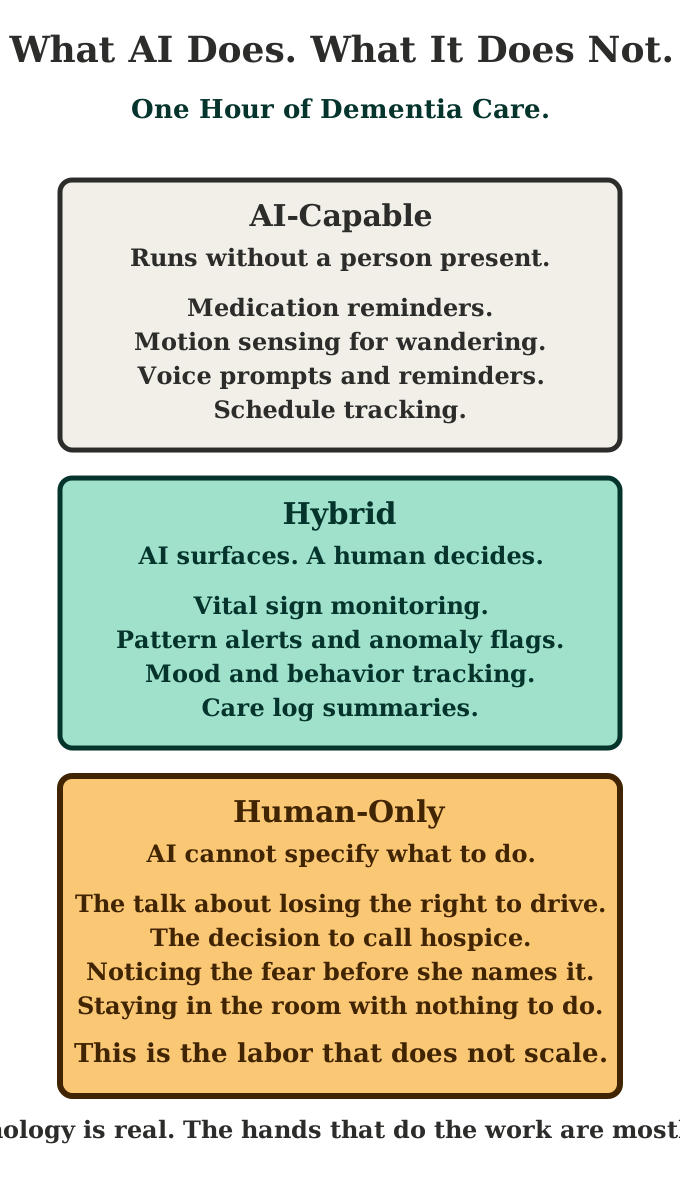
Watch the most advanced dementia care technology working in a real home for six months. Track every alert, every voice prompt, every decision the family made. A pattern appears. The technology surfaces information. A human still makes every consequential choice about what to do with it.
Care work is mostly what happens between the events you can measure. The medication schedule is automatable. The decision to call hospice is not. The blood pressure reading is automatable. The conversation in the kitchen where you tell your father he cannot drive anymore is not.
The labor the AI cannot do is mostly performed by women. Which means the labor the AI cannot do is the labor the economy was already paying least for. The substitution failure lands on the same shoulders the substitution was supposed to relieve.
The hands do not scale. The presence does not scale. The judgment that knows when to stay in the room with nothing to do does not scale.
The hands hold a coat together like a stitch nobody notices until the coat tears.
This is the moment the forecast breaks. The bill comes due to the caregivers#
This is where the forecast hits the wall.
The abundance argument says automation frees labor. The freed labor moves to higher-value work. But the labor that needs the freed workers most, the labor of caring for their parents, is not in the labor market the forecast describes.
And the wall is closer than the forecast says.
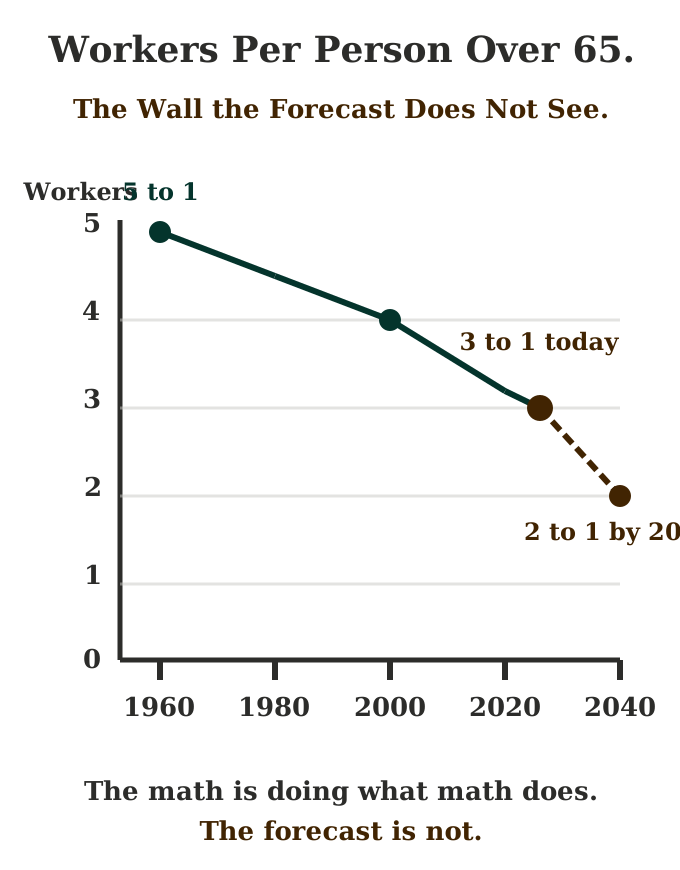
In 1960 there were five working-age adults for every American over sixty-five. In 2026 there are three. In 2040 there will be two. The math is doing what math does. The forecast is not.
Informal caregivers in this country already perform labor worth more than two trillion dollars a year. They are not in any Gross Domestic Product (GDP) table. They are not in any labor force participation rate. They are the labor the AI transition is supposed to liberate humans to do more of. They are already doing it, and the system does not see them.
The wall is the demographic curve. The wall is the gendered invisible labor. The wall is the assumption that someone is always there. The forecast does not see the wall because the forecast does not have eyes for the parts of the economy that have never been counted.
The country is aging into a care economy AI cannot scale. The math does not bend. The daughter at the bedside is still the daughter at the bedside. The forecast has more years than the daughter does.
The math the forecast does was a math problem. The math the country actually faces is a wall problem.
The engineers cannot build what they cannot specify#
Beyond the demographic wall there is the technical wall. AI engineering has a vocabulary problem with care work.
The capabilities AI extends are the ones engineers can write specifications for. Care work resists specification. Notice when she is anxious before she knows she is anxious. Decide when to push back and when to comfort. Stay in the room when there is nothing to do.
Each is a description. Not one is a specification.
Description tells you what something looks like. Specification tells the machine what to do. Care work has rich descriptions and almost no specifications. The descriptions are useless for automation.
Watch a senior software engineer try to write a product spec for the labor a home health aide does in a single hour. It cannot be done. Not because the aide does anything mysterious. Because the things the aide does are made of judgment that has not been written down anywhere, in any language an engineer can compile.
A decade of care robotics research has produced impressive sensors and impressive voice agents and impressive sentiment analysis. It has not produced a robot that anyone wants taking care of their mother. The investment was not the problem. The specification was.
The gap is not temporary. It is not the kind of gap that closes with another generation of chips. The gap is structural. The labor stays human, regardless of how much computational power gets thrown at the problem.
The engineering frame is the wrong frame for this labor. That is the technical wall.
The hands matter. The presence matters. None of it is in the forecast#
Here is what this post does and does not do.
It does not tell you what to do about the wall. It does not propose a policy. It does not predict when the forecast collapses. It only asks you to see what was hiding in plain sight.
The labor that AI cannot replace is mostly invisible. The labor is also mostly the work of caring for the people who taught us, raised us, loved us. The forecast does not see this work because the forecast was built by people whose mothers were cared for by other people. The hands that did the work are not in the forecast. They never were.
Three of every four hours of care work in this country are unpaid. The hands that do them belong to specific people. Mostly daughters. Often the daughter who was supposed to be the white-collar worker the abundance forecast was about to liberate.
I have been one of those daughters. I have counted the hours. I have read the forecasts. I am writing this so the hours and the forecasts can be in the same room together for the first time.
The work of presence stays at the bedside like a lamp that nobody named in the inventory. The lamp is still on. The lamp has been on for years. The forecast does not see the lamp because the forecast was written in a different room.
You noticed it. That is what the post was for. The assumption you have read past in every abundance forecast for the last two years is now visible. It cannot become invisible again.
The hands matter. The presence matters. The voice that says the right thing at the right time matters. None of this is a constraint AI engineers know how to write down. Which means none of it is in the forecast. Which means the forecast is wrong about what comes next.
The hands matter. The presence matters. The voice that says the right thing at the right time matters. The forecast cannot see any of it. The daughter at the bedside is the labor the abundance forecast was about to liberate, and she is already doing the work the forecast cannot name.
The argument draws on Elon Musk’s Moonshots podcast interview with Peter Diamandis and Dave Blondon, December 2025.


