

Artificial Intelligence (AI) arrives with two outcomes in the same window. Abundance for some workers. Unrest for others. The conventional framings pick one and skip the and.
Which workers does AI hit first, and what does the forecast actually say?
White-collar work goes first. Blue-collar work goes later. The industrial-era story has the order wrong. Anything that lives in bits gets automated now. Anything that needs hands on atoms takes longer. Abundance and unrest arrive together in three to seven years. The middle of the labor market is where they collide.
White-collar work goes first, blue-collar work goes later#
For a hundred years the story has run the same way. Factories fell. The factory worker lost the wage. The knowledge worker kept the salary, the office, and the credential. The credential was the moat. The moat held.
AI inverts the order.
Anything that lives in bits gets automated now. The junior analyst writing a deck. The mid-level accountant closing the books. The drafter pulling lines on a screen. The scheduler routing the day. The summarizer turning a meeting into notes. All of it lives in screens, text, and judgment. All of it is the work AI does already, today, in production.
Work that lives in atoms takes longer. The electrician pulling wire through a wall. The plumber under a sink. The nurse turning a patient at three in the morning. The mechanic under the hood of a truck. The roofer on a ladder in a winter wind. The humanoid robot has to mature before any of those jobs change hands, and the robot is not ready yet.
That pattern is the opposite of what the last century trained the eye to expect.
An exposed worker is not the one in boots. The exposed worker sits at a desk, in front of a screen, holding a credential built in an era when bits were the scarce thing. Bits are now the abundant thing. The credential moat ran dry like a creek in a drought summer.
The first jobs at risk wear suits.
The bottleneck on AI is electricity, not chips#
Popular coverage tells a chip story. Nvidia, transistors, the next generation of silicon, the names that fill the headlines.
Yet the actual bottleneck sits upstream.
Chip output grows faster than the United States power grid can absorb it. A gigawatt of training capacity requires more than chips. It requires transformers. Substations. Cooling water in volumes large enough to draw down a river. A power source that can be turned on in less time than it takes to get connected to the grid, which is a year at minimum and often longer.
Consider the largest training cluster in the world, which had to stitch together a patchwork of gas turbines to get past the wait. Forty turbines, ten to fifty megawatts apiece, trucked in and wired together, because the year of grid wait was a year the cluster could not afford. The chips were on the truck before the cooling water was on site.
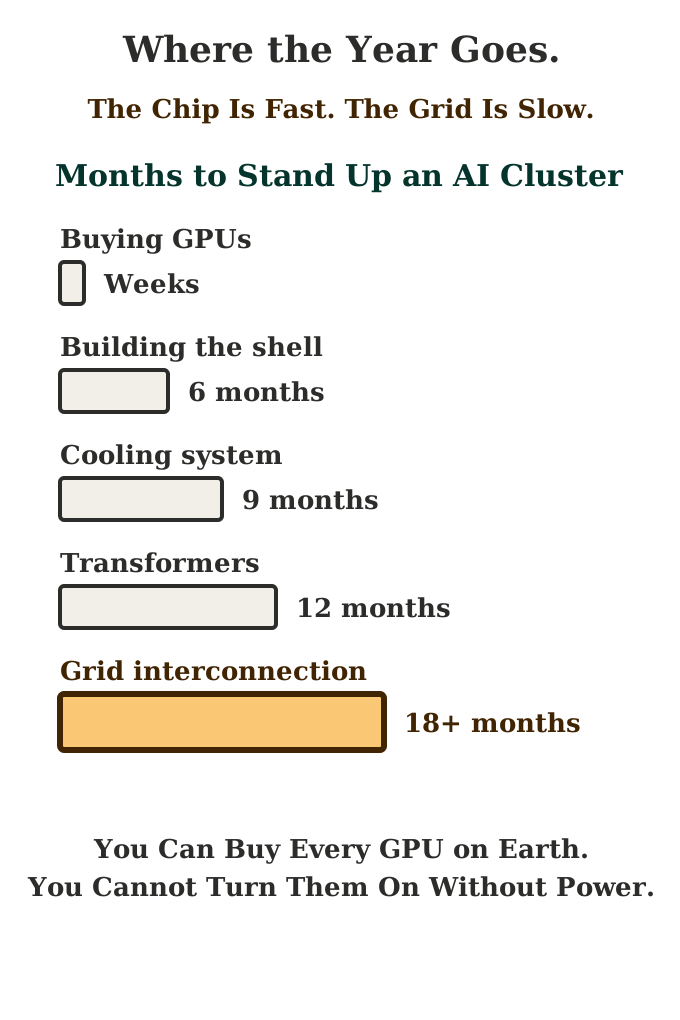
Chip wars are the visible front. The power wars are the actual one.
This matters for the labor argument because the rate of AI rollout depends on power, not on chips. The capability is here. The deployment runs at the speed the grid can absorb new load. That speed is slow. The slow part is not the silicon. The slow part is the steel, the copper, and the permit.
Look two years out and the transition story is a power story. The workers exposed today are exposed because the bits already moved. The next workers in line will be exposed at the speed the grid grows new megawatts. That speed is the speed of construction crews, transformer factories, and the people who pour concrete for substations.
That bottleneck sits upstream of the chip, and it moves slowly.
Abundance and unrest at the same time#
A forecast names both outcomes in the same breath. Universal high income. Social unrest. Both happen. The window is three to seven years.
Conventional framings pick one.
Take the optimist case, which is abundance. The cost of goods and services falls toward the cost of materials and electricity. The same income buys more. Universal high income is deflation, not redistribution. No check from the government. Prices fall instead.
Now take the pessimist case, which is unrest. Jobs disappear in cohorts. Mid-career workers lose the credentials they built a career on. The political coalition that held the wages together loses its leverage. The street does what the street does when leverage runs out.
An honest case names both. Abundance and unrest land in the same window, on the same workers, in the same year, often in the same month. The technical case for abundance does not answer the political case for distribution. The technical question is solvable. The political question is the harder one.
Our political system has no script for both at once. The coalitions that built a welfare state were built around the value of labor. The same coalitions lose leverage in a world where labor is no longer the scarce input. The mechanism that delivered the abundance is the mechanism that breaks the coalition.
Which outcome happens is not the question. Both happen. The question is who experiences which one, and the answer is not random.
The answer has names and ages attached.
The middle of the labor market is where abundance and unrest collide#
Younger workers can adapt the trajectory. The college freshman picks a major that touches the world AI cannot reach yet. The high school senior takes a trade. The graduate who is twenty-three this year has thirty working years to route around the transition.
Older workers near retirement can ride it out. The worker who is sixty-three this year and has assets in the bank can hold steady through the bumpy years. The pension still pays. The Social Security check still arrives. The mortgage is mostly paid off.
The worker in the middle has no good move.
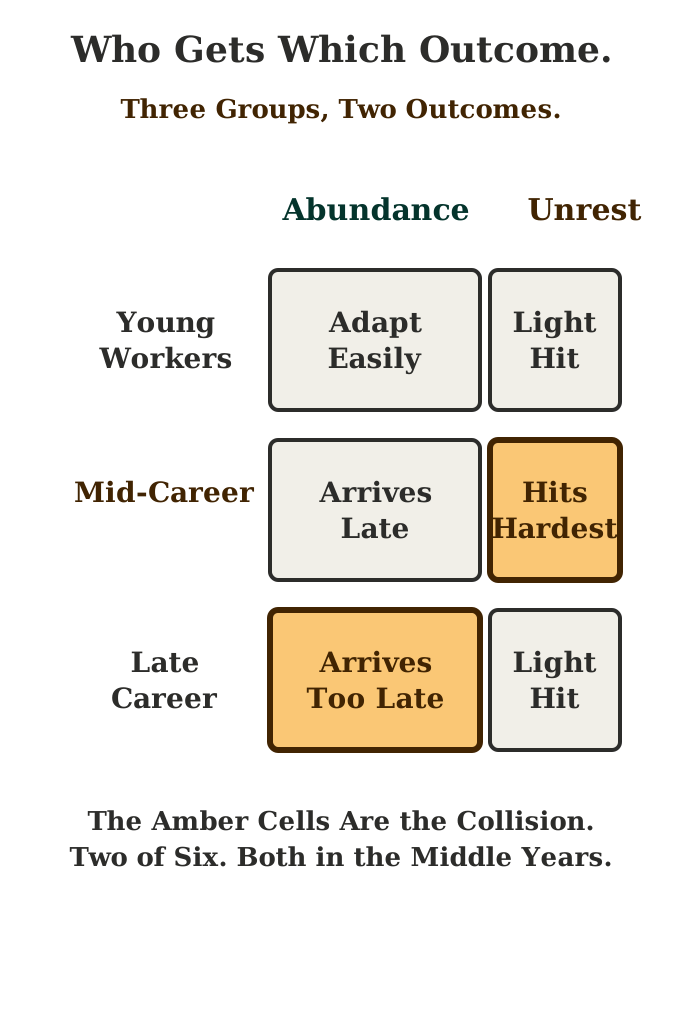
A mid-career worker stands like a tree in a hurricane. The accountant at forty-five. The paralegal at fifty. The mid-level project manager at fifty-two. The credential is real. The mortgage is real. The dependents are real. The savings plan is real and built on a forty-year career assumption that the next seven years break.
This technical forecast does not have a story for that worker. The talk that names abundance and unrest in the same sentence does not name who absorbs which one. The talk treats the transition as bumpy. The bumps land here. The bumps land on the parent at the kitchen table who is calculating whether the salary survives the year.
Collision is not abstract. It has names. The names are the readers of this post.
In the middle sits the worker the forecast cannot see. The forecast can see the kid who has not started yet. The forecast can see the retiree who has finished. The middle worker sits in the gap between the two, and the gap is exactly where the transition lands hardest.
The retirement plan was built on an economy that no longer exists#
Every savings formula assumed three things. Wage growth. Asset appreciation. A knowable horizon. The transition breaks all three at once.
Wage growth depends on which side of the AI line the work sits on. A worker whose job AI replaces does not see the paycheck rise. A worker whose job AI augments sees the paycheck rise, often a lot, until the augmentation tilts toward replacement.
Both cohorts look identical from the desk on the first Monday of the year, and the difference shows up only in the year-end check, when one paycheck held and the other did not. The worker has been clearing mortgage payments out of the bank account on the assumption the salary holds.
Asset appreciation depends on whether abundance arrives as falling prices or as concentrated capital returns. If prices fall, the same dollar buys more bread and medicine for the family. If returns concentrate at the top of the capital stack, the median worker’s portfolio does not catch the lift. The first story is the optimist’s. The second story is the record of forty years.
No horizon of forty years remains. The next three to seven years are the discontinuous ones. After that the shape of the economy is not the one the savings formula was tuned to.
Advice the forecast offers is to stop saving. That advice was offered to a younger audience.
Picture a worker who is sixty today, sitting at the table with a spouse and a calculator on a Sunday afternoon. The numbers stretch through the bumpy years before any abundant outcome arrives, or they do not. The savings do not stretch through ten years of disrupted earnings just because the abundance is coming after.
Built for a stable horizon, the retirement plan meets a horizon that is no longer stable.
Consider the household that built the plan around a forty-year career and a thirty-year retirement, which now has a planning problem the talk does not name. The home, the children, the parent in the spare bedroom all live inside that plan. The post does not give the talk’s advice; it names the gap and stays with it.
Care work is the labor the AI transition does not solve#
A surgical robot is easy to imagine. The humanoid platform stands at the table. The blade moves with millimeter precision. The procedure ends. The patient lives. Every robot has performed every variant of the operation in shared experience, and the gap between the best human surgeon and the best robot closes inside five years.
Harder to imagine is the night nurse. The dementia patient does not lie still. The conversation does not follow a script. The nurse sits in the chair beside the bed for hours, holds a hand, repeats the same answer to the same question, takes the patient to the bathroom, changes the sheets, returns to the chair. The work is not precision. The work is presence.
That night nurse holds a hand like a lighthouse on a rocky coast.
Care work is the labor the transition does not solve quickly. It is also the labor that grows fastest as the population ages. The aging child watches a parent fade. The aging spouse watches a partner forget the morning. The household at the center of the care economy is not the household the forecast addresses.
Robots replace a small slice of healthcare. The night nurse, the home health aide, the hospice worker, the dementia ward staff, the family caregiver, the daughter who flies home every other weekend to sit with a parent: that is the rest of healthcare. AI does not replace the work because the work is not the kind AI replaces.
An aging parent at home, the daughter on the phone, the son driving across the state for the weekly visit: those are the families the talk does not name. The labor of care is the labor that survives longest. It also pays the least and stays the most invisible.
Jobs that survive longest are the ones the forecast does not name. Care work is the category. It anchors what it means to grow older in a household that holds its people through the years.
Abundance and unrest arrive in the same window. The conventional framings pick one outcome and skip the and. The collision lands at the kitchen table, where a parent calculates whether the savings stretch through the bumpy years. That gap is what the post is about.
The argument draws on a public interview with Peter Diamandis and Dave Blondon on the Moonshots podcast, December 2025.


