

Artificial Intelligence (AI) does not reshape every job at the same speed. It improves some capabilities fast and some slowly. The slowest one is the bottleneck that decides how long your job lives.
Will AI take my job, and how long do I have to plan around it?
Will AI take your job? Three questions tell you how long the job lives. Does the work require a human face. Does the work require a hand in the world. Does the work require a domain only a long career builds. The more answers are yes, the longer the job lives.
Every job has one capability that decides how long it lives#
Look closer at any single job. Every job is a bundle of capabilities. AI improves some of them fast and some slowly. The one that improves slowest decides how long the job lives.
Not the average rate. Not the fastest. The slowest.
Think of a chain, only as strong as its weakest link. Your job is the chain. The weakest link is the capability AI cannot do well, and that link is where the job holds on.
Take the nurse practitioner. The job is a bundle. Pattern-matching across a scan is one capability. Holding the hand of a frightened parent in a fluorescent hospital room at two in the morning on the worst night of the year is another.
AI gets better at the first capability every quarter. The second capability is not on the same clock as the first one and never will be. The job lives as long as that second capability does.
Take the contractor. The blueprint reading is one capability. The walk-through with the husband and wife in their kitchen, naming what the renovation will cost the family this year, is another. AI handles the first. The second is the job.
None of this means some jobs are safer than others. The point is that every job has a bottleneck capability inside it, and the bottleneck is what determines the job’s lifespan.
Most workers cannot answer the question. What is the AI-slowest capability my job depends on? Ask the question to ten people at a desk in any office, and seven will tell you about the parts AI is taking. Two will tell you the parts AI is augmenting. One will tell you the bottleneck. The one is the worker who has run the test on themselves.
You are going to be the one by the end of this post.
The test is three questions. Run it on your job#
Once you can see a job as a bundle, the test follows. Three questions. Ten minutes the first time. Five minutes after that.
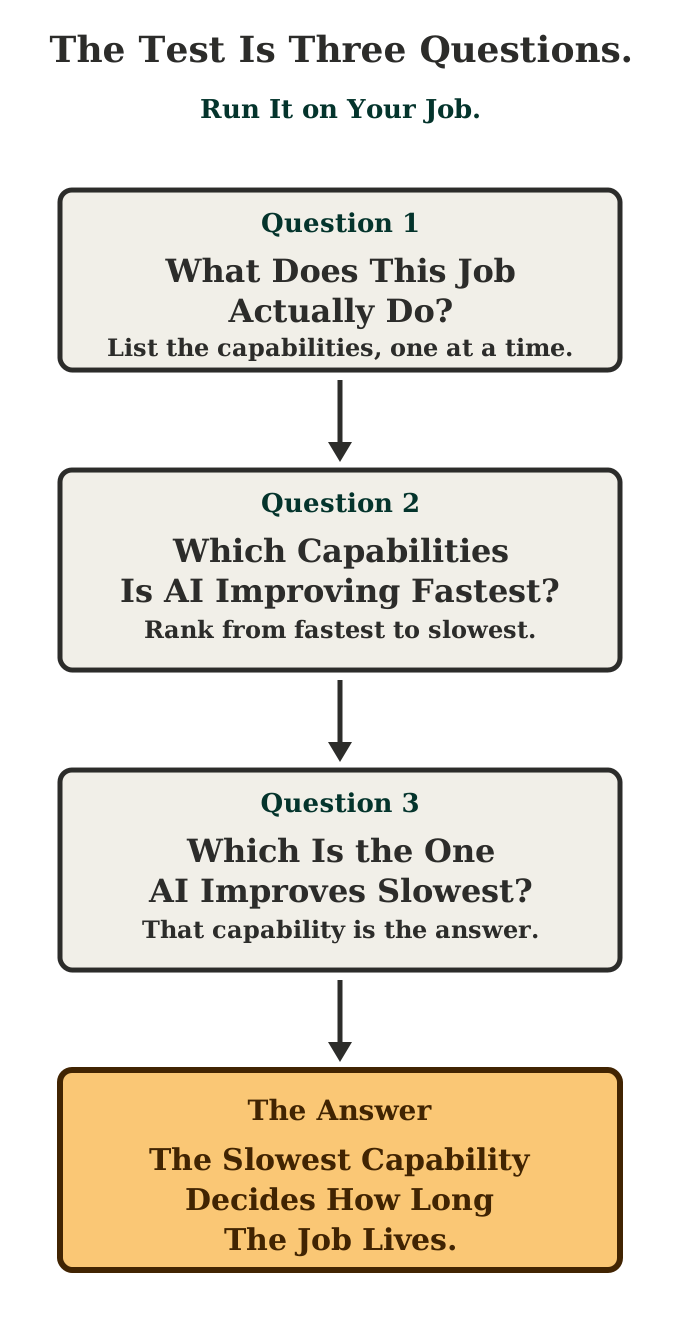
Question one. What does this job actually do? Make a list. Not the job description. The actual tasks. Twenty items if you are honest, ten if you are tired.
Question two. Which of those tasks is AI getting better at fastest? Mark them with a check in the margin next to the task list. Use any AI tool you have used in the last six months as the calibration.
Question three. Which is it getting better at slowest? Mark that one with a star.
That starred capability is your job’s bottleneck. It is what decides how long the job lives.
Run the test on a thirty-year-old radiologist. Same job as a sixty-year-old radiologist. Different answers. The thirty-year-old’s bottleneck is years of high-volume pattern reading the AI is closing in on. The sixty-year-old’s bottleneck is the conversation with the family in a waiting room after a bad scan. Same job. Different bottleneck. Different timeline.
Sometimes the test tells you a job you thought was vulnerable is safer than you assumed. It will sometimes tell you a job you thought was safe is more vulnerable. Trust the test over the intuition.
Think of the test as a thermometer in a fever. You do not need it on a calm day. You need it on the day the news cycle is running hot. The number on the thermometer is the same either way.
Run it on yourself first. Then your spouse. Then the kids at the kitchen table choosing what to study next year.
The test identified three categories. They look nothing like the forecasts#
Apply the test across enough jobs and three categories show up. The categories cut across the divisions every career counselor in the country still uses.
The first category is slow-AI bottleneck. The job’s load-bearing capability is one AI improves slowly. The job has runway. The night nurse holding a hand belongs here. The plumber under a sink belongs here. The kindergarten teacher reading to a child too tired to sit still belongs here.
The second category is fast-AI exposure, the middle of the labor market where abundance and unrest collide. The job’s load-bearing capability is one AI improves fast. The job has a clock. The mid-level analyst writing a deck from a data file belongs here. The drafter pulling lines on a screen belongs here. The associate at a law firm summarizing documents belongs here.
The third category is hybrid. The job has two bottleneck capabilities, one of each kind, and the job’s future depends on which capability the worker leans into. The mid-career project manager belongs here. The accountant who runs the books and also runs the difficult conversation with a small business owner belongs here.
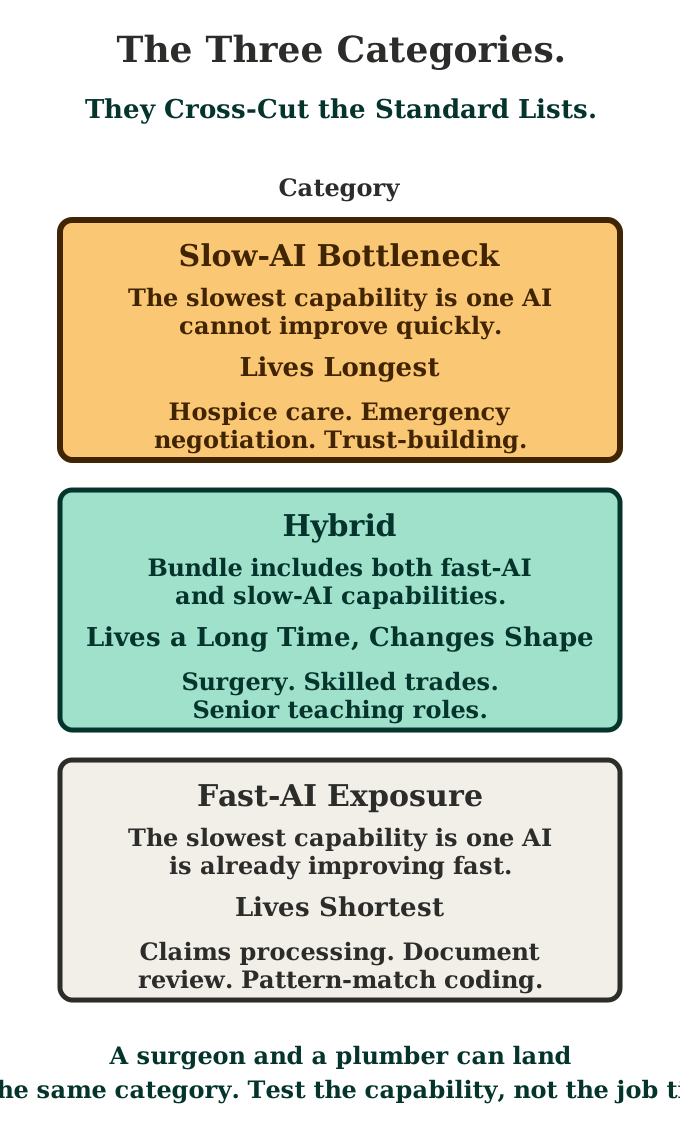
A thirty-five-year-old surgeon who built a practice on robotic-assisted procedures lands in fast-AI exposure. A sixty-five-year-old surgeon who built a practice on difficult-conversation expertise lands in slow-AI bottleneck. Same job title. Different category.
One lawyer who built a career on document review lands in fast-AI exposure. A lawyer who built a career on jury work and client relationships lands in slow-AI bottleneck. Same job title. Different category.
That credential people spent decades earning is not the unit of analysis. The category is set by the capability bundle inside the job, not by the credential printed on the wall. The capability bundle is the unit. That is the disagreement between the test and the forecasts every career counselor still recites.
Forecasts say the lawyers are at risk. The test says some lawyers, not the others. Forecasts say the doctors are safe. The test says some doctors, not the others.
Because of that gap, the policy responses being designed right now are aimed at the wrong people.
The answer changes. Re-run the test every year#
Any test that gives you the same answer in 2026 and 2030 is not a test. It is a forecast in a costume.
Here is the reason the test works: it anchors to current AI capability rates. Those rates change. The capability that is AI-slowest this year may not be AI-slowest in 2027.
Put the test on the calendar. Once a year. Same week each year. Birthday week works. New-year week works. Any anchor that the household will remember works.
Run it five years in a row, and the yearly version of yourself knows things this year’s version of you has not yet learned to notice. The first year tells you the bottleneck. The third year tells you whether the bottleneck is moving. The fifth year tells you what direction your career has been quietly rotating in while the news was telling you something else.
Running the test once a year is like a farmer checking the fence in spring. The fence does not announce when it has rotted. The farmer who walks the line finds out before the cattle do.
You are not predicting the future. You are noticing the present, on schedule, year after year. That builds a kind of judgment a forecast cannot give you, because the forecast guesses once and the judgment is recalibrated against a year of fresh evidence.
Some years the answer will shift a little. Some years a lot. A big shift is not the test failing. A big shift is the test working. The change is the signal.
Small discipline, this. Once a year, fifteen minutes. The change it compounds is large.
The people the test helps most are the ones who run it earliest#
Every forecast arrives after the market has already moved. The test arrives now, before it moves.
Look at the workers who five years ago started shifting toward the capabilities AI still cannot do well. They were running an informal version of the test on themselves.
Consider the nurse who moved from billing into hospice work. The lawyer who moved from due diligence into mediation. The teacher who moved from grading into the small group of kids who needed someone in the room. They were running the test without naming it.
They are now the workers in the safest part of the labor market.
This test is built for the people who cannot afford to be wrong about which way the career goes. Which is most people. The household with a mortgage, kids in school, parents in the spare bedroom. The career is the income. The income is the floor under the house. The bottleneck capability decides whether that floor holds.
Whoever runs the test in 2026 has a different five years coming than the reader who runs it in 2030.
You do not need a forecast. You need a test. Run the test on your job. Run it again next year. The test is the answer the forecast cannot give you.
This test is yours. Run it this weekend. Run it on your job, then on your spouse’s job, then on the kids choosing majors. Put it on the calendar for next year. The forecast is the consolation prize you take if you skip the test.
The argument draws on Chad Jones’s public lecture A.I. and Our Economic Future at Stanford, 2026.


