

I keep coming back to the same gap when I read about Artificial Intelligence (AI) in 2026. Inside the labs, the scaling curve keeps delivering. Outside the labs, the argument is still whether the curve exists at all. That gap is the risk worth your attention.
Why is AI still scaling in 2026?
AI is still scaling in 2026, and the curve has held for roughly fifteen years. The gap is not in the technology. The gap is between what the labs see and what the public sees. Closing it is the part nobody has solved yet.
Why is AI still scaling in 2026?#
Step back from the headlines. Fifteen years ago, a neural network called AlexNet showed that a computer could begin to recognize images at a useful level. Seven years ago, an early language model from that lineage showed the same pattern held for text. The signal then was small. The signal now is not.
Here is the basic claim of the field, plain. More data, more compute, more model. More capability.
That pattern has held for fifteen years across every generation of model and every category of task. Each year the curve climbs. Each year the curve refuses to flatten.
Five years ago a computer couldn’t write a one-page essay. It couldn’t code a feature on request. It couldn’t describe what was happening in a short video. In 2026 it can do all three at a useful level, on any laptop at a kitchen table. Five years is a kid’s whole run through high school, and the machine crossed all of it.
Intelligence, in the way the labs use the word, is the ability to handle any task expressible in text or images. The scope is wider than most readers think. A spreadsheet of patient outcomes. A contract draft. A year of customer notes. A building diagram. A code review. The model handles all of these as variants of the same thing.
Compounding is the part most coverage misses. A single year of improvement looks like a model that writes a slightly better email than the year before. Five years of improvement stacked together is a model that drafts the contract, reviews the code that runs the office, and reads the medical chart a family is staring at on a Tuesday morning.
That compound function turns ordinary year-over-year work into a phase change the public hasn’t been trained to recognize. Same engine. Same direction.
Think of the field as bread rising. Flour, water, and yeast are the ingredients, and heat is the catalyst that turns them into a loaf. Take any one away and the loaf doesn’t rise. Add all three at scale and the bakery runs three shifts a day. The labs have spent fifteen years adding more of all three at once, and the loaves keep getting bigger.
Like a freight train rolling toward a sleeping town, the curve has been audible for a long time. The whistle has been loud. The people at the station have noticed. The people farther up the road have not.
Start with the scaling story because every other claim here rides on it. If the curve flattens, the urgency softens. If the curve keeps going, the urgency does too. The gap between those two pictures is where the rest of this lives.
Why are people inside AI labs more worried than people outside?#
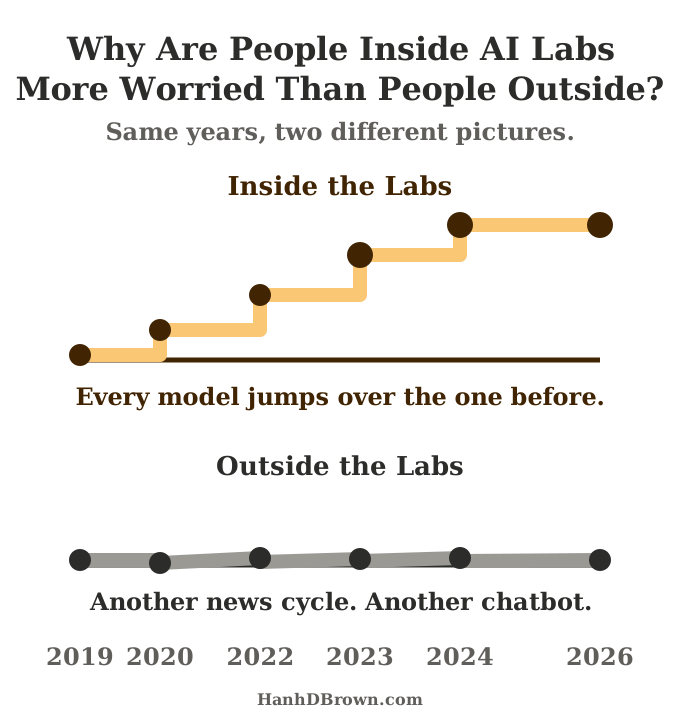
People working with frontier models see a slope. Every two or three months, a new model exists that handles tasks the previous model couldn’t.
Outside the labs, the same months register as another news cycle of half-explained chatbot announcements. The two pictures aren’t the same picture. The lab sees a continuous climb across model generations, and the public sees a series of unrelated chatbot events strung along the same months.
The asymmetry of vantage is the story, not the chatbot.
A small scene makes the lab view concrete. A writer fed a model a few paragraphs of personal reflection. The model wrote back a list of fears the writer hadn’t put on paper but recognized as accurate the moment they read them. The hour the writer spent reading the list changed what they thought the technology was. The hour was an exhibit, not an anecdote.
Calling AI a hype cycle describes part of the consumer experience accurately. The chatbot in the browser does feel like a parlor trick on a slow Tuesday. The capability inside the labs is on a different curve. The two are easy to confuse from outside, and hard to confuse from inside.
A second scene helps. A doctor in a hospital tested a model against the same diagnostic page the team had worked with for a year. The model arrived at the same answer in a minute.
That team had spent the year because the year also produced the room of conversations with the patient that the model would never have. The model did the page in a minute, and the team did the room across the year. The room is where the patient actually lived through the answer the page returned.
Public unpreparedness carries a cost, and it isn’t symmetric. A society that prepares late for AI doesn’t just lag. It concentrates the benefits in fewer hands. It spreads the harms to more.
Whichever room holds the most information moves first. Every other room responds. The same dynamic has played out in every wave of computing, and the lesson has been forgotten every time.
Here is the part nobody mentions. Inside the labs, the technical work of containing what AI does is going better than expected. Outside the labs, the social work of preparing for what AI will do is going worse than expected. Both are true at the same time. The second one is what keeps the people inside the labs awake.
Pay attention to who is paying attention. The chatbot is the symptom. The wave is the curve. The curve is still climbing.
What is AI interpretability and what has it found?#
By now you’ve seen the shape of the gap, so the next question is whether anyone is doing useful work inside it. The answer is yes, and the work has moved faster than most coverage admits.
Interpretability is the work of looking inside a neural network the way medicine looks inside a brain with an imaging machine. The model used to be a black box. The box is becoming less black, room by room, year by year.
Specific neurons inside the model have been identified as carrying specific concepts. Other circuits have been traced through the model that match how the model performs particular tasks, such as building a rhyme in a line of poetry. The findings are still partial. The findings are also real.
A finding looks like this. A small group of neurons fires together every time the model handles the concept of a bridge. A separate group fires for the concept of a fence. A third group fires when the two concepts get connected in the same sentence. The diagrams come out the other side of the machine on a page a researcher can read.
Look at the same model again six months later, and you turn up new circuits the earlier pass missed. The science is cumulative. The picture sharpens with every new lens the field grinds.
None of this means the entire system is now transparent. The point is that the field knows how to look. The right tools exist. The right experiments run. The right diagrams come out the other side of the machine.
This shifts what AI safety means. Safety used to be a philosophical posture, a statement about caring how the technology behaves. Safety is now also an engineering practice, a way to inspect a model the way a doctor inspects a patient. The two aren’t the same. The engineering version is the part that lets the philosophical posture stay honest.
Lab work is the part of the AI conversation that has gone better than expected. The technical containment problem is moving on a clear schedule. The model can be probed. The model can be aligned to a set of stated principles. The model can be tested against held-out cases the training didn’t see.
Real progress, then. The corresponding social work is not on the same schedule.
Take that imbalance seriously. Naming what is working on the technical side is part of why the public side matters. The lab has done its piece. The rest is yours.
What would actually close the AI awareness gap?#
You’ve seen the gap, recognized its shape, and learned the labs are making progress on the technical half. The natural last question is what closes the public half. The honest answer is that virtue doesn’t close it. Structure does.
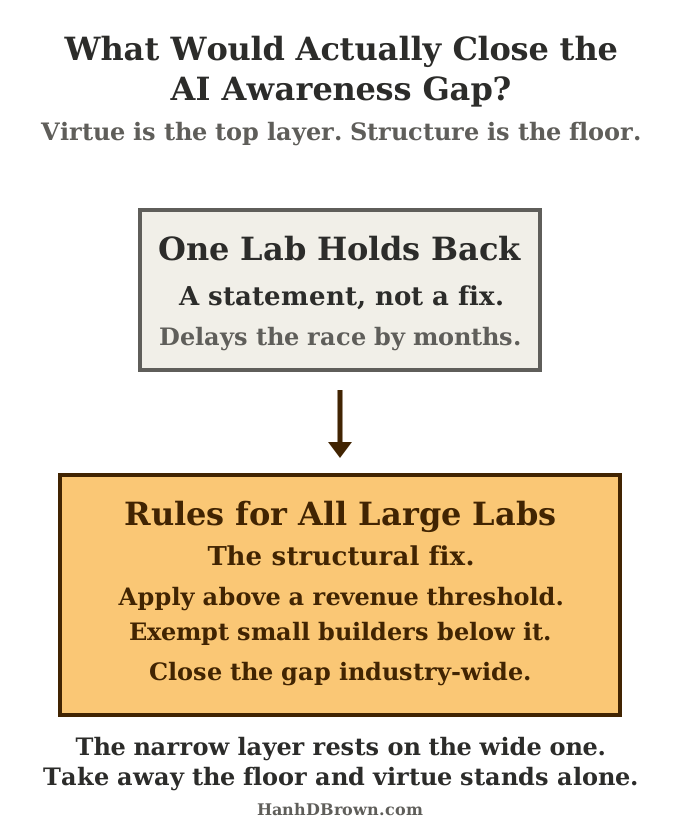
Holding a model back unilaterally is commercially expensive. A single lab can hold the line for a season. A second lab won’t. The race begins regardless of who declines to start it. The model gets shipped a few months later by whoever was second in the original queue. Restraint by one player is a values statement, not a structural fix.
Like a fence built after the cattle wandered off, virtue rules made after the race began mark the rancher’s good intentions and nothing else. The cattle are still on the road. The road still needs a real fence.
Structure answers where restraint can’t: rules that apply above a threshold. California’s frontier-AI transparency law, Senate Bill 53, uses a revenue threshold to focus disclosure obligations on the largest labs. Set high enough, it reaches only the roughly four or five frontier labs and no one else. The exact figure has been debated and revised across the bill’s lifecycle, so check the current statute first.
How the rule is built is the point either way. A regulation that falls only on the incumbents can’t be described as raising the ladder after climbing it, because the incumbents are the people who would have to comply. The rule asks for disclosure of safety and security testing. The rule doesn’t ask the small builder for anything at all.
Critical thinking is the human skill that gets harder to automate and more valuable as generated content fills the public square. The ability to recognize what is fake. The ability to recognize manipulation as manipulation. The ability to hold a slow position in an environment built for fast reactions. That is the moat that doesn’t get automated.
Deskilling is a choice, not a consequence. The tool used one way builds the skill. The tool used another way replaces it. The defaults matter. The defaults are set in the home, in the school, in the office, and in the policy.
The family table is where most real planning happens. A parent thinking about a kid’s career. A teacher choosing the next book. A household deciding which tools sit on the counter. A son looking after a parent who lives alone. A husband and wife mapping the next ten years of work. All of it gets harder when the public conversation lags a year behind.
It is also where the awareness gap is felt first. The school career night is the second place. The doctor’s waiting room is the third.
Holding the middle position is harder than holding either pole. The accelerate-at-any-cost framing has the energy of a campaign. The this-is-not-real framing has the comfort of a familiar pattern. The middle has neither. The middle position takes the benefits seriously, takes the risks seriously, and refuses to collapse into a single sentence on either side. Hold both.
The wave is visible from the shore. The wave has been visible for years. The hours before the wave lands belong to whoever is willing to look at it. Your move is the only part that isn’t fixed.
Now the map is in your hand. The next move is yours. The cost is the hour it takes to read the curve honestly and decide what to do with the time before the wave lands.
What you get back is a working answer to the question every parent, spouse, and kid is going to be asking out loud over the next five years. Look at the wave. Then act on what you see.


