

For 50 years, biology had one of its biggest unsolved problems. A single doctoral student spent five years to fold one protein. Then a single Artificial Intelligence (AI) system folded 200 million of them in about a year. That is the number that matters.
What did AlphaFold actually do, and why does it matter?
AlphaFold finished a billion years of human work in one. The Artificial Intelligence (AI) system folded 200 million proteins in about a year, work a single doctoral student would need five years per protein. The bottleneck on solving large problems has moved from intelligence to direction.
What did AlphaFold actually do?#
Protein folding sat unsolved as a grand challenge in biology for 50 years, longer than a whole scientific career. The shape a protein takes after it is built decides whether the protein cures a disease or causes one. The shape was the bottleneck on understanding biology at the molecular level.
One doctoral student used to spend five years to solve the shape of one protein. AlphaFold solved 200 million of them in roughly a year. One year. The whole catalog.
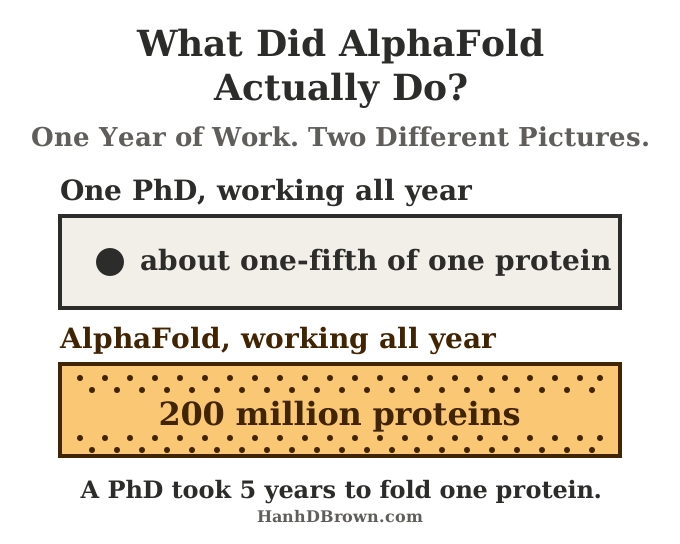
At the old pace, that same work would have taken roughly a billion years of doctoral time. The compression is not a marketing line. The compression is the number that carries the argument. A single program produced more of one specific kind of biological knowledge in twelve months than the field could have produced under any imaginable expansion of human labor.
Structure is what the field has been waiting for. A protein structure tells a researcher which molecules can bind to it and how a drug might be shaped to fit. Many diseases that resisted treatment for decades resisted it because the field could not get a clean structure to work from.
The bottleneck on understanding the disease was the structure. With the structure in hand, the field can start asking the next question. Different question. Different answer.
Like a single mason laying every brick of a city in one season, the system did at a stroke what could not be done at scale before. The mason does not work faster than a mason. The mason works at a different unit of labor. The output is not a building. The output is the city.
This result was open-sourced. The system and its predictions were published, not paywalled. A protein-folding tool kept behind a license would have been a competitive advantage for one company. The same tool published is something every working biologist on the planet can use today, at a hospital, at a university, at a small lab that could not afford to license a thing.
Publication is what turns the win from a product into a public good. The Nobel Prize recognized that distinction directly. The breakthrough is what got recognized. The choice to share the breakthrough is what made it civilization-grade and not just laboratory-grade.
How is AI changing scientific research?#
Protein folding is not the special case. Protein folding is the first member of a set. The same kind of system can be pointed at fusion research, at new materials, at battery chemistry, at drug design. The argument is not that AI helped science go a little faster.
It is that AI gave science a different shape of time. Problems that used to require a lifetime of focused work can now be tried inside a calendar year. The change in unit is the change. A faster spreadsheet does not change what a spreadsheet is for. A force multiplier of this size does change what the field is for.
Our own brain evolved for hunter-gathering. It then built modern civilization, including the 747s that fly across oceans and the computers on which AI runs. The lesson is that general intelligence, once it exists, can be applied far beyond the conditions it evolved for. AI is the second member of that small set. It generalizes the same way.
This same architecture played a game of Go, then became the template for the system that folds proteins. The same template will become the system that designs the next battery and the next material. The tools improve at roughly a monthly cadence on the speaker’s framing. Every month the curve moves a step. A small step. Then another.
Fusion sits one notch above the protein case in difficulty. A protein lives in three dimensions and a plasma lives in seven, with magnetic fields and thermal gradients added on top. The pattern that AlphaFold cracked for proteins is the same pattern researchers are trying to crack for the magnetic confinement geometry inside a tokamak.
Battery chemistry sits one notch below. Materials live in two and three dimensions and the search is for combinations of elements that hold charge well and degrade slowly. AI is good at search at that combinatorial scale. Combinatorial search is what the architecture does well. Search is what it learned to do.
In the last ten years, AI went from a research lab to the phone in a working parent’s pocket. The next ten years will move that distance again. The science applications are the leading edge. The everyday applications are the broader wave. Both are running at once.
Has AI moved the bottleneck on solving big problems?#
For most of the last century, the limit on solving a large problem was how much thinking the problem needed. Smart people were finite. Time with them was finite. The thing you bought when you funded research was cognitive labor.
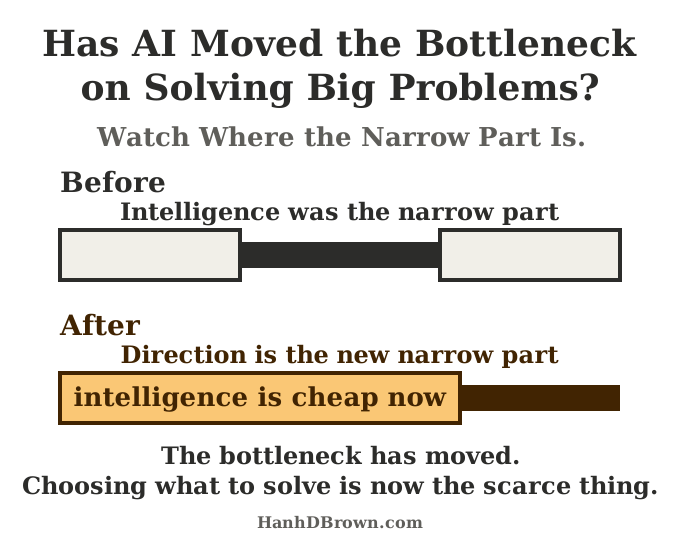
When intelligence becomes cheap, the shape of the limit changes. The cognitive labor is no longer the scarce input. Direction is. Which problems get the cheap intelligence pointed at them, and who decides. This is the moment the trick becomes visible. The interesting question about frontier AI is no longer how capable the system can get. The interesting question is what we ask it to do next.
These three orders of magnitude help. Assistants compress hours. The chat window drafts the email in minutes that took the worker the morning. The brief that took the analyst an afternoon takes the analyst an hour.
Agents compress months. The system runs the analysis the team would have spent a quarter on, the document review the legal department would have given a junior associate for six weeks, the research scan the librarian would have queued up for a month.
AlphaFold-class systems compress lifetimes. The work that would have taken a generation gets done in a year. Protein folding is the first member of that class. The second and third are already in motion.
Like a kitchen full of cooks but only one printed menu, the limit is no longer the cooks. The limit is the menu. The cooks can produce more, faster, with less waste than the kitchen ever ran before. None of that matters if the menu still only lists pancakes.
The person leading the lab is making the positive case about the technology the lab builds. That is a conflict worth naming. The strongest version of the case rests on what has already shipped. The next version is the forecast above it. The reader has to tell the two apart. The post owes that test.
Will AI really cure diseases in the next 10 to 20 years?#
AI helping to solve all disease sits on a stated working timeline of 10 to 20 years. That is the forecast. The shipped artifact is narrower and more concrete. AlphaFold has already cleared the protein-folding bottleneck, which was the limiting step on understanding many diseases at the molecular level.
In practice, “solve all disease” means closing the gap between disease discovery and effective treatment for the diseases AlphaFold-class biology can unlock. The phrase is bold. The mechanism is concrete.
Each protein structure tells a researcher what the molecule can bind to and how a drug might be shaped to bind to it. Many diseases that resisted treatment for decades are diseases the field could not get a clean structure for.
That same approach is being pointed at fusion, at materials, at batteries. The energy science underwriting the next century is the field after biology that AI is restructuring on a similar curve.
Costs, the energy demand, the displacement of work, the concentration of compute power, all of that exists and matters. None of it is what this article is about. The reader should know the ledger is bigger than the side this post takes.
A forecast tested by what gets shipped over the next 24 months is a forecast worth tracking. A forecast tested by the ambition of its framing is not. The shipped artifact is the floor. The forecast is the ceiling above it. The reader can hold both at once.
Here is a working test the reader can run. Pick a disease that has resisted treatment for thirty years. Ask whether a working drug or a working diagnostic for that disease enters human trials inside the next 24 months.
The forecast is moving when the answer is yes. The forecast is rhetoric when the answer is no and the conversation pivots to a different disease. Move on. Or stay honest. Track what ships. Not what gets announced. Not what gets promised.
Do you still need to study math and science in the age of AI?#
Yes. The reason follows from the reframe. The bottleneck on big problems has moved from intelligence to direction. Foundational learning is what lets a person direct the tools and orchestrate them. The people who can ask the right question of an AI system are the people who understand the topic well enough to know what a right question would look like.
For a child, this means the traditional math and science ladder still matters. Math and science do not become obsolete because the tools became more capable. They become the thing that lets a kid grow into the person who points the tools at a worthwhile problem.
Any parent at the kitchen table deciding what their 10-year-old should learn does not need a new curriculum. The parent needs the old curriculum plus a habit of trying the tools on real work.
Like a violinist handed an electric amplifier, the amplifier does not replace the years of bowing. The amplifier reaches the back of the room. The bowing still has to be there for anything worth amplifying to come out of the speakers. The foundations are the bowing. The AI tools are the amplifier. The amplifier without the bowing produces volume without music. No music. Only noise.
That same principle applies to a 60-year-old at a desk in the afternoon. Do the foundational learning in the topic you actually care about, then try the tools on the work you actually do. The kid is not the only family member who has this decision in front of them. The older adult has the same decision, scaled to a different domain and a different decade.
What “trying the tools on real work” looks like at the kitchen table on a Saturday morning. A retired teacher opens a chat window and uses it to draft the letter to the school board the retired teacher would have written by hand. A spouse uses the tool to compare the two retirement plans the household has been arguing about for a month.
One grandparent asks the tool to summarize the medical report the doctor sent over and to translate it into the words the family uses. The work was always real. The tool is the new amplifier. The foundations are what let the user hear when the tool gets the answer wrong.
A billion years of work, finished in one. The question is no longer whether the tool is real. The question is what we point it at next.
Source: Google DeepMind, at the 2026 Google for Korea AI Vision Fireside Chat, Seoul.
A billion years of work, finished in one. The bottleneck has moved. The reader who carries one number from this article and one reframe has the working filter for every AI headline of the next decade.


