

For a long time the change looks like nothing to you. You upgrade a tool. You read another headline. Then one season the curve turns, and you feel late along with everyone else. That shape has a name. It is a smooth exponential, and it explains both the calm and the panic in the air right now.
Artificial Intelligence (AI) sits on that curve. Most people misread it twice. They call the flat years proof that nothing is coming, then call the surge proof that everything is lost. Both reads are wrong. This is a field guide to the curve and to the steady response it asks for.
Why does AI progress feel like nothing, then everything at once?
AI progress runs on a smooth exponential: long flat stretches, then a sudden surge that feels like it came from nowhere. The mature response is neither hype nor doom. It is steady preparation that ratchets up as the power does, the way you raise safeguards on anything compounding.
Why does AI progress feel like nothing then everything?#
Picture a kettle on the stove. For ten minutes the water just sits there, cold. Then it roars to a boil in the last ten seconds. Like a kettle that hides its heat until the very end, the curve was climbing the whole time. You only notice at the top.
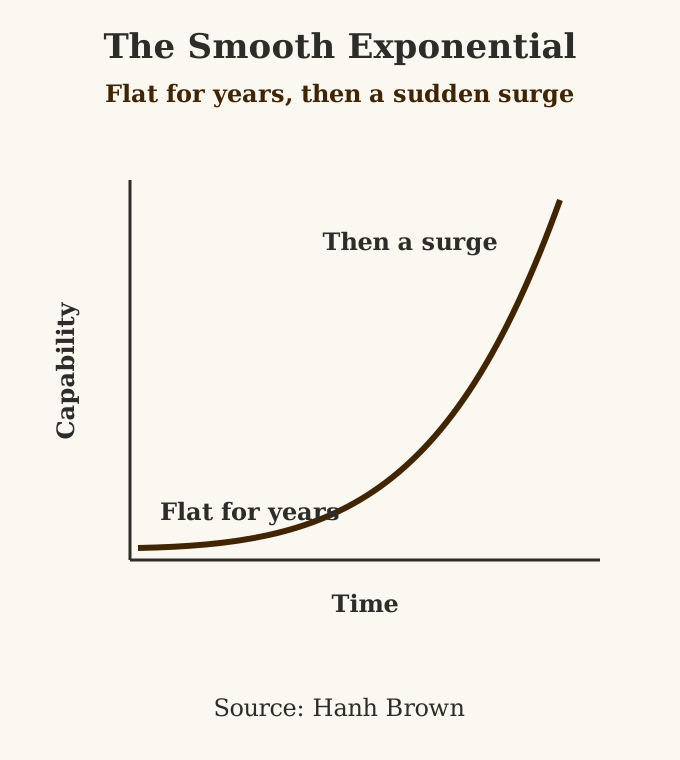
That is what a smooth exponential does to the eye. Each step is a fixed multiple of the last. Early on the steps are tiny, so the line looks flat for years. Then the same multiple lands on a big number, and the line shoots up. Nothing broke. The math just reached the steep part.
The trap is the way people read the flat part. During the quiet years, the safe-sounding view is that the worry is overblown. During the surge, the safe-sounding view is that it is too late to do anything. Panic and denial are the same mistake wearing different clothes, and the exponential punishes them both.
The mature response is dull on purpose. You do not swing between complacency and alarm. You set your countermeasures to climb with the capability, a notch at a time, the way a careful pilot or a surgeon works a checklist while the stakes rise. Steady hands, rising guardrails.
So read the curve for what it is. Not a cliff. Not a hoax. A line that was always moving, now in the part where each year does more than the last decade. That single picture is the lens for everything that follows.
Which business advantages survive cheap, fast AI?#
Start with a hard question for any business. Which of your advantages still matter once software is cheap to write and fast to ship. Some will hold. Some will wash out. The two get confused all the time.
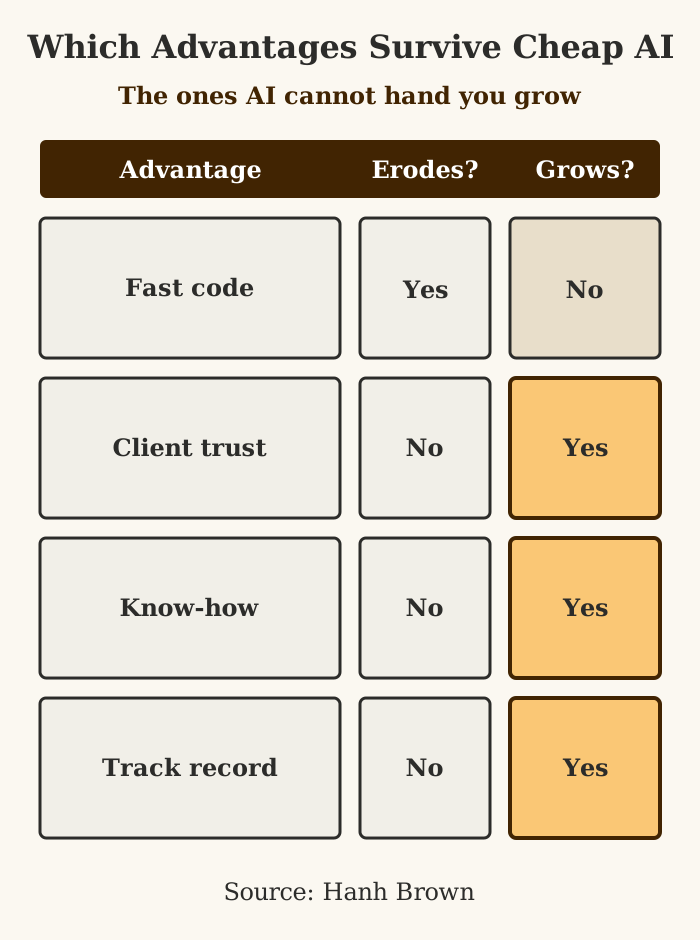
The ones that wash out are the ones the machine now does for pennies. If your edge was that you could write complex software no one else could write, that edge is thinning fast.
When Anthropic shipped its own coding tools in early 2026, the market value of a pile of software companies fell hard overnight. Traders called it a software apocalypse. The loop is the point. The company whose decisions anchor this piece helped trigger that fall. The moat was code. The code got cheap.
The ones that hold are the ones the machine cannot hand you. A customer who trusts you. Deep knowledge of a messy domain. A relationship built over years of kept promises. Like a barn that stands on its foundation and not its paint, the structure survives even when the surface gets stripped. The paint was the easy software. The foundation is the trust.
There is a quieter advantage too. Standards spread when the trustworthy players pull the laggards up. One firm copies another’s safety work. Or it does the right thing just to avoid looking bad. Call it a race to the top. It is slow. It is real. It rewards the company whose word is good, because a kept word is the one moat a rival cannot clone.
Here is the part nobody mentions. The pie usually gets bigger, not smaller. When a market grows tenfold, an incumbent can lose share and still grow in absolute terms. There are real losers, the ones who mistook paint for foundation. There are also quiet winners who lean into the parts that do not automate.
So run the audit this week. List your advantages in two columns. One column is what AI now does cheaply. The other is what only people, time, and trust can build. Then move your weight onto the second column before the first one erodes under you.
Which jobs will AI replace first?#
Entry-level white-collar work is the first to feel it. The warning that AI could erase up to half of such jobs in a few years is an order-of-magnitude estimate, not a precise forecast. The honest version is that the disruption could be that large, and the concern has not eased.
The mechanism is a hump, not a cliff. Automate ninety percent of a task and the worker gets sharply more productive on the last ten percent. For a while that worker is worth more, not less. Then the automation creeps toward the whole task, and the leverage runs out. The same curve that lifts you can pass you.
There is a brighter side, and it is concrete. New roles are appearing at the seam between the technical and the human, hybrid jobs that pair model skill with customer work. The durable work clusters in three places: the physical world, relationships, and people who can point AI at the right goals.
For anyone running a team, the choice is the whole ballgame. When AI raises your capacity, you can do the same work with fewer people, or far more work with the same people. The second path grows the business while the first just shrinks the payroll. With the pie expanding, do more with the same is usually the smarter bet.
The unsolved problem is matching. The new work does not appear in the same building, or the same week, as the old work disappears. That gap is where careers stall. Plan for that gap now. Do not wait for the letter to arrive.
What red lines should AI companies refuse to cross?#
Power this large needs lines that do not move under pressure. Two come up again and again as the hard ones: mass surveillance and fully autonomous weapons. The test of a line is not the press release. It is whether it holds when crossing it would pay.
Take the weapons line. The principle is that a person, never the software, makes the final call to act. The nightmare is the reverse, a system where the machine decides and no human ever sees the choice.
A weapon that picks its own targets removes the one part that can still say stop, the human hand that can refuse.
The honest snag is that a line on a contract only binds the one who signs it. A rival can sign the same deal and ignore the same limits. So the real leverage is not one company’s policy. It is raising enough awareness that lawmakers write guardrails that bind everyone, across party lines.
There is a deeper claim worth stating plainly. It is not worth winning if winning requires the very things the fight was supposed to protect. A democracy that builds mass surveillance to beat an authoritarian rival has already lost the thing it was defending. The line is the point, not an obstacle to it.
There is a case for capability, not only against it. A strong hand can deter a war it would otherwise have to fight. Better eyes and faster warning make an aggressor think twice at the border. Strength can keep the peace. The danger is not the tool. The danger is a tool with no human hand on it.
So judge any builder by the lines they keep when keeping them costs money. Anyone can publish a values page. The ones that matter are written in what a company refuses to sell.
Should a powerful AI tool ever be held back?#
Sometimes the right move is to not ship. Anthropic judged one of its own models, Claude Mythos, too dangerous to release on schedule, because it was unusually good at finding software holes and turning them into working break-ins. The testers given early access reportedly asked for it to stay locked up. They called it a weapon.
By Anthropic’s own account, the tool found thousands of new vulnerabilities across major operating systems and browsers, plus more in private code that earlier tools missed. Those numbers are the company’s release claim, not an independent audit, and some security researchers dispute how serious the findings really are. A capability like that helps whoever holds it, attacker or defender, and the question is who gets it first.
The answer Anthropic chose was defender-first. Give the tool to the people patching the holes, let them bolt a finite set of known doors, and the attack surface gets hard to exploit. The aim is a more secure internet within a year, not a tool sealed away forever. Staged release, strongest safeguards first.
Holding a finished product back while rivals ship is a direct hit to revenue. The company offers that cost as proof that its values are not just decoration.
Worth naming plainly. It is Anthropic citing its own decision, and the same company’s chief executive is the one who made that call and now holds it up as the tell. A principle is only real once it costs you something to keep it. Weigh it for yourself, knowing whose principle it is.
The locks are not done. Weaker guardrails on an earlier model could be talked into saying too much, and the whole industry’s defenses are still thin. That is another reason to open the door slowly. You widen it only as the locks get stronger.
Notice the tell for the reader. When any company gives up money, market position, or political comfort to honor a stated limit, the limit is likelier to be real. When it only talks, wait for the bill it is willing to pay.
How should we think about the risk of AI catastrophe?#
Now the hard part, the one people most want to look away from. A stated estimate from inside the industry puts the chance of civilizational collapse somewhere around ten to twenty-five percent. That is one person’s number under deep uncertainty, not a measurement. It is still a startling thing to hear from a builder.
The right way to hold a number like that is the way you hold any serious risk. You cannot drive it to zero. You can drive a too-high number much lower, and you can say so out loud. Like a seatbelt that cannot promise you walk away, only that you are far more likely to, the goal is not a guarantee. The goal is better odds, honestly stated.
There is an airline version of the argument. A plane built ten times safer than the rest still cannot promise it never crashes, yet you would never board one with a one-in-four chance of going down. So the work is to push the probability from too-high toward boring, through testing, oversight, and limits that bind even the people who built the thing.
What actually lowers the number most is the part left unsaid, and it is fair to press on it. Testing a lot, holding red lines, accepting checks on your own power, these help. Whether they are enough is the open question, and no slogan closes it.
Two roads. The same technology could spread power or hoard it. One road leads to people freer, with better medicine and a fairer shot at justice. The other leads to a watched and managed life, a high-tech version of the old nightmare.
Which road we take is not set by the machine. It is set by the people who build it, the people who govern it, and the rest of us who use it. The hero is not one brilliant figure. It is a balance of power that no single hand can tip.
This is where it comes home. A family does not stop driving because crashes exist. It buckles the kids in, slows down in the rain, and keeps its eyes on the road. That is the whole posture toward this technology, scaled up. Not panic. Not denial. Hands steady, guardrails rising, eyes open.
Source: Dario Amodei, chief executive of Anthropic, in a documentary-style interview, 2026.


