

Artificial Intelligence (AI) just broke a rule that held software in place for thirty years. The rule was simple. You cannot throw money at a software lead. That rule is gone.
If code is no longer a moat, where do the new AI moats actually live?
Code is no longer a moat. The new AI moats sit elsewhere in the stack. Data with a real cost to acquire. Distribution into a captive audience. A supply chain a competitor cannot rebuild in a year. The model is rented. Everything around the model can be owned.
The rule that held for thirty years just broke#
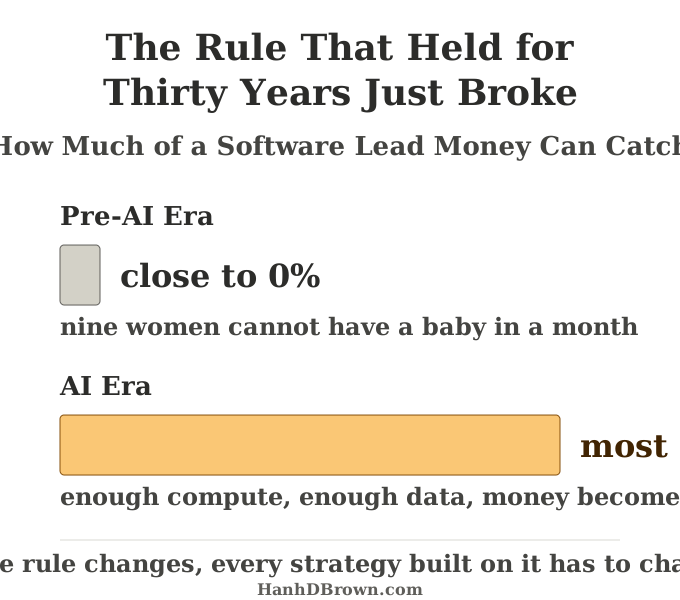
For thirty years, software ran on a single load-bearing rule. You could not throw money at a software lead.
Nine women cannot make a baby in a month. Sixty engineers cannot ship the same code as twenty in a third of the time. The work was sequential, the code was the work, and the work would not compress.
Every wave the technology era produced tested that rule. The personal computer. The internet. Mobile. Cloud. Each wave changed the playing field. None of them broke the rule.
That rule broke in late 2022. With enough compute and enough data, money is now an answer to most technical problems. The capital race is real for the first time in the modern technology era.
You are one of three readers. A founder building a company. An operator at an established firm. A young person trying to figure out what to learn for the next thirty working years. The broken rule means something different to each of the three, but it means something to all three.
Popular markets got the diagnosis right and the prognosis wrong. The market saw the rule break. It then concluded the frontier labs would absorb the entire economy.
That conclusion is wrong like a screen door on a submarine.
This change is large. The downstream consequences are larger, and they are the whole story from here.
Code is no longer a moat. Neither is the user interface#
If you cannot throw money at a software lead, code is a moat. If you can, code is a catch-up problem. The user interface is a catch-up problem too.
Whatever a company sells, it is no longer the code. It is no longer the screens. The thing the customer pays for is downstream of the code, and the code is now the cheapest part of the stack.
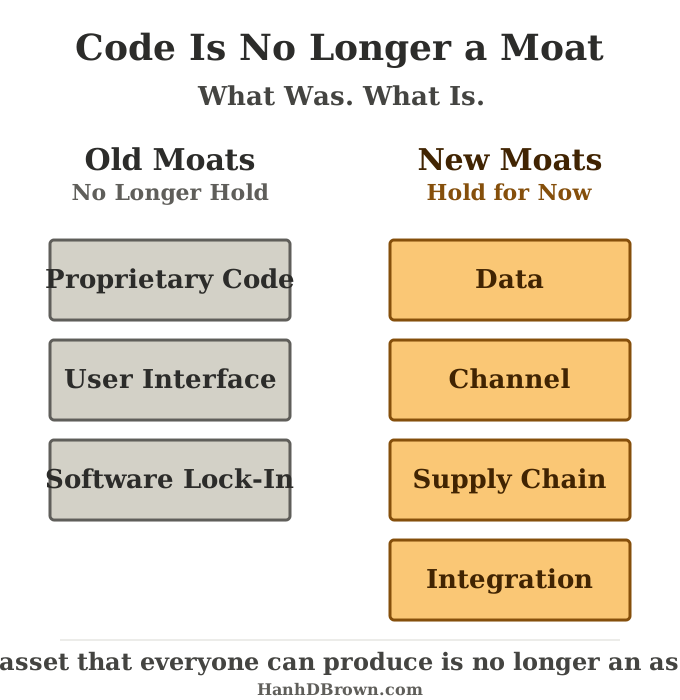
The new moats are on a short list. Data the competitor cannot legally collect. A channel relationship the customer signed years ago. A global supply chain built across two decades of contracts and on-the-ground negotiation. The integration work that ties software into the systems running a customer’s business, a job that takes a decade and breaks the first three vendors who try it.
It is short on purpose. Each moat on the list is a thing money cannot make appear.
Look at the four moats one at a time. Data the competitor cannot collect is the customer’s behavior log built over years of paid interactions, locked behind contracts the new entrant cannot duplicate. Channel is the sales rep at the customer’s office who handled the contract three years ago and is on speed dial when something breaks at midnight in a hotel room two time zones away.
Supply chain is the contract with the airline that started in 2009 and renews every two years on a handshake at a hotel bar near the conference. Integration is the seven engineers on the customer’s tech team who know which custom field maps to which database column in a system the customer has been running since 2014.
Each is a year of relationship the competitor cannot fast-forward with capital. Each is paid for in time, not money.
Companies that bet their defensibility on code now have a choice. Find a different moat by building one of the four above, or be acquired by someone who has one. The companies that try to keep selling code as the moat will lose the room slowly, then all at once.
One old assumption pulled the rest of the playbook along with it like a thread that pulls a sweater apart. The pricing was tied to it. The board pitch was tied to it. The hiring was tied to it. The whole company shape was tied to it.
An asset that everyone can now produce is no longer an asset. That is the rule that just hit code. The next question is which of the company’s assets stays an asset when AI gets another generation better.
The honest answer is the asset that takes years of physical, relational, or contractual work to build. The honest answer is not the code.
Gold bricks everywhere. Nobody picks up the silver one#
Popular opinion has decided the frontier labs are about to one-shot every software-as-a-service company in the economy. Anyone who has operated such a company in the last decade knows the conclusion is wrong.
Take a single example. Business travel software.
To run business travel software, you need supply chain relationships with every major airline and every major hotel chain in the world. You cannot scrape the websites. They will send a cease and desist on a Monday and cut off the data feed by Friday. You sell into a role called the corporate travel manager, a job nobody at a frontier AI lab has ever met.
No lab will build the supply chain. The lab will not learn the role. The margin in that work is in the single digits and the work itself is unglamorous in a way the lab’s incentives reject.
There are gold bricks everywhere. Nobody picks up the silver one. The labs go where the margin is. The unglamorous channel and supply chain work is protected by the unglamorous nature of the work itself.
This protection is not permanent. If the prize gets large enough, the labs will come. The defense is to keep building the work that takes decades, not weeks, to replicate. The supply chain. The integration. The customer relationship measured in product cycles rather than quarters.
Any reader who runs a vertical software business already knows this in the gut. The new moats hold. The wall around them is the boring work nobody at the lab wants to do.
Public-market diagnosis is correct on the rule. The prognosis on what the labs will do with the rule is the part most coverage gets backwards.
AI is electricity. Learn the tool#
Younger readers get the last move, and it is advice.
If you are nineteen or twenty this year, AI is electricity. A young person in 1900 who refused to learn electricity was choosing a smaller life. The choice was not catastrophic. It was just smaller, every year, for the rest of the career.
Learn AI as a tool set. Then pick a field you care about, and apply the tool. The tool is something you reach for and use most months, not a one-time skill you acquire and set aside.
Default narratives say AI is going to collapse employment. The data so far points the other way, because software engineering employment is growing, including inside the frontier labs themselves. The mass replacement story is louder than the numbers.
Real danger is not that AI gets bigger than people expect. It is that the country gets scared, overreacts, and loses the race. The slow harm of bad policy beats the fast harm of fast software.
For the household with a kid choosing a major, the move is to encourage the field the kid loves and to add AI as a layer on top. The kid keeps the calling. The household adds the tool.
A young woman who loves architecture and learns AI is more powerful in five years than a young woman who just loves architecture. A young man who loves nursing and learns AI is more powerful in five years than a young man who just loves nursing. The tool plus the calling beats either alone. Always.
Code is no longer a moat. The user interface is no longer a moat. The moats are supply chain, channel, data, and integration.
If you are building a company, that list tells you what to invest in. If you are running one, that list tells you what to protect.
Buying a stock? That list tells you what to look for in the company. If you are nineteen, that list tells you what kind of field to learn around. Same list. Four readers. Four answers.
The rule that held for thirty years just broke. The moats moved. Code is no longer one. The new ones are supply chain, channel, data, and integration. The reader who can name which of those four sits under the company’s product is the reader who knows what to invest in this year and what to walk away from next.
The argument draws on Ben Horowitz in conversation with Anj Madhushree at the AI Coachella event, Stanford University, 2025.


