

A chain is only as strong as its weakest link. Artificial Intelligence (AI) makes the strong links stronger, fast. The weak ones it cannot touch yet.
Why is AI's economic upside slow and its downside fast?
AI's economic upside arrives slowly because the chain strengthens one link at a time, and the chain has thousands of weak links the technology cannot touch yet. AI's downside arrives quickly because the chain breaks at one link, and a single bad actor with a jailbroken model can target one critical system.
For 150 years, every transformative technology kept the growth line at two percent, not above it#
For 150 years, U.S. real income per person grew at two percent per year. Through electricity. Through internal combustion. Through antibiotics, jet engines, transistors, the internet. Each technology kept the line going. None of them bent it upward.
This is the cleanest historical fact in macroeconomics. Plot real income per person on a log scale from 1870 to today, and the line is nearly straight. Two percent a year, every year. Two world wars and a Great Depression sit on top of it without bending the curve. Half a dozen of the most transformative technologies in human history sit on top of it without bending the curve.
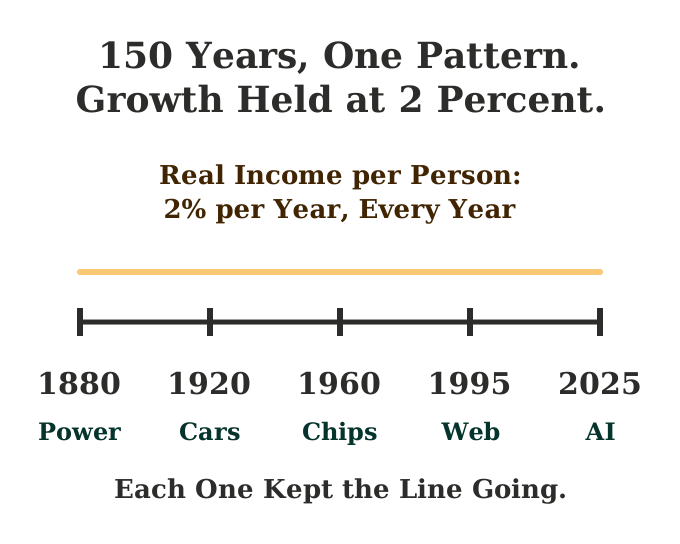
The pattern is not that transformative technology produces visible growth acceleration. The pattern is that transformative technology keeps existing growth from slowing. Electricity replaced steam. Transistors replaced vacuum tubes. The internet replaced the fax machine. Each one kept the curve going for another fifty years. None of them moved it up.
This is the baseline against which any AI growth claim has to be judged. If AI is just another transformative technology, the line stays at two percent for the next fifty years, give or take a tenth of a point. If AI breaks the pattern, it has to do something none of the others did.
The case that AI breaks the pattern rests on one assumption. The assumption is that AI automates not just the strong links in the production chain, but also the weak ones. The case that AI does not break the pattern rests on the historical record. Predictions about which technology bends the curve have been wrong before, every time.
Predictions arrive early; the jobs at the weak links survive longest#
Geoffrey Hinton said in 2016 that radiologists would be obsolete in five years. Ten years later, there are more radiologists than then. They earn more, too.
The pattern repeats: a confident prediction that happens to land near the truth on timing, but is wrong about everything around it. Self-driving cars were declared imminent in 2012. In 2026, Waymo is rare outside the Bay Area, and most cities still wait. The technical capability arrived years ahead of the integration, the trust, and the physical-world reorganization that lets the capability replace the work. Capability and adoption run on different speeds.
Jobs are bundles of tasks. The radiologist still reads. They also consult, explain to anxious patients, coordinate with the oncologist, testify in court when imaging matters. AI takes the reading. The other tasks are the weak links, and the worker holding the weak links becomes more valuable, not less.
The jobs with the longest runway are the ones at the weak links. The electrician on a job site. The plumber. The night nurse holding the hand of an Alzheimer’s patient. The kindergarten teacher reading to a five-year-old who refuses to sit still. These jobs are physical, relational, and built on trust earned over years. The chain still needs them, and AI cannot route around them.
The most exposed worker is not the one the headlines worry about. It is the junior analyst whose job is screens, text, and judgment without a physical anchor. The mid-career economist whose work is text and equations. The associate at a law firm summarizing documents. The model already does most of what those workers do, and the rest of the chain does not need them to stay employed.
The recent inequality direction may invert. The high-skilled cognitive workers are the ones in the path of automation. The electrician and the plumber are not. The shape of who wins from the next decade of AI is not the shape the last forty years drew.
Slow on the upside, fast on the downside#
Weak link models are slow to improve. They are fast to break.
This is the asymmetry the AI economy conversation keeps missing. The chain strengthens one link at a time, because every other link has to be reinforced before the strongest one matters. Automating the strong links and leaving the weak ones is like sharpening every knife in the kitchen and leaving the rusted hinges on the door. The kitchen still does not function.
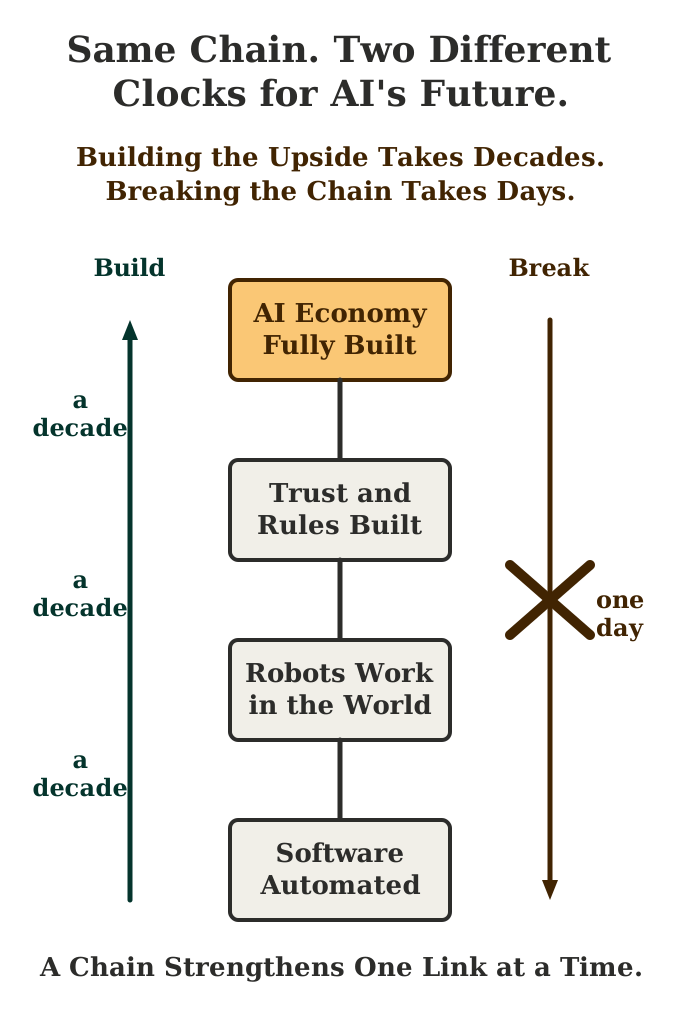
But breaking the chain is different. The chain only needs to fail at one link. A jailbroken frontier model in the hands of a bad actor works like a master key that fits every lock in the building. The bad actor does not need to automate the production economy.
They need to break one piece of critical infrastructure. The electric grid. The financial system. A lab capable of designing a pathogen.
The Challenger came apart in 1986 because a single rubber O-ring failed in cold weather. The other 25,000 parts of the shuttle worked perfectly. The whole vehicle was lost. That is what a weak link looks like when it breaks, and that is the model for what catastrophic AI risk looks like in 2030.
Building out AI’s economic upside takes decades, because the chain has to be strengthened one weak link at a time, and each one takes years of complementary innovation and physical reorganization. Breaking a critical system takes days, because the chain only has to fail once.
The policy response should reflect the asymmetry. A regulatory framework calibrated to gradual change is not calibrated for fast breaks. The catastrophic risks arrive on a faster clock than the economic transformation. Both clocks are running, and neither one waits.
Abundance does not solve distribution#
If the explosive growth scenario arrives, the economy generates enough surplus to make everyone better off in theory. That is the optimist’s case for AI. The technical question of growth and the political question of distribution are separable, and the political question is the harder one.
Whether abundance solves distribution depends on whether the political coalition for redistribution survives a world where most citizens have lost their economic leverage. The last twenty years of U.S. policy are not encouraging on this front. The labor share of GDP has fallen by ten percentage points. The capital share has risen by the same amount. Whatever the cause, automation or market concentration, the trend itself is settled.
A worker who owns shares in the S&P 500 holds a claim on the capital share. A worker who does not is more exposed. Capital ownership is itself a kind of insurance against automation. The post does not solve that asymmetry. It names it.
Universal abundance is not the same as universal dependence. A world where the typical citizen depends on a transfer from the productive sector is not automatically a world where the typical citizen is fine. The political coalition for redistribution is held together by leverage, and leverage is held together by economic contribution. If most citizens lose the second, the first is in doubt.
The hope in the optimistic case is that tax and transfer programs will scale to match the surplus. The mechanism is well understood. The political will is not. The technical question is solvable. The political question may be the harder one this decade and the next.
The chain strengthens slowly. It breaks fast. The next ten years are the test of whether families prepare for both clocks at once. The work that holds a family through illness and old age, the work built on trust and physical presence, is the work the chain still needs, and the work worth raising the next generation to do.
The argument here draws on Chad Jones’s public lecture A.I. and Our Economic Future at Stanford, 2026.


