

The most important point about Artificial Intelligence, the systems that now read and reason on a tier that used to require a person, was a throwaway about lonely older adults. The industry missed it. The frontier capability that costs billions every year is being absorbed by audiences that already had power, not the ones who would gain the most.
What is the real test of AI in the next five years?
The real test of AI in the next five years is whether it reaches the people who need it most. The frontier capability is being absorbed by enterprises and hedge funds that already had access to capability. The audience that would benefit most, including older adults living alone, is barely in the design conversation.
Will AI take my job? The labor argument is wrong in its math, not its conclusion#
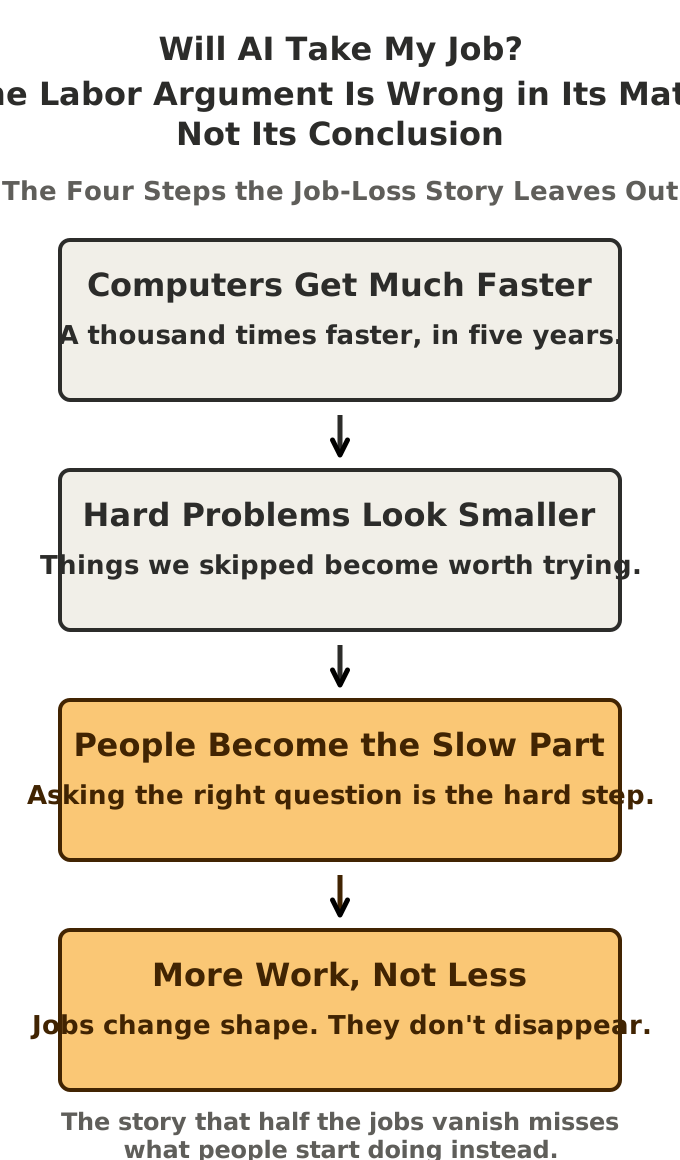
Everyone fights about the wrong forecast altogether. Half the jobs gone. That is the prediction. The prediction is wrong, not in its conclusion but in its underlying math.
Here is the actual mechanism the pessimistic case misses. When a tool becomes a thousand times faster, the problems that were off the table become tenable. The set of things worth attempting expands with every increase in speed. The bottleneck moves. Answers arrive in seconds. The next question takes a human a week to formulate properly.
That labor prediction underestimates two things in the same breath. It misses the speed at which new problems become attempts. And it misses the demand for human judgment that those new attempts generate downstream. Every wave of automation made the same prediction. Half the jobs are going. Every wave was partly wrong, in the same predictable direction.
An honest version of the optimistic case is not that nobody loses. It is that the count of jobs is the wrong number to argue about. The right number is the count of attempts. Faster tools make more attempts possible. More attempts make more judgment necessary.
This 100 percent framing has a soft edge. It is honest about scale and only deliberately soft on timing, and a software engineer still faces the change differently from a radiologist. A radiologist faces it differently from a home health aide. Some workers face the change first. The transition is not uniform.
Pessimism is the easy case. Anyone can do it. The optimistic case asks you to picture the new attempts before they exist. That is harder. A weather forecaster who has been counting tornadoes can tell you the size of the storm. They cannot tell you what towns will get built afterward.
A thousand-fold speedup is a phase change, not a benchmark#
A thousand times faster is not faster. It is something else.
Think of it like a plane that can fly Mach 10. The first thing you notice is not the speed itself but a different sensation entirely. The first thing you notice is that the world feels smaller than it did yesterday.
Flying from New York to Tokyo used to be a long international journey. Now it is a long lunch. The world did not actually shrink at all. Your map of what was reachable expanded outward.
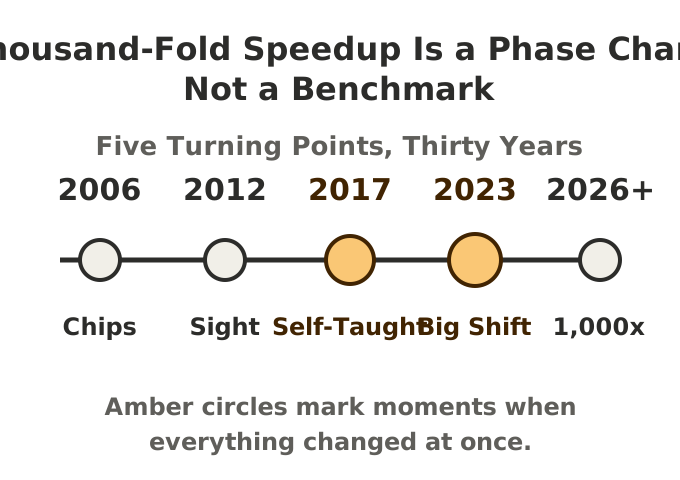
That same logic runs on compute. The next five years could deliver a thousand-fold increase in available capacity. Problems that look hard today, smart-grid optimization, protein folding for diseases nobody has named, traffic systems that learn the city, all start to look small enough to attempt. The map of tenable problems expands.
This is a phase change in the strict physics sense of the word. The field of AI changed phase around November 2023. Before that point, the scaling laws were nothing more than a hypothesis researchers debated openly. After the phase change, they became the operating reality of the entire field. The change was not a gradient. It was discontinuous.
One footnote shadows the forecast. Nobody likes to read it. The thousand-fold speedup assumes energy and water availability that the most enthusiastic projection treats as given. The grid does not yet have that headroom, and water budgets in several states already buckle under steady data-center load. That assumption deserves its own argument.
Even with the footnote, the mechanism is real. Speed reshapes the perceived size of what is hard. A grid problem that took a year of human modeling becomes an hour of compute. A protein structure that took a decade becomes a Tuesday. The world does not get smaller. The map of what we can try gets larger.
AI is learning languages no human has ever spoken#
Chatbots are a side effect of the actual scientific work happening underneath.
Underneath, the real news is that AI is now learning representations that have no human equivalent at all. The language of proteins, where shape and function are the same word. The language of cells, where chemistry and behavior cannot be separated. The geometry of physical systems, where the structure carries information that natural language was never built to carry.
A productivity tool helps a worker do a known task faster than before. A scientific instrument lets a researcher see what was invisible before any tool had pointed at it. AI used to be the first thing. It is rapidly becoming the second. That is a different category of technology with a different set of beneficiaries.
In the Arrival movie, aliens communicated in shapes. The shapes carried more information than any sentence could. The hero figured out that the shapes were the language, not a translation problem. AI’s emergent representations work the same way. They are not English with extra steps.
This is not just research. Non-engineers are now building real businesses on these tools. The leading example to date is a small business built with no-code AI tools reportedly generating around $23 million annually, which is the kind of number that used to require an engineering team. The technology divide that used to separate engineers from everyone else is closing.
Someone who could not write a line of code three years ago can now ship a product. They can run a customer support flow and bill a recurring fee against it every month.
Implications run two ways. The frontier of capability has moved past the categories the industry uses to sell AI. And the floor has dropped low enough that the people who used to be locked out are not locked out anymore.
Who benefits most from AI? Not the audiences the industry is building for#
The most underrated application of AI in the next five years is not in a server farm. It waits at an 84-year-old widow’s kitchen table.
A robot that holds a real conversation with her at the kitchen table. A voice that remembers what she said yesterday and asks how it went. A system that knows her medications and notices when she forgets one. The technology exists. The will to build it does not.
Simple math drives it. Frontier capability is absorbed by audiences who can pay frontier prices. Enterprises. Hedge funds. Ad networks. Companies that need to forecast supply chains a quarter ahead.
None of those audiences look like an 84-year-old in Michigan, the only customer this piece keeps returning to. The willingness-to-pay is low. The per-customer revenue is small. The market is not venture-funded. The math does not work for venture funds.
No startup will close this. It is a mismatch between where AI capability lives and where AI need lives. The audience that would benefit most from a companion that listens is the audience the industry has not built for.
My point is not that the industry is broken. The industry is doing what industries have always done. It serves the customers who can actually pay for the service. AI works like a delivery truck moving fast past the houses that did not sign up. The truck does not stop at every door. It stops where the paying customers signed for the route.
The same dynamic in benefits navigation#
That pattern is not unique to elder companionship. It shows up wherever a household has to navigate a system designed for institutional users. Medicare’s enrollment paperwork is a labyrinth.
Social Security’s calculations require a tax accountant to verify. A retiree on a fixed income, picking between two plans with different drug formularies, is exactly the audience an AI system could help. And exactly the audience nobody is building one for.
The technology exists. The market is small. The need is large. The truck keeps moving.
What scarcity looks like when raw cognition becomes abundant#
If a tool that costs nothing can do every analytical task, what stays scarce?
An honest answer names the things the tool cannot do. Judgment is the first. The ability to weigh competing harms when both choices are real. Taste is the second. The ability to choose between two true sentences and pick the one that lands. Empathy is the third. The ability to read what is not in the data because it never went into a dataset.
And then there is the harder one. The ability to see around corners. To know what question will matter in six months. To pick the right problem from a set of problems that all look equally tractable. That capacity does not commoditize.
It is the difference between the senior person on the team and everyone else.
AI changes who holds the scarce position on every team. It works like the difference between an architect and a bricklayer. The bricklayer’s tools got a thousand times better in a single decade, and the architect’s judgment got more valuable in exactly the same week.
What this means for a parent thinking about a kid’s career resists a clean answer. It is not “avoid the trades that automate.” Every trade automates on some timeline, eventually. The timing is impossible to call from inside the present.
More useful is the question of which trades sharpen judgment. That is a smaller list. It does not match the existing college majors cleanly. A residency program teaches it. A long apprenticeship teaches it. A first job under a serious mentor teaches it.
Kids who learn to ask the next question after the answer arrives are the ones who land well.
An 84-year-old widow in Michigan does not need a foundation model. She needs something to talk to at 3 a.m. The technology exists. The will to fund it does not. That is the test of whether AI’s frontier means anything to the people whose lives could change the most.
Jensen Huang’s interview with Jody Brown on the inaugural episode of A Bit Personal, 2026, anchors the argument here.


