

You watch your kid type a half-finished sentence into an Artificial Intelligence (AI) chatbot and come back with a paragraph that scans better than yours did at their age. The thought lands quietly. Do they still need to learn the slow way? This is for the parent holding that question tonight.
What should kids learn when AI does the heavy lifting?
What should your kid learn when Artificial Intelligence (AI) does the heavy lifting? Math, science, and the slow work still matter. Intelligence got cheap; judgment did not. Foundations are what let a child use the tools well rather than be used by them. Keep encouraging the slow work.
Do your kids still need to learn math and science in the age of AI?#
Now picture it with a math problem. The temptation to drop the drilling is reasonable. Sit with it for a moment.
Here is the honest answer: yes. Not because tradition demands it. Math and science are how a child learns to ask whether an answer is right. AI gives confident answers all the time. Most of them are right. The ones that are wrong are not labeled.
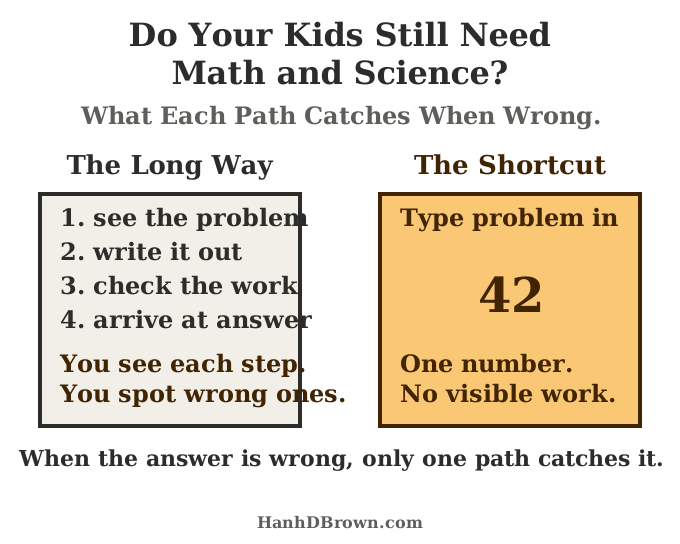
Any child who has done the slow work knows when something does not smell right. The kid who only ever fed the problem to a tool does not. The difference is invisible most days. The difference is everything on the day the tool is wrong and the answer matters.
Like a carpenter who can spot a crooked joint by eye, the eye is built over years of careful work, not in an afternoon. The carpenter does not need a level for every joint. The carpenter looks at the cut and knows.
Right now the school system is in a real fight about this, with some districts pushing for more AI tool fluency while others double down on foundations. You will see the fight in your child’s curriculum and in the homework that comes home. The framing here is simple. The tool can change every year. The judgment cannot be rebuilt in a hurry. Foundations come first.
This same principle applies to your own learning, by the way. The parent who learned the basics of a topic well still reads better through any new tool than the parent who only ever skimmed. The kid is not the only one in the house this advice covers.
What does “AI-Ready” actually mean for a kid today?#
People throw around “AI-ready” as if it names a specific skill. It does not. It does not mean knowing the best prompts. It does not mean memorizing which model is good at which task. Those change every month.
AI-ready means a child who can read a tool’s output and judge whether it serves the goal. The judgment is the thing. The tool is the thing the judgment is applied to.
Reach for the tool first and the judgment second, and a child has a brittle skill. A child who builds the judgment first and adopts the tool second has the tool plus the judgment to use it.
Judgment runs on foundations. Reading well. Computing well. Knowing how a system works under its hood. A child who has read whole books knows when a paragraph wanders. A child who has solved arithmetic by hand knows when the math does not add up. A child who has built something with their hands knows when the description of a thing does not match the thing.
You feel the tension as a parent. The world tells you the future is AI, while the school insists it is also long division. You hear both, and they do not seem to agree. They agree more than they seem to. The world is right that AI is the future, and the school is right that the long division is the foundation. The child needs both, in that order.
Here is a useful image from the source. Some of the most interesting capabilities in today’s AI tools are capabilities the makers of the tools did not know were there. A kid who understands a system well can find capabilities the builders missed. The future will be built by people who can do that. The foundation is what gets a kid to that door.
One kid learns the tool but not the system and stays a guest in the room. The kid who learns the system and then picks up the tool owns the room. Both kids can do today’s homework. Only one is being prepared for work not yet invented.
What should you encourage your kid to try?#
Better prompting is not the most useful thing a kid can do with AI. The most useful thing is to pick a problem they care about and chase it further than they could alone.
A side project. A curiosity. A small business idea. A science fair entry. The garden in the back yard. The story they want to write. The game they want to make.
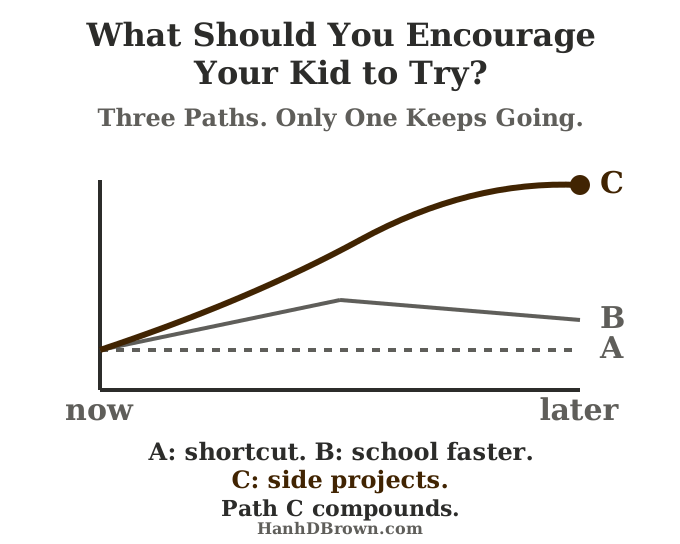
Three paths sit in front of every kid. Path one. Use the tool as a shortcut to finish the assignment. The kid gets the assignment done and learns nothing extra. Path two. Use the tool to do school work faster. The kid clears more assignments and learns marginally more.
Path three. Use the tool to chase something the kid cares about and could not have built alone. The kid learns the assignment plus the tool plus the topic plus the judgment about when the tool helps and when it does not.
That third path is the one that compounds. Paths one and two flatline. The kid on path three discovers what the labs are still discovering. The kid on path three brings home a project at the dinner table that none of the adults could have predicted.
Like a kid in a workshop trying every tool on the bench, the kid finds the tool that fits the project. The kid learns which tool cuts clean and which one tears. The kid keeps the cuts that work and throws out the ones that do not. None of that learning happens when the parent stands over the bench and tells the kid which tool to pick.
Even the labs that built the tools do not know what every capability is good for. The official documentation lists the obvious uses, while the interesting uses live in the gaps the documentation missed. A kid who keeps trying things finds capabilities the labs missed. That finding is where the next decade of value lives, and your kid could be the one who finds it.
Your part in this is small. Ask what they are curious about. Hand them the tools. Get out of the way. Then ask, at dinner sometimes, what they made.
Will your kid still need a college degree?#
Honestly, it is maybe, maybe not, and the question is not quite the one to be asking. The right question is whether the years and the dollars buy the foundations and the judgment the rest of life will run on. Some colleges still teach that. Some have always charged a lot for a credential the market accepts as a proxy.
AI changes the math by making the credential matter less and the foundations matter more. The credential is a signal. The signal works when employers cannot easily check the underlying skill. As AI lowers the cost of checking, the signal is worth less. The skill underneath is worth more. The program that teaches the skill keeps its value. The one that sells the signal does not.
Cost is the side of college we have been quiet about so far. A four-year degree costs a lot of money, a lot of years, and a lot of opportunity that could be spent doing something else. The cost was justified when the credential opened doors.
Those doors are being checked differently now. A parent reading this should not skip the cost question. The cost question is half the conversation.
Here is a reasonable rule. Foundations-heavy programs still pay. The math major, the engineering program, the chemistry track, the literature curriculum that demands real writing.
Credential-heavy programs are a tougher call. The school that markets a brand and a network but does not stretch the student is a worse deal than it was ten years ago. The school that bends the student through hard material is a better deal than it was, because the foundation it builds is what the next decade rewards.
None of this tells you which college to pick. It tells you which question to ask the college. Ask what the program teaches that a tool cannot do for the student.
Ask what the program leaves the student able to do that the student could not do at the start. Ask whether the work is hard in a way that builds something that lasts. The college that answers those questions well is worth the cost. The college that cannot answer them is not.
How do you talk to your kid about all this without scaring them?#
A child reads the room. A kid feels the adult’s anxiety about AI even when the words say everything is fine. The most useful thing a parent can do is be honest about what is changing and clear about what is not. Both halves of the picture, named out loud.
Start with the changing part. The tools are real. They are very capable. They get better roughly every month. A kid going through school today will see capabilities at graduation that did not exist at enrollment. The world the kid enters as a working adult will not be the world this article was written in.
The not-changing part. Curiosity matters. Judgment matters. The slow work of learning a thing well matters. People matter. Showing up matters. The kid who reads, writes, computes, and works hard at things they care about will have an easier time than the kid who skated through on the surface, no matter what the tools do in the meantime.
Like a parent at the dinner table explaining the weather, you do not need to predict the storm. You name what is true. You tell the kid the rain is coming, the rain has always come, the rain will come again, and the kid still has to learn to walk in it. The kid does not need a forecast. The kid needs the long view.
A small script you can borrow. “These tools are going to change the world you grow up in. You will do things at twenty I could not have done at forty. The way you get there is the same as it always was.”
“Read books that are hard for you. Solve problems that take a while. Try things on your own. Ask questions you do not know the answer to. The tools will be there when you need them. The work that makes you ready for them is yours to do.”
The cheap thing got cheaper. The thing that compounds is still the same. Keep encouraging the slow work.
Source: Google DeepMind, at the 2026 Google for Korea AI Vision Fireside Chat, Seoul.
The thing that compounds is the slow work. The thing that gets cheaper is the speed. Keep the slow work, and the speed becomes a gift instead of a substitute.
That is the version of the answer your kid is going to need. It is also the version that has always been true under every previous wave of cheap intelligence the world has built.
Calculators did not replace mathematicians. Spell-checkers did not replace writers. Search engines did not replace researchers.
That pattern repeats with this generation of tools, on a different scale, with the same underlying answer. The tools change. The need for judgment about the tools does not change at the same rate. Foundations first. The tool, second. The work, always. That is the part the parent at the kitchen table can hold.


