

For sixty years, software was written by humans typing rules into a computer. Then in 2012, three researchers showed a neural network the answers, and the network learned the rules on its own. That moment was the start of Artificial Intelligence (AI) as we know it.
Is AI just a faster chip?
No. AI is a reinvention of computing. Networking, software, the methodology that links them, and the chips themselves all changed at once. The trillion-dollar data center infrastructure is being retooled to support a new workload, not to run the old one faster. The chip is the smallest part of what changed.
In 2012, software stopped being written and started being taught#
For sixty years, software was a craft. An engineer sat down with a problem. The engineer broke the problem into rules. The engineer typed the rules into a computer. The computer followed the rules. If the rules were wrong, the engineer rewrote them. That was every line of code from the 1950s through 2011.
Then AlexNet. Three researchers, a stack of graphics cards, and a million labeled photographs. They did not write rules for recognizing a dog. They showed the computer ten thousand pictures of dogs and let it figure out what made a dog a dog. The result on the ImageNet competition was so far ahead of every prior approach that the field changed overnight.
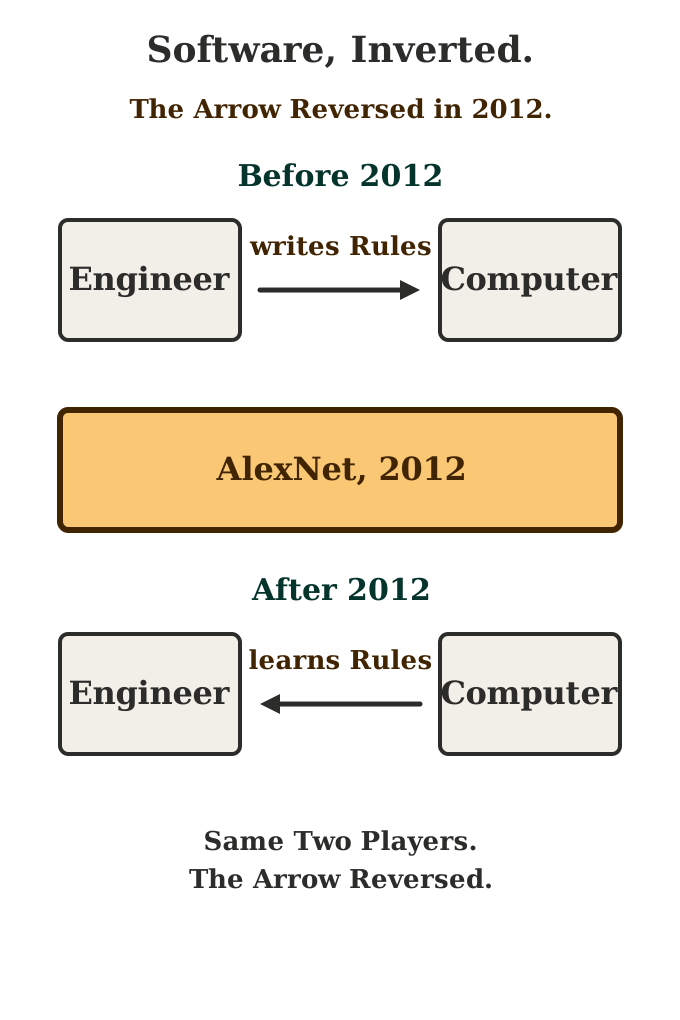
The shift is the inversion of every programming course ever taught. Before AlexNet, the engineer specified every step the computer should take. After AlexNet, the engineer showed the computer the right answers, and the computer worked out the steps on its own. The computer was shown examples until the pattern stuck. Software stopped being written. It started being taught.
Every major AI application since 2012 descends from that day. Speech recognition. Image generation. Code assistants. The chatbot at the bank. The medical scan reader. None of those products were written line by line. All of them were taught.
This is the foundational fact about AI that the chip discussion keeps missing. AI is not a faster way to run old software. AI is a different kind of software, produced by a different process, a kind that could not exist when the engineer was the only teacher in the room.
The chip is the smallest part of what changed#
Outsiders see chips. Insiders see a stack.
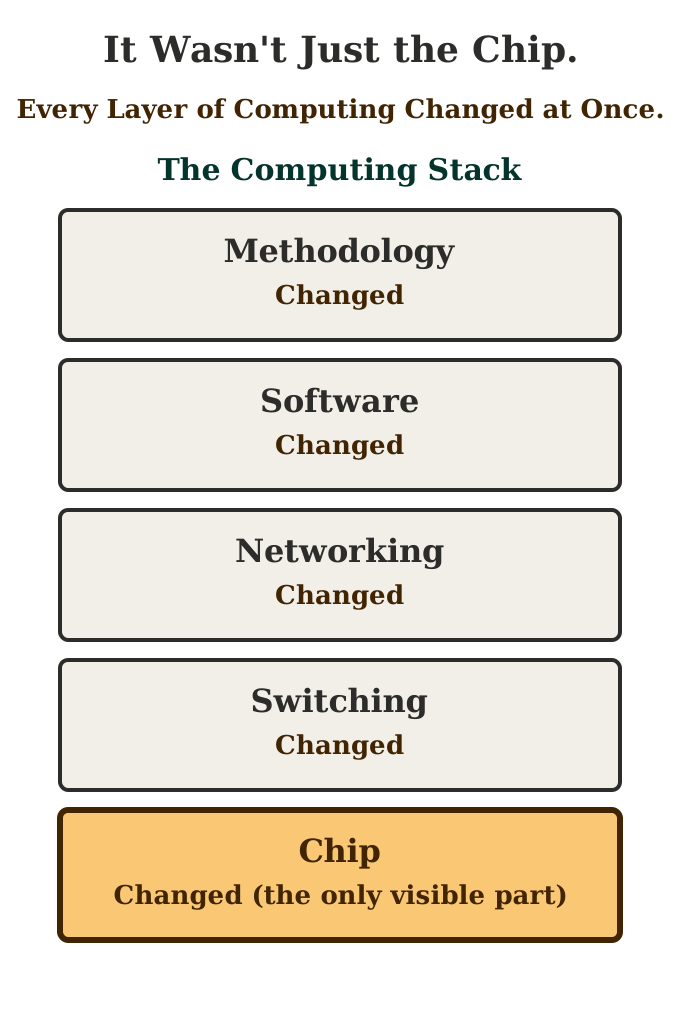
The networking changed. The switching that routes data between chips changed. The way memory connects to compute changed. The software stack on top of all of it changed. The methodology engineers use to design the system changed. The chip is one layer of five, and every layer was rebuilt at once.
The H100, the chip that trains most of today’s frontier AI, was designed with the help of AI. The system has already started building its own next version. That is the kind of recursion that compounds in ways outsiders do not yet model.
A trillion dollars of data center infrastructure is going to be retooled to match. That number comes from the company that sells the shovels for the retooling. The forecast may be right; the source has every incentive to predict the future it is selling into.
Verify the figure elsewhere. The underlying argument that the data centers will be rebuilt is supported by physical reality, not by the forecaster’s revenue model.
The first AI supercomputer weighed 70 pounds and contained 35,000 parts. Robots were required to assemble it. It cost $250,000. Eight of its chips came from one factory in Taiwan. What looks like a chip from the outside is a system, built across half a dozen disciplines, on top of a global supply chain no single country owns.
The reinvention is not the chip. The chip is the most visible piece of a much larger change, and most of the change is below the surface where outsiders never look.
Today’s computing is retrieval. Tomorrow’s adds generation.#
Every time someone touches a phone, electrons travel to a data center, the data center pulls a stored file, and the file comes back. That is the retrieval model. It is most of what computers do today, and it has been the dominant model since the internet was built.
The new model is different. The data center still retrieves. But it also generates. The phone asks a question and a freshly-composed answer comes back, written by a model in the instant it is requested. The image, the summary, the recommendation, the code, the email draft. All produced on demand.
The computational difference between retrieving a stored file and generating a new one is several orders of magnitude. A retrieval lookup costs a fraction of a watt. A generation call costs several watts, sometimes more. Multiply by billions of requests per day and the data center retooling becomes inevitable.
This is why the infrastructure question is real. The internet was built to fetch. The next internet has to make. The physical system underneath has to change.
Intelligence is not one thing#
Saying AI is like saying ball. The word covers many different objects, and the conversation gets clearer when the parts are named.
AI today is excellent at perception. It recognizes the dog in the photo. It finishes the sentence. It classifies the medical scan. It generates a paragraph in the style of any writer who has ever published online. These are one-shot tasks. The model takes an input and returns an output. It is very good at this.
AI today is not yet excellent at multi-step reasoning. The kind of work where a person takes a goal, breaks it into a tree of decisions, walks the tree to the best leaf, and acts on the result.
The kind of work a paralegal does building a case. The kind of work a doctor does building a differential diagnosis. AI is improving here, but it is not there yet.
The gap between perception and reasoning is the next horizon of AI work. How long the gap takes to close is the open question, and the timeline depends on what counts as reasoning in the first place. Estimates range from a few years to decades. The honest answer is that the timeline depends on the definition.
What is solid is the distinction. Conversations about AI get sharper when perception and reasoning are separate words. The dog in the photo is one kind of intelligence. The plan for the next ten moves is the other. Calling both AI flattens a difference that matters.
Export controls did not stop competition. They inspired it.#
The U.S. tried to slow China’s chip industry with export controls. The restrictions were designed to keep advanced AI chips out of Chinese hands. The measurable result has been the opposite of the stated intent.
Chinese chip companies have multiplied since the controls began. Dozens of new firms have opened, with public funding and private capital chasing the gap the controls created. The Huawei Mate 60 Pro shipped with a 7-nanometer chip in 2023, several years ahead of what Western analysts had predicted. The lead is narrower than was assumed.
Restrictions in technology work like a dam built across a wide river. The water rises and finds a new channel. The dam does not stop the water. It changes the path. This is the pattern of restrictions in trade more broadly, and the pattern of technology controls across every era. When access to a thing is restricted, the people denied access build their own.
The U.S. lead in semiconductors is real. A frequently-cited industry estimate puts the gap at roughly a decade. But a decade-old chip squeezed hard can still produce useful results five years out of date. The lead matters less than the framing suggests when the people behind are willing to work harder and accept worse hardware to close the gap.
The policy implication is not that controls are pointless. It is that the goal of controls is to widen the gap for a year or two. Controls cannot stop the competition. The competition is already running.
The sentence the talk did not say#
The talk runs for thirty minutes and does not contain one sentence about the people whose work is being reinvented alongside the computing. Not one sentence about jobs displaced, wages compressed, or work amplified.
The reinvention of computing is a story about machines. The consequence of the reinvention is a story about people. The talk tells the first story and not the second. This is not unique to the talk. The technical conversation about AI runs in venues where the labor question is not on the agenda. The labor question runs in venues where the technical conversation is not on the agenda.
The two conversations are about the same event. The two conversations rarely meet.
The reader of this post is the person the second story is about. The mid-career professional whose work is text and screens. The older worker whose pension depends on a job that may or may not exist in five years. The family member whose household budget runs on those wages. The retiree whose Medicare claim sits in the data the specialized AI is about to learn from.
The consequence of the reinvention lands on real households. The talk leaves the household out. The post stops here, with that absence named, because the absence is the editorial move no one else watching the talk will make.
The chip is the smallest part of it. The reinvention is the rest. The family looking at the next decade is looking at both the chip and the rest, and the post does the family the favor of naming the rest out loud.
The argument here draws on Jensen Huang’s interview with Andrew Ross Sorkin at the New York Times DealBook Summit, 2023.


