
Powerful companies always say the right things. That fact is older than any of the companies in question. In Artificial Intelligence (AI) the script is the same one the rest of the corporate world has been reading from for a century. The reader watching the script gets nothing from another reading of it.
How do I know which AI companies actually care about safety?
The reliable test of an AI company's safety stance is action that costs the company something. Three count. Holding back a working product to slow an arms race. Lobbying for the rule that would bind the company while peers oppose. Building governance that limits what the founder can do later.
The instinct is correct. Stop there anyway#
The fastest way to dismiss a powerful company’s safety claims is to point out that powerful companies always make them. The instinct is correct. As a default. Powerful companies have a long record of saying the right things and doing the convenient ones. A reader who walked away on the principle alone would be right more often than wrong.
The instinct stops being correct when the same company has, on the public record, done specific things that cost it money, market position, or political standing. The right move is to keep the instinct and check the record.
This is for the operator, the investor, the informed citizen at the edge of the AI industry. The reader who has to decide which AI companies to take seriously when they talk about safety. The reader who suspects the choice should not be guesswork.
Power over a generation-defining technology concentrated in a small set of companies almost overnight, almost by accident. The few firms that sit on top of the stack now did not plan to be there a decade ago. The situation is the table the rest of the conversation is responding to.
When a company in this position says it wants to do good, the listener has no way to verify the claim from the statement alone. The reliable test is action that costs something. Costly action is harder to fake. Rhetoric is easy.
The default instinct to distrust claims of virtue is correct most of the time. It should yield. When evidence appears. This piece is a request to keep the instinct and add the evidence layer. The post that follows names three things on the record that count as evidence.
The model held back in 2022#
First piece of the toolkit. Did the company ever hold back a working product to slow a race it was already winning?
In 2022, a model that could have shipped before ChatGPT was kept off the market. The wait was deliberate. The world probably gained a few months of distance from the arms race.
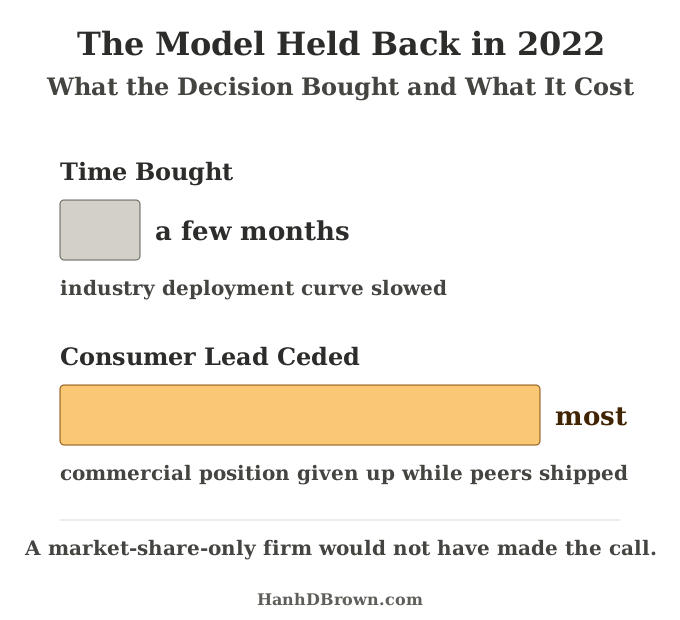
The decision ceded the lead on consumer AI. Almost certainly. A company optimizing only for market share would never have made that call. The first mover became the household name. The brand stuck. The company that held back its model became the second name a reader has to remember.
The cost was not theoretical. It showed up in download numbers. In keyboard share. In the name your spouse says when she means “the AI thing.” The market does not redistribute first-mover prizes when you explain your reasoning afterward.
The choice looked like a runner who slows on the last lap to let the field catch up. The runner does not win the race. The runner finishes honestly. The runner is keeping a clock they believe is the right one.
Whether the slow-down was the right call is a question for hindsight. The slow-down was on the public record. The slow-down cost the prize. That is the part the test counts.
Warning about risk is not a marketing strategy. Telling buyers your product could be dangerous. It drives buyers away. A company that warns about risk while selling the same technology is paying a real cost, not making a sale. The warning’s content does not matter here. The warning itself is the opposite of a marketing move.
A few months of distance from the arms race is what the decision bought. That is small in the long run and real in the short. The point is not that the delay was decisive. The point is that the company paid for the delay. A company that pays for a delay it could have skipped is telling you what it cares about.
Lobbying for the rule that binds you#
Second piece of the toolkit. Did the company advocate for regulation that would bind it, while peers and the administration opposed the rule?
California Senate Bill (SB) 53 is the cleanest example. The bill was a transparency law for large model builders. It exempted every company under five hundred million dollars in revenue. In practice the bill applied to four or five firms. One of them was lobbying for it.
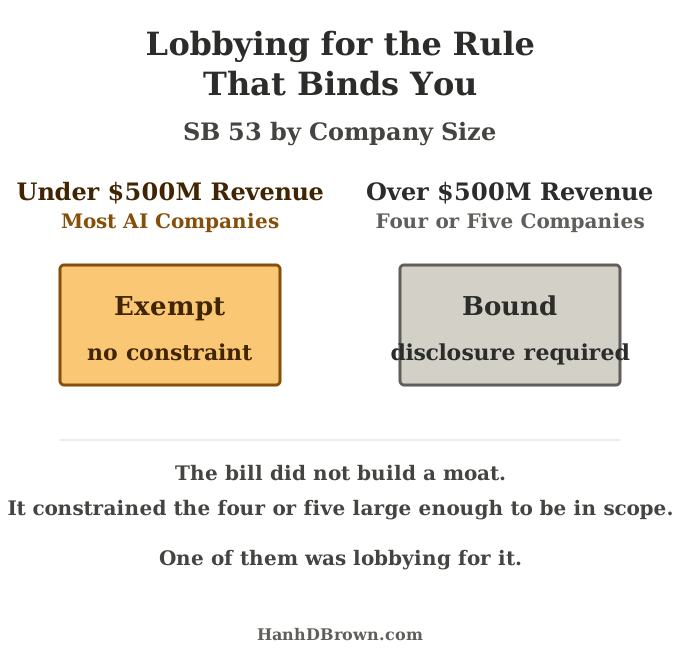
The standard counter writes itself. Large incumbents support regulation. Because regulation builds moats around them. The exemption fact refutes the counter. Directly. The bill did not build a moat. The bill built a constraint. It bound the four or five companies large enough to be in scope. The small builders the company would otherwise want to push around stayed free of the rule.
Advocating for the rule that binds you is rare. Especially while peers oppose. The bill leaves a paper trail. The lobbying meetings happen on the record. The company is not buying favor with regulators. The company is spending favor with peers and with the administration to argue for its own constraint.
This move meant giving up an advantage the company already held in order to keep the larger game worth winning. The company loses the immediate gain. The company keeps a market it considers worth competing in.
A company that would never give up an advantage it holds has only one loyalty. The loyalty is to its own position. A company that gives one up has a second loyalty. That second one pays in something other than position.
The chip-policy fight worked the same way. Pushing for export rules that limited the company’s own chip suppliers made the suppliers very angry. Suppliers paid the lobbying cost, not regulators. A company looking to maximize supplier goodwill would never have picked the fight. The fight is on the record.
Self-regulation has costs in both directions. The peer cost: other industry leaders treat the advocate as a defector. The administration cost: an administration that favors deregulation marks the advocate as a problem. Both costs are paid in political capital. The company cannot spend that capital twice. A company that pays them is telling you which budget item it ranks higher.
Writing the founder out of the loop#
Third piece of the toolkit. The most structural. Did the company build governance that constrains the founder from redirecting the mission later?
The Long-Term Benefit Trust (LTBT) appoints a majority of the company’s board seats. The trust is composed of financially disinterested individuals, people who own no equity in the company and have no commercial stake in its outcome. The founder is structurally written out of the loop on board appointments.
A founder who only intended to talk about distributed power would not sign over board appointment authority. Structure is harder to undo than commitment. Posters come down. Board bylaws do not. Not without a process that leaves a wake of public documents and a list of who signed off on the change.
The choice looked like a captain who chains the wheel before the storm and throws the key over the rail. The captain still steers the ship in fair weather.
The captain has made it impossible to redirect the ship when the storm hits. That includes the captain’s own future hand. A captain who would never throw the key overboard is a captain reserving optionality. The rest of the crew has no way to verify what the optionality is for.
The structure is not perfect. A sufficiently large investor majority, applied with enough patience, can in principle work around any governance constraint. The honest framing is that the structure raises the cost of redirection. Governance is the practice of raising those costs. The trust does not make redirection impossible. The trust makes redirection slow, visible, and expensive enough that the cheap version of it cannot happen.
The framework is not “trust the company.” The framework is “trust what cost the company something.” Three actions. The model held back. The rule the company lobbied to bind itself with. The structure that limits the founder. Each costs commercial ground. Each is on the public record. Each is something an operator who only wanted market share would never do.
The family that has put the inheritance in a trust the eldest son cannot redirect knows the move from the inside. The household that has written a binding power of attorney for a parent before the parent loses capacity knows it too.
You constrain the future actor while you still have the standing to do so. Children watching parents make those choices learn what a serious commitment looks like. The AI conversation is missing that part.
When the actions stop costing, the test stops working. So far the costs are real. The test still works. The reader holding the test in their hand has a usable filter. The filter does not depend on trusting the next press release the next company puts out. The filter beats the press release every time.
The three actions are not a complete safety program. They are a usable test. The test runs in five minutes. Against any company that talks about AI safety. The next time a company you have to take seriously sends a press release you have to evaluate, apply the test.
When the actions stop costing, the test stops working. So far the costs are real and the test still works. The reader with the test in hand has a better chance of seeing what the company is actually choosing.
The argument draws on Dario Amodei, co-founder and chief executive officer of Anthropic, in conversation with Nikhil Kamath in Bangalore, 2026.


