

Every Artificial Intelligence (AI) vendor pitch a chief information officer has heard in the last twelve months starts at the model. The model is real and worth what it costs. The model is also not the part that decides whether the business gets value back.
Why is AI orchestration, not the model, the blind spot in enterprise deployment?
AI orchestration is the blind spot, not the model. The model layer is commodity within months. The orchestration layer is custom and expensive forever. Most enterprise pitches that start with the model end at a sidecar nobody owns. The control plane is where the ROI lives or dies.
Every pitch starts with the model#
Watch where the pitch opens, and it is always the same slide.
Yes, the model is real. The model is impressive. The model is worth what it costs. None of that is in dispute.
What is in dispute is whether the model is the part of AI that determines whether the business gets value back. It is not.
Intelligence inside the model is converging across providers, which is the story most coverage keeps skipping across the three layers. Every enterprise software vendor in the room is calling the same handful of frontier models from the same handful of cloud providers. The token bill is different. The intelligence inside the model call is mostly the same across all the providers.
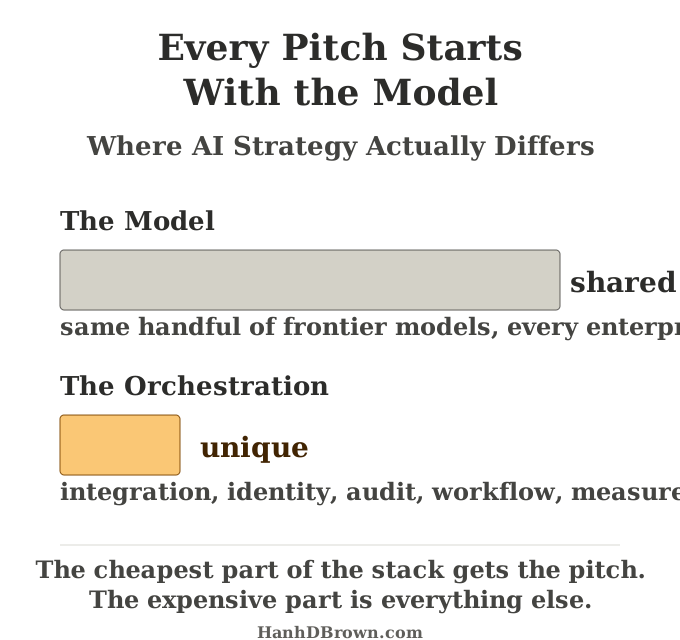
That shared intelligence is becoming the cheapest part of the stack.
Expensive is the orchestration around the model. The integration with the systems the customer already runs. The identity layer that decides which agent is allowed to do which thing for which person. The audit log that records which decision was made and why. The workflow that turns a model response into an action the business can stand behind.
Picture the reader: a chief information officer with a board meeting next quarter. The reader is a chief financial officer trying to find the return on the last four AI line items.
The reader is an operator at any level trying to make AI useful inside a real business with real systems. The pitch deck the reader is reading next week opens at the model. The pitch deck closes before it reaches the layer where the value actually lives. The reader’s job is to notice the closing slide and ask what comes after it.
Think of the model as the engine. The orchestration around the engine is the car. The car is what gets you to work. The engine alone sits on a pallet.
This piece, start to finish, is about the car and the road it drives. The car is the part of the AI strategy that produces measurable value the board can read on a single page. The car is what the post is for.
Three hundred and sixty-seven sidecars#
Walk into the typical enterprise.
About three hundred and sixty-seven applications are running the business. Some are core systems built in the early two thousands. Some are software-as-a-service tools picked up in the last decade. Some are spreadsheets that act like applications. The number is rough. The shape is real.
AI has been bolted onto most of those applications as a sidecar. The customer relationship tool has an AI assistant. The expense system has an AI assistant. The document tool has an AI assistant. The chat tool has an AI assistant.
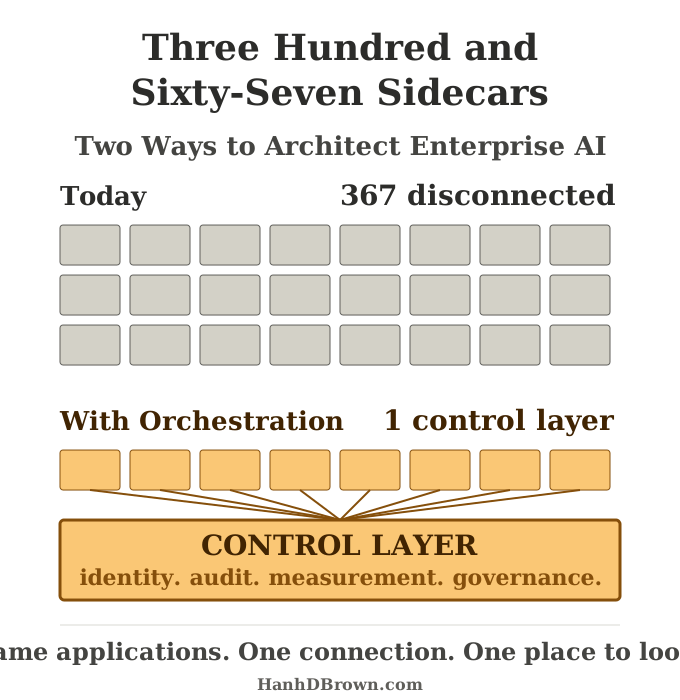
None of the sidecars are connected to each other. None of them are governed centrally. None of them report cost and value into a single dashboard the board can read. Each sidecar is a separate contract with a separate vendor doing separate work, billing separately, and producing a separate audit trail.
This is the architecture the chief financial officer is asking about when she asks where the return on investment is. The return is real in any one sidecar. The return for the business is the sum, and the sum cannot be calculated because the data lives in seventeen tabs in three vendor portals.
A senior knowledge worker at the typical large company today opens about seventeen tabs to do an hour of work. Each tab has its own AI sidecar. Each sidecar surfaces an answer. None of the answers know about the other answers. The worker is the integration layer, in their own head, on a Tuesday afternoon, on a deadline. The integration layer is exhausted.
Each sidecar is a fix that looks like progress and runs like a faucet nobody can turn off. It is paid for separately, on a different invoice in a different vendor portal. Each sidecar produces value separately. The work of stitching the sidecars together stays human and stays underpaid.
A sidecar is like a key without a lock. The key looks beautiful in the catalog. The catalog never mentions the door.
So the architecture itself, not any single tool inside it, is what quietly swallows the return on investment the board keeps hunting for. The fix is not another sidecar. The fix is the layer underneath.
Six out of ten bought it. One out of ten uses it#
About six in ten companies say they are using agentic AI. About one in ten say they have built something autonomous with it. The other five have a license and a token bill.
Capability is not the problem here. The capability has shipped. The agents work in demos and in early deployments and in the demos the salespeople ran last month.
What is missing sits between capability bought and capability used. The license sits on the shelf the way a treadmill sits in the basement. The intent was real. The integration into the actual workflow of the actual business never happened. The capability waits for a quarter that does not arrive.
Once again the fix is not more capability. The fix is using what was already bought.
Any chief information officer who can answer the question “what is on our agent roadmap and who owns each agent” is in the top decile. The one who cannot is in the bottom three. The difference is not budget. The difference is the layer underneath the sidecars that governs each agent as an owned role and says who owns what.
A household that buys a kitchen appliance, puts it in a closet, and never plugs it in has paid for the capability and never used it. The same household, multiplied by the size of an enterprise software budget, is what most companies are doing with agentic AI right now. The appliance is on the shelf. The receipt is in the drawer. The capability is waiting.
Relief arrives the day the household decides which meal the appliance is for and clears the counter for it. Inside the enterprise, the same three moves turn a shelved license into working output. Pick the workflow the agent owns. Connect the agent to the systems that run the workflow. Watch the capability turn into output the household can taste.
None of this is an argument against capability itself, which is real and already paid for. The post is against the gap between capability and use.
Ninety-five percent cannot answer the board’s question#
Ninety-five percent of enterprise AI programs cannot tell their board what value the AI is producing.
Boards keep asking. The question is fair. The answer is sitting in pieces across seventeen vendor portals, three cloud bills, and forty-eight hundred logs nobody has assembled into a single view. The data is not missing. The data is scattered.
Here the fix is a single control layer. The layer does three things.
It discovers every model, every agent, every workflow, and every identity touching the AI surface of the business. It governs all of them with one set of rules, applied consistently, with a kill switch that works. It reports cost and outcome into a single dashboard the chief executive can read in one place on one screen.
That control layer is the answer to the board’s question. The control layer is also what makes the model worth the budget the company already approved. The model is the engine. The control layer is the car. Both are needed. Only the car gets you somewhere.
The model thinks. The workflow acts. The chief executive needs both, and needs both to report into the same dashboard.
Households running a budget through a single ledger know the rule already. The household that tracks the savings, the mortgage, the medical bills, the kids’ tuition, and the parents’ care expenses in one place can answer the question “where did the money go.” The household that keeps each category in a separate notebook cannot. That same question returns at enterprise scale, with worse handwriting.
Intelligence is cheap. The layer that surrounds the intelligence is the expensive part. The expensive part is the part most pitches skip. The blind spot is the layer the pitch deck closes before it reaches.
Any reader who can name the orchestration layer underneath their own AI stack can answer the board on the first call. The reader who cannot is still in the ninety-five.
The model is the engine. The orchestration is the car. The pitch deck the reader is opening next week stops at the engine. The blind spot is the layer between the engine and the car, and the layer is where the value actually lives. The fix is not a better model. The fix is the layer the model sits inside. Naming the layer is the first move.
The argument draws on Bill McDermott’s Knowledge 2026 keynote, with Amit Zavi and Holly, Las Vegas, May 2025.


