

Notice the word Artificial Intelligence (AI) in any news story you read this morning. The word is doing three different jobs at once. Three different capability layers wear the same two letters. The story almost never tells you which one is on the page.
How do I read AI news to know what is actually being announced?
How to read AI news: separate the three layers and notice the sentence the news always skips. Capability. Orchestration. Compute. The sentence the headline omits is the one about which layer the announcement actually touched. The other two layers stay where they were.
AI is three different things in every news story#
Pull the two letters apart and three separate machines fall out, each doing a different job under the same disguise.
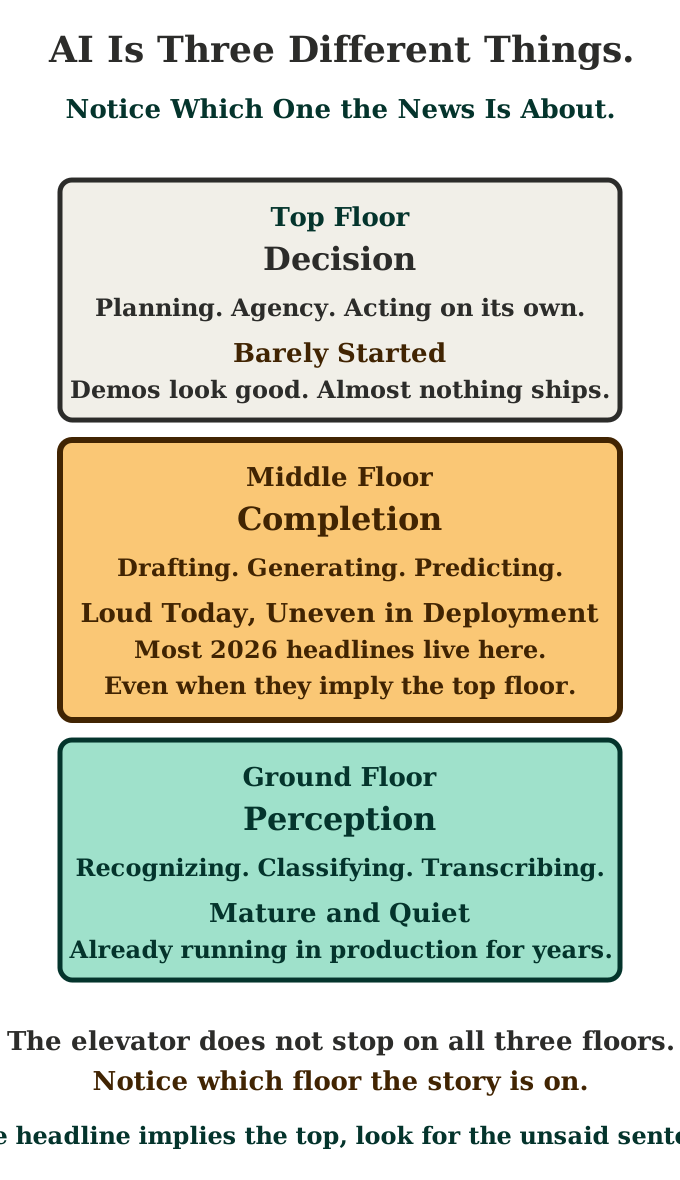
Perception. The model recognizes, classifies, retrieves. This is the floor that reads a scan, finds a face in a photo, indexes a million documents.
Completion. The model generates, drafts, finishes the pattern. This is the floor that writes the email, finishes the code, produces the next paragraph.
Decision. The model plans, chooses, acts. This is the floor that picks the next step in a multi-step task and executes it without a human in between.
Three floors. Three different jobs. The headline uses one word for all three.
Take a real news story from 2023, which is only a few model generations back and already reads like ancient history. The model passed the bar exam. The capability measured was completion. The model finished legal sentences in the way a trained lawyer would. The capability is real and the test was honest.
News writers slid easily from “passes the bar” to “AI lawyers.” The leap requires the third floor. The third floor is decision. The decision floor was not what was tested. The decision floor is barely built. The test measured the completion of legal sentences and the headline implied the practice of law. Two different floors.
They are not lying. They are using a word that points at three things and choosing the layer that gets the clicks. The reader’s job is to separate the layer that did the work from the layer the headline implies.
A doctor reads the chart and the patient at the same time, knowing that both are saying something different. The trained AI reader does the same with a news story. Read the headline and read the underlying capability layer side by side. The two often disagree.
Once you can name the floor the story lives on, the other two floors stop crowding the picture. The story becomes legible.
The gap between what the model does and what the product does is where the hype lives#
The next move sits inside the layer you just named.
Look at the gap between what the model can do once and what it can do every time. The press release describes the first. The deployment lives in the second. Learning to read the gap is the single most useful skill for anyone trying to use AI to make a decision at work or at home.
In a demo the model passes the bar exam, drafts the contract, books the trip. The same model in deployment misses the edge case, fabricates the citation, confuses the dates. Both happen in the same product, often in the same week.
Reading the demo without the deployment is like a wedding photo that hides the marriage. Both are real. The photo and the marriage are different objects. Most of the reporting is about the photo.
The gap is not a bug. The gap is the shape of the technology right now. Pattern-completion models are reliable in the middle of the distribution and unreliable at the edges. The middle gets the demo. The edges show up later in the deployment, on the day the customer needed the right answer.
Any household at the kitchen table evaluating a new AI tool can ask one question to read the gap. What is the failure rate on the kind of work you actually need it to do? Not the benchmark on the press release. The failure rate on the task at the kitchen table, on the desk, in the office on a Tuesday afternoon.
Today’s models are in the in-between state. They are past pure retrieval. They are not yet reliably generative. The announcements describe the second state. The actual capability is mostly the first state with generation flickering on top.
A demonstration is a sample of one. The deployment is the population. Most AI news is reporting the sample.
Now notice the sentence the announcement does not say#
Take any AI press release from the last month. Read it twice. The first time, read what it says. The second time, list what it does not say. The list of absences is more predictive of next year than the list of presences.
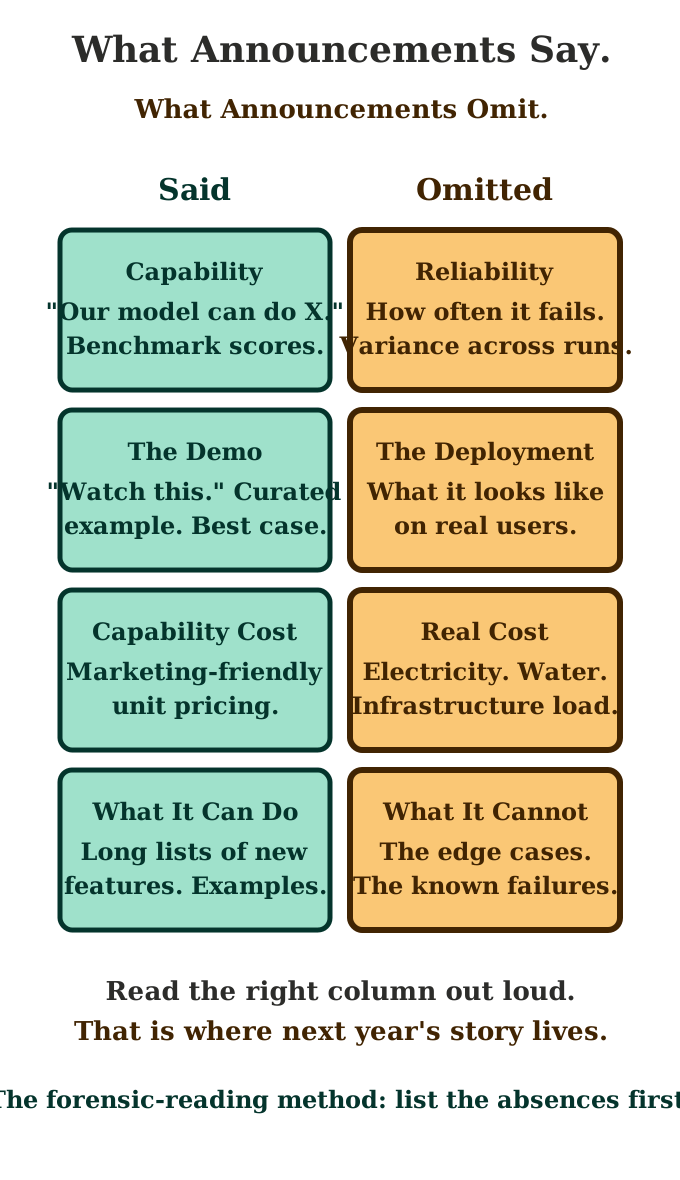
That absent sentence is almost always one of three. About reliability. About cost. About what the model fails at. Train the eye to look for those three categories first.
Readers who notice the absent sentence look at the whole room, not just the body in the middle of it. The body is in every photo of the crime scene. The room is what most observers walk past.
This forensic move generalizes beyond AI to any technical announcement. The press release for any new technology has the same shape. Load up the bright claims. Leave the failure modes for the small print at the bottom or for the reporters to discover later. Reading the absent sentences is a skill that pays out across the whole technology beat.
A specific example helps, one you can still look up. The 2026 announcement of an autonomous coding tool described the languages it covered, the integrations it shipped with, and the developers who tried it. It did not describe the rate at which the tool produced code that compiled but did the wrong thing. That unsaid sentence, the failure mode, is what the next product update will silently fix.
Notice how the pattern repeats. The headline lives on the second floor (completion). The unsaid sentence is on the third floor (decision) or the first (perception). The announcement keeps you on the floor where the announcement is impressive. The reader steps off and checks the other two floors with a flashlight.
The most useful sentence in any AI announcement is usually one of the sentences the announcement chose not to include. The next year of the story lives there.
The three capabilities each have their own reliability curve#
With the layers and the gap and the absent sentence in place, the last move is to read each layer on its own timeline.
Three layers, and they do not progress in lockstep. They are on three different curves.
Perception is the most mature. Models recognize faces, sort photos, read scans, transcribe speech, and search images with reliability that is high and getting higher. The first floor is built and the elevator works.
Completion is the newest and the most uneven. The same model that writes the elegant paragraph for the press release can produce a paragraph the same week that no editor would print. Capable in demos. Unreliable in deployment. The second floor is framed but the floor is not finished.
Decision is barely started. What looks like agency in current AI is mostly scripted completion wrapped in a wrapper that calls the model in a loop. The third floor is a blueprint and a few studs. The elevator does not stop there yet.
Reading the layers on separate timelines tells you which AI announcements are routine, which are real, and which are still mostly marketing. A new perception product is an incremental improvement on a mature capability. A new completion product is a real bet that may or may not work in deployment. A new decision product is almost always a re-skinned completion product running in a wrapper.
Readers who can sort an announcement into the right floor and the right point on the right curve have a calibrated read on what comes next. The reader who treats all three layers as one curve gets surprised every quarter by a thing the curve never promised.
Any household that uses an AI tool at home can run the same calibration. The transcription tool is on the perception curve. The drafting assistant is on the completion curve. The agent that claims to book the trip and pay the bill is a decision-floor product with a perception-floor reliability claim, and the claim does not survive the first attempt.
Those three curves are why AI feels both miraculous and disappointing in the same week. Two of the floors are doing different things at the same time on different speeds.
The method is permanent. The state of AI is temporary#
Here is the closing move.
Whatever is true of AI in 2026 will be wrong in 2027, only a year of drift and already enough to date every specific claim below. The benchmarks will move. The reliability curves will shift. New models will close gaps the post named as durable. Other gaps will open in places the post did not predict. The specific claims in this article have a shelf life measured in months.
But the method does not. The three-layer read works whether the layers are at the points the post described or twenty points further along the curves. The demo-versus-deployment gap exists in every press release that has ever been written, in every technology, since printing was new. The unsaid sentence is a property of the press release as a genre, not of AI as a technology.
Anyone who learns the method learns to read every new AI announcement the same way without re-learning the system every quarter. The system below the method is changing fast. The method itself is older than the technology.
Households at the kitchen table that learn the method can pass it to a teenager choosing a major. The same teenager can pass it to a younger sibling years later when the technology has moved again. The method is portable across the family and across the decade.
AI’s state is temporary. Its method of reading is permanent. Both of those sentences are true at the same time and the post is about holding them at the same time.
You are reading the news in 2026. The headline points at the second floor. The unsaid sentence lives on the third or the first. The capability curve under the headline has a slope, and the deployment always trails a step behind the demo. The three layers will be at different points next year than they are this year.
Read each layer separately. Read the gap. Read the absent sentence. Run the method on the next announcement that arrives at the breakfast table tomorrow morning.
You are reading the news in 2026. The headline points at the second floor. The unsaid sentence lives on the third or the first. The capability curve under the headline has a slope.
Households at the kitchen table that learn to read the layer, the gap, and the absent sentence have a portable tool for the rest of the decade. The next announcement arrives at the breakfast table tomorrow morning. Run the method.
The argument draws on Jensen Huang’s DealBook Summit interview with The New York Times, December 2023, and subsequent benchmark releases through early 2026.


