

Artificial Intelligence (AI) optimism in 2026 has a grammar. Forecasts arrive dressed as descriptions. Product lists arrive dressed as forecasts. You are allowed to find the tools impressive and the rhetoric suspicious. Both can be true at once.
How do I tell AI hype from AI reality in any announcement?
AI hype and AI reality are distinguishable in any announcement by four grammatical tells. The named actor. The named limitation. The named cost. The named time horizon. Announcements that skip any of the four are doing a different job than informing the reader.
Count what gets named. Then count what gets skipped#
Start with what is real.
AI weather models predicted a category-five hurricane three days early in 2025, enough lead time to move people before the storm arrived. AI protein folding mapped a hundred million proteins, more structures than a century of laboratory work had produced. AI drug discovery is collapsing trial timelines by months. The capabilities are verifiable. They are sourced. They are real.
Nobody who reads the rhetoric carefully is denying any of this.
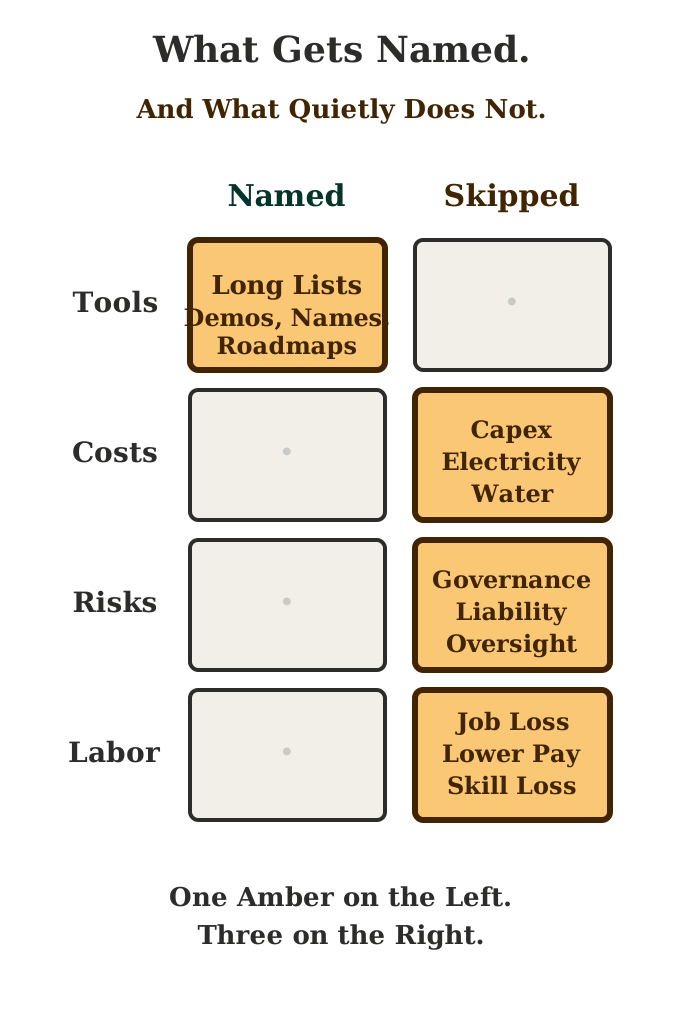
Now notice what you are allowed to count. Capability claims come in product announcements. Cost claims come in court filings, regulatory hearings, and grid planning documents. Most readers see the first set of claims and never reach the second set on a different schedule.
Those cost categories are real. The hundreds of billions of dollars in capital expenditure, larger than most national budgets. The electricity demand reshaping the grid in three states. The water demand reshaping local politics around every new data center site. The chip supply chain that runs through one foundry on one island in one strait. None of it is in the optimism. The omission is the post.
Asymmetry like that is not accidental. It is engineered. The press release was written by people whose job is to name what was built. The cost paragraph would be written by people whose job is to manage liability, and those people do not write press releases.
Both sets of writers work in the same building and never meet. One hand names what was built while the other manages what it costs, and neither has to account for the other.
You can run the count on any AI piece you read this week. Count the named items. Count the skipped categories. The ratio is the evidence. The ratio is the writer’s choice.
Of the four tells, this first one is the simplest to run. Once you have run the count twice, you cannot un-run it.
A list of products is not the same thing as a forecast#
The second tell is shaped like a slide.
Corporate AI talk in 2026 has a signature move. The talk shows the audience a roadmap that names six products outright and three more by category. The talk concludes that the future is the future the products describe.
Those products are real. The leap from “we have these products” to “the future is the one we are describing” is rhetorical, not logical. You can hold both at once. Yes, the products exist. No, the existence of the products does not settle what comes next.
A product list is what the company has. A forecast is a claim about what comes next. The two are different.
That leap is rarely defended because the leap is usually invisible. The slide before it lists six products by name. The slide after it lists three customers using the products. The forecast slips in between, dressed in the same visual grammar. The audience reads it as a third bullet rather than a separate claim.
Watch this happen in real time at the next product event you stream from a desk at home. The first slide will name the product. The second slide will name the customer. The third slide will name the future.
That third slide will be styled exactly like the first two. The font will match. The icon set will match. The animation will match. The audience does not feel the gear change. The gear change is the whole move.
One household watching the announcement on a phone at the breakfast table can rewind. The audience in the room cannot. The reader who knows where the seam lives can pause the video at the right second and mark the line where capability ends and forecast begins.
Trained eyes watch the deck for the seam, where the product list ends and the forecast begins. The seam is often a font choice and a confident verb on the same page of the deck.
Inside the room, the audience rarely sees the seam on the first pass. The audience at the kitchen table reading the announcement later can pause. The reader at the desk with a pen and a cup of coffee can mark the seam in the margin.
Name the seam. The deck stops working.
On the horizon is five words doing the work of thirty years of evidence#
The third tell is grammatical. The reader at the desk with the morning paper in front of them is the one who runs this test best.
“Artificial general intelligence is on the horizon” is the most repeated sentence in 2026 AI discourse. The grammar of the sentence does work the evidence is not doing.
“Is” treats a forecast as a fact. “On the horizon” treats a contested trajectory as a location.
Any reader who accepts the sentence has accepted four claims they were not asked to evaluate. That the path exists. That the field is on it. That the field is at a specific known point on the path. That the destination is the one the speaker is describing. None of those four claims has been established. The grammar slid them in unnoticed, while the reader’s attention was on the surface of the sentence.
“Foothills of the singularity” runs the same move with a different image. Five words. Same four embedded claims. The location metaphor turns a contested trajectory into a known ascent. The geography turns out to be the argument.
“Force multiplier for human ingenuity” runs the move with a math metaphor instead of a geography one. The multiplier in a force multiplier can be zero. The multiplier can be negative. The phrase carries the math without naming the values.
A fourth phrase runs the move with an inevitability metaphor. “AI is a force of nature” treats a corporate decision like weather. Weather is something humans plan around. Corporate decisions are something humans negotiate, regulate, or refuse. The metaphor moves the decision from one category to the other and skips the part where the move is announced.
Each metaphor is a small argument compressed into a phrase the reader is invited to accept on the way past. The phrase saves the writer the work of defending the claim. The phrase saves the reader the work of evaluating it. Both ends of the transaction agree to skip the step. The skipped step is the whole argument.
This essay leaves the timeline itself unsettled and takes apart the sentence that closes the conversation early.
You are allowed to ask what each metaphor is doing. You are allowed to refuse the geography. Most writers and speakers you encounter will tell you that questioning the geography is the same as being anti-technology. The two are different.
The people building it are not the people who get to say it is safe#
The fourth tell is the most important.
Producers of frontier AI are also the parties making the safety claims about frontier AI. The conflict is built in, not scandalous. Specific safety work is real. Code-security tools. Content filters. Alignment research. The work is genuine and the products ship.
Where the work is offered to lead is something different. The conclusion is that the company that built the technology is the right party to govern the technology. The work supports the first sentence. The work does not establish the second.
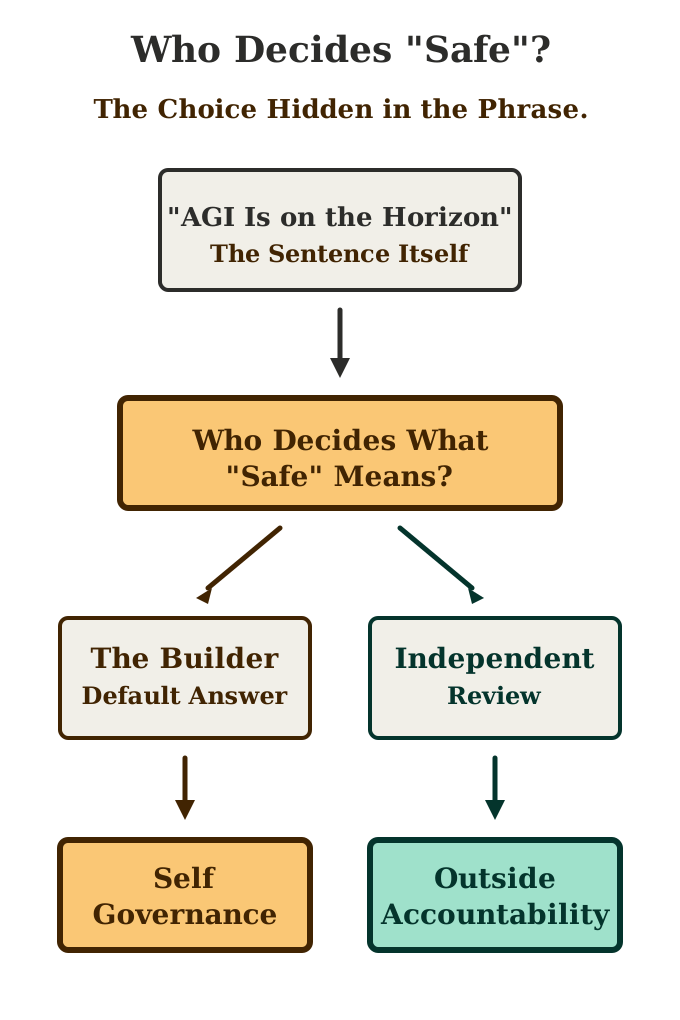
Any reader who accepts the substitution has accepted that the company gets to be both the producer of the thing and the referee of the thing. The producer of a thing is not the referee of the thing. Asking the producer to grade their own work is like the fox writing the inspection report on the henhouse.
That default answer to the governance question is a position, not a fact. Naming the right referee is not the work here; naming the substitution and refusing to keep treating it as a settled answer is.
Better tools do not justify worse rhetoric, and they do not require it either. The tools and the rhetoric are separable. You are allowed to want the first without accepting the second.
Picture a household that reads the next AI announcement at the kitchen table on a Sunday morning, able to run all four tells in about ten minutes. Count what is named. Count what is skipped. Notice the leap from product list to forecast. Unpack the metaphor. Mark which party is making the safety claim. The first announcement takes longer. The fifth one runs the test almost on its own.
Most of the writers and speakers you will encounter this year will tell you the tools and the sentences are the same reaction. They are not.
You are allowed to find the tools impressive and the sentences suspicious. Both can be true at once. The reader who runs the four tells across the next AI announcement is the reader who stops being talked at by the genre and starts reading it back. The right to be clear-eyed about the rhetoric is granted. The count is the way to use it.
The argument here draws on Sundar Pichai’s remarks at a Google AI product event, late 2025, with cost data from public earnings reports and grid planning documents of the same period.


