

A deep-tech Artificial Intelligence (AI) company started in 2026 takes about ten years to mature. Artificial General Intelligence (AGI) arrives around 2030. That puts AGI at roughly year five of a ten-year journey. AGI is not the endpoint. AGI is the mid-point event. The planning consequence cascades through every decision a founder makes today.
How does AGI arrival change deep-tech AI startup planning?
Deep-tech Artificial Intelligence (AI) wins where wrappers lose because AGI arrives in year five of a ten-year journey, not at the end of it. The defensible posture intersects AI with the world of atoms. Materials, medicine, biology, energy, robotics. Same starting line. Opposite finishes.
How does AGI arrival change startup planning?#
Any deep-tech company started today finishes around 2036. AGI arrives around 2030. That places AGI at year five of a ten-year journey, not year ten. AGI is the mid-point event, not the endpoint. The planning consequence is concrete and cascades through every decision a founder makes.
This is for a founder, an investor, an engineer considering deep-tech, or anyone deciding what to build now. The reader who has noticed that the default coverage of “what to build in AI” is split between hype and defense, and that neither framing fits the ten-year horizon.
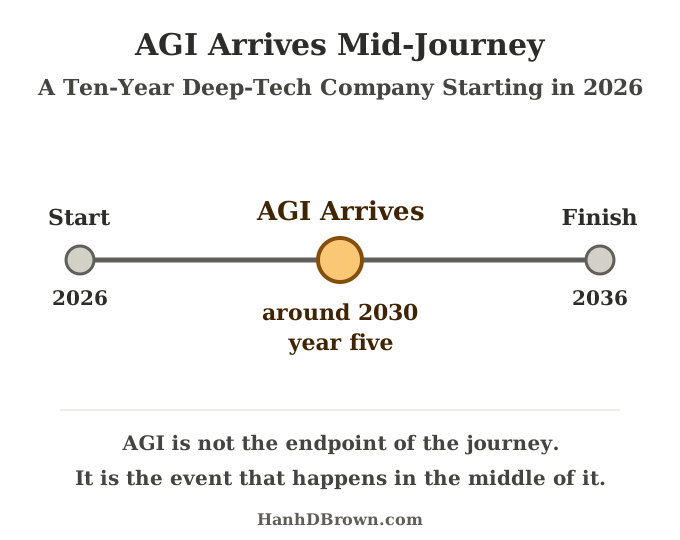
The mid-journey framing cascades. Market choice. Pick markets where AGI’s arrival makes the work easier, not obsolete. Team composition. Recruit people who will use AGI as a tool when it arrives, not people whose value evaporates. Tool stack. Build on layers AGI extends, not layers AGI replaces. Exit bracket. Assume the value of the company changes shape when AGI lands.
Like a farmer who knows the river will flood at year five and plants the orchard accordingly, the founder who plans for mid-journey AGI plants different seeds in different fields than the founder who plans around it. The farmer who plants for the flood gets a harvest. The farmer who plants against it loses the field. The same ground produces opposite outcomes on the same calendar.
AGI could arrive at year three or year eight rather than year five. The mid-journey framing holds inside that bracket. Outside it, the framing breaks in one direction or the other. That bracket is what the people closest to the problem use when they plan their own roadmaps.
A ten-year company built around year-five AGI is a different company than one built for year-fifteen AGI. The market it enters is different. The team it hires is different. The capital it raises is different. The exit it plans for is different.
Call it year five. The decision the founder makes today holds up across all the bracket years, give or take.
Why are AI wrapper companies risky?#
Two companies start in 2026. One wraps an Application Programming Interface (API) around a foundation model and calls itself AI for science. The other combines AI with a deep technology in the world of atoms. Same starting line. Same foundation models. The clock runs forward to 2036 the same way for both companies.
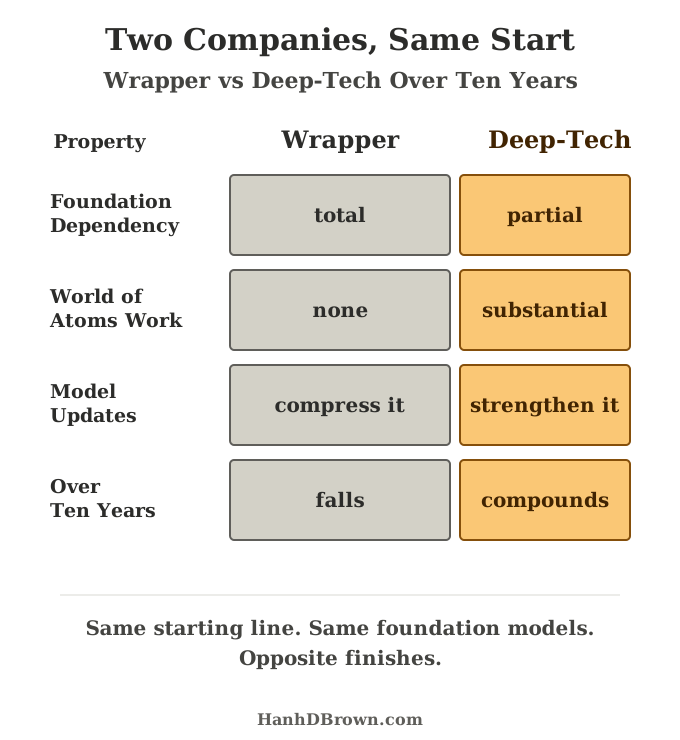
Run the clock and the wrapper has been compressed every year by foundation-model updates that obviated each piece of its moat. The deep-tech company has grown stronger every year, because the same model updates made its specialist tooling more capable. Opposite finishes from identical starting conditions.
Defensible ground is the intersection of AI with another deep technology. Materials. Medicine. Biology. Energy. Robotics. These intersections are the safe ground because the world-of-atoms portion has no shortcut. Foundation models cannot route around physical reality. A molecule does not respond to a better prompt. A patient does not heal because the chatbot improved.
That mechanism runs in opposite directions on the two postures, and the direction is what decides the outcome. The wrapper depends on the foundation model for its entire moat. Every model improvement is either an obviation or a free competitor. The deep-tech company depends on the world-of-atoms work the foundation model cannot do. Every model improvement is a better tool inside the same long-running project.
Like a stall owner whose shelf only sells what the wholesaler ships this week, the wrapper company carries no inventory the wholesaler cannot ship to the competitor next door. The stall stays open while the wholesaler underprices the shelf. The stall closes when the wholesaler decides to sell directly. The shelf was never the value.
The deep-tech company carries inventory the wholesaler cannot ship. A clinical trial in progress. A factory line in calibration. A patent on a molecule. These are months and years to acquire. The model update does not threaten them. The model update makes the team working on them faster. The inventory and the team compound together. The wrapper has neither and cannot build either inside the same time window.
Founders who build the deep-tech side are interdisciplinary. Expert in both AI and the other technology, or part of a founding team that spans both. A foundation-model tourist on the AI side, paired with a tourist on the deep-tech side, will not build the durable thing. Two tourists do not become a guide by sharing an office.
How will AGI use specialized AI systems like AlphaFold?#
AGI does not absorb specialized AI systems. AGI uses them as tools the general system calls when it needs a precise answer. The general system calls AlphaFold for protein folding. AlphaFold returns the answer. The general system handles the language and reasoning around it. The two systems do not merge.
Pouring all of biology into the general model would degrade the model’s language skills. Capacity is not free. The model has to spend somewhere. Specialization stays separate by design, not by accident.
AlphaFold is the canonical example of the factoring. Roughly three million researchers around the world use it for daily protein folding work. The system that the head of Google DeepMind helped build is now the protein-folding tool the general AI calls when it needs an answer. The factoring is not speculative. The factoring is already running today.
Like a workshop that builds a tool a museum still uses a decade later, the specialist who builds the right tool builds something that outlives the surrounding generation. The general AI calls the tool. The tool returns the answer. The handoff is older than software.
Useful AI takes one shape: general-purpose tool-usage models plus specialized tool systems. A deep-tech company that builds the specialist tool builds something the general AI uses across the office, the desk, and the working year. A wrapper builds something the general AI replaces in an afternoon. The factoring decides which kind of company you are building.
What should I build in AI in 2026?#
The founder ethic on offer here is the same one that built DeepMind. In 2010, AI was niche. Investors said it would not work. Academia thought it was a dead end. The founder who had conviction anyway built DeepMind. The same engine that built DeepMind now builds the defensible deep-tech companies of 2026.
Hard problems are not harder than easy ones in aggregate. They are differently difficult. Life is short and the working years are shorter than the life. The right disposition is to put your finite energy on the thing that would not happen without you pushing it.
A parent at the kitchen table on a Sunday morning, choosing what to spend the next decade on, is making the same strategic decision as the founder choosing the next company. Finite energy. Finite years. A small set of problems that will not get solved without that specific person. The household running through the calculation looks like the boardroom running through the calculation.
Whoever builds the deep-tech intersection is expert in both AI and the other technology, or part of a team that spans both. The conviction has to be in both fields. A foundation-model tourist on the AI side and a science tourist on the other side does not produce the durable thing.
That two-companies experiment runs every year of the next decade. Same starting line. Same foundation models. Opposite finishes. The difference is whether the company’s work has a world-of-atoms portion the foundation model cannot shortcut and a founder who can hold both fields.
An investor reading the deck looks at the same two companies and has a harder time telling them apart in year one than in year five. The wrapper looks like the deep-tech company on the slide. The two diverge as the underlying model improves. The investor who reads the divergence early backs the right one. The investor who reads it late funds the wrong moat.
AGI in year five is not a threat to a deep-tech journey. AGI in year five is the leverage that arrives when the journey is half-built. The founders who plan for that arrival win the next decade. The founders who plan around it, or against it, do not.
Source: Google DeepMind, in conversation at Y Combinator, 2026.
Same starting line. Same foundation models. Opposite finishes. The difference is the world-of-atoms portion and the founder who can hold both fields at once. The choice in front of the 2026 founder is which side of that line to land on, and every decision in the next ten years compounds from that one.


