

Powerful countries are not picking the smartest Artificial Intelligence (AI). They are picking the cheapest one to deploy and the easiest one to modify. The default debate covers which model wins a benchmark. The race the world actually runs is which model wins the global distribution layer. Distribution decides the default. The default decides the values.
Why does open weights AI win distribution, and why does that decide whose values win?
Open weights AI wins distribution. The cheapest deployable option becomes the global default in countries without their own frontier program. The values encoded in the winning model become the defaults of downstream Artificial Intelligence (AI). Capability is one variable. Distribution decides whose values win.
The race the policy debate is not having#
Capability is the number every headline keeps score of, and it is the wrong scoreboard for what the world runs. Whose model is smarter. Whose model thinks longer. Whose model wins a benchmark. That race is real. It is not the race the rest of the world is watching.
This is for a policy analyst, a congressional staffer, a technology executive, or an AI practitioner thinking about why “we won the capability race” might still leave the United States losing the global default. The reader who has noticed that the framing and the outcome are pointing in different directions.
One variable decides what most of the world ends up running, and it is a different one. It is distribution. Distribution is being won by the cheaper option. Not the better one. A country without a frontier program does not buy the smartest model. It picks the model it can deploy this quarter at a price its budget can carry.
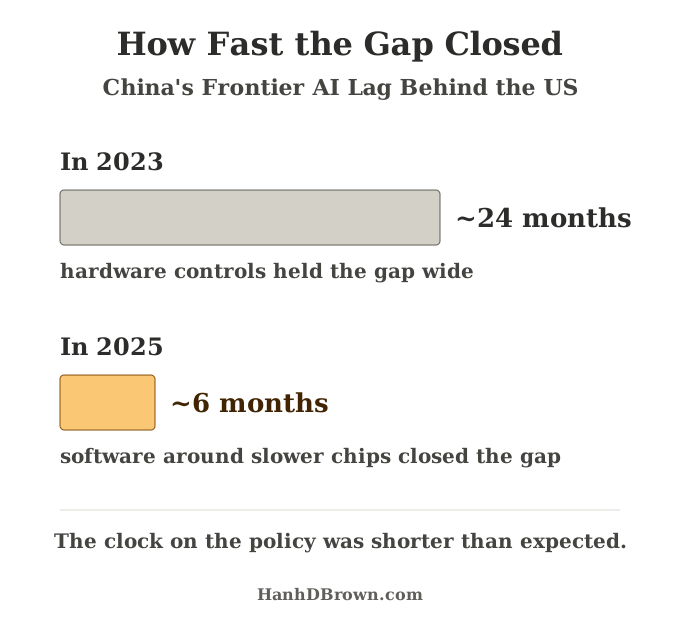
China moved from roughly eighteen to twenty-four months behind on frontier capability down to about six months behind. The compression happened in a single year. The catch-up did not happen by acquiring more chips. It happened by building smarter software around slower chips.
Take the Ascend chip, the headline example. A slower process. Deliberate software workarounds. A working frontier model produced without the hardware the controls were designed to deny.
Chinese builders shipped open weights into the global download channel the same quarter the model became competitive. The DeepSeek release is the public marker of that shift, free to download and free to modify in any office or home with a working laptop. The platform reached the working laptop before the policy debate caught up to the platform.
Hardware export controls were the right policy. They worked for a while. They are now starting to leak. The clock on a policy is shorter than the policy assumes when the adversary innovates around the constraint. That is the lesson the chip story carries past the chip story. The next constraint a policymaker writes will have the same clock attached to it, whether anyone in the room acknowledges the deadline.
Like a textbook the school chose at the start of the year, the model that wins distribution sets the defaults for every student in the building, whether the principal noticed the choice or not. The textbook decides what every child in every classroom reads. The school chose the textbook on one Tuesday in August.
Now the clock has shortened. The race has split into two. The toolkit built for the first one does not fix the second. The reframe is the point of the rest of this piece. A reader who keeps the distribution lens will see the next year of headlines differently.
Open has no phone number#
A closed model is controlled by a company. The company has a phone number. A government can call. The military can call. The company sees every query. The company can update the model. The company can recall the model. An open model has none of those things after release.
The weights are public. Anyone can download them. Anyone can modify them. Anyone can re-deploy them. Once the file is out there is no central operator and no recall path. The same property that makes an open model cheap to deploy in a developing country makes it cheap to weaponize in a basement room.
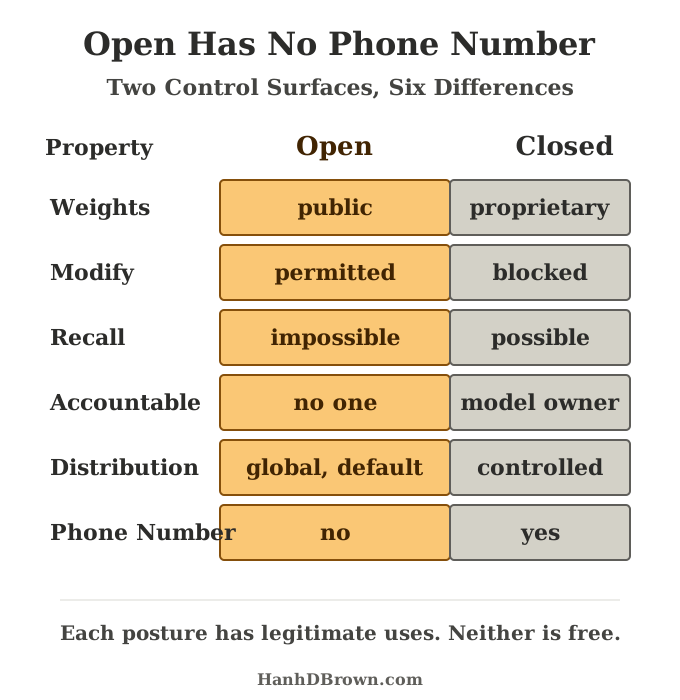
Open and closed are not aesthetic choices. They are different control surfaces. Each has legitimate uses. The geopolitical question is which posture wins the global distribution layer. The answer in 2026 looks like open, the option most budgets can actually afford. Cheap. Modifiable. Shipping faster. The closed posture owns the high end of the benchmark, the open one the laptop on the kitchen counter.
Like a song nobody can pull off the radio after the broadcast, an open model spreads on terms its maker no longer governs. The radio plays the song every hour. The store hears it. The child in the kitchen hears it. The store owner has no phone number to call to make it stop.
A lone actor plus an open frontier model produces a weapon nobody can recall. The risk is not theoretical. It is a feature of the openness, not a bug. The same property does both jobs at once.
The closed-model owner can patch the same flaw in an afternoon. The open-model author finds out the bad version exists by reading about it later. The patch never reaches the copies already running on a million laptops in a hundred different countries. Patched official versions move at press-release speed while the unfixed copies move at the speed of bittorrent.
Distribution wins by default in most of the world. A country buying its first national-scale AI service in 2026 is choosing between a download and a vendor contract. The download arrives by sundown. The contract takes a quarter. The default values follow the model that wins.
Two things called alignment#
Alignment hides two different things under one word. The first is safety behavior. A model refuses to help with suicide. A model refuses to help build a weapon. The first kind is broadly shared across the major builders. The second kind is value style.
Free speech. Rights of women and minorities. The broader Western liberal package. The second kind is contested. A model trained against one value set writes differently, recommends differently, and refuses different requests than a model trained against another. The training is not neutral. No model is. The values ride along with the weights wherever the weights ride.
This is not an argument that the Western package is settled inside the United States. It is the argument that the package most of the world’s parents would prefer their daughters and sons to default to is the version with rights and speech in it, not the version where those defaults are absent.
Every family teaching a child what fairness looks like at the kitchen table is teaching against a default the next generation will inherit from whichever model wins distribution. The mother explaining why a girl in the next village should go to school is doing values work the AI tutor on the kid’s tablet will either support or quietly work against.
The father at the desk reading the news in his second language is reading translations a model produced. The translator was trained somewhere by someone, against a value set the reader had no chance to inspect before the page loaded. The kid reading homework answers off the family laptop is absorbing more than the answer.
If the model that wins distribution is trained against a value set the United States and its allies would not choose, the world’s downstream AI defaults to that value set. Not by anyone’s decision. By the geometry of distribution. Alignment is one word for two jobs. One is shared. The other is being decided this year by whichever model wins the global download race.
The cartel problem, and what beats it#
Multilateral agreements among the small set of frontier builders are necessary and structurally unstable. The Organization of the Petroleum Exporting Countries (OPEC) pattern. The incentive to defect grows with the lead. A signed agreement among ten competitors who share most of the world’s AI capacity is no more durable than an oil cartel.
Whatever makes a small set of oil producers unstable makes a small set of AI builders unstable. The small group can agree on the rules and treat the agreement as binding, but each member holds the unilateral power to walk away the moment defection pays. One builder honors the line for a season, then decides the season is over. The others find out late, after the lead has already been taken.
Abandoning multilateral coordination is not the structural fix. The fix is to build the alternative that does not depend on the agreement holding. A serious American open-weights model carrying Western values. Gemma 4. Nemotron. A handful of startups working on more.
A closed-only American posture loses the global default because distribution beats quality when cost differs by an order of magnitude. A government deciding between two AI systems on a tight budget will not read the benchmark scores in the back of the brochure. The procurement officer in the ministry checks the deployment cost and the licensing terms and the modification rights first.
There is a real question about whether a serious open-weights frontier model can be made safe enough to release. The question is not whether the release is risky. The question is whether the risk of not releasing one is larger than the risk of releasing one. That tradeoff is the work.
That work has a clock attached to it. A working American open-weights alternative shipped in 2027 changes the global default. A working alternative shipped in 2030 changes nothing the schools and households that adopted the 2027 default have already absorbed.
Whichever model wins this year educates the kids who graduate in five. The mother teaching the daughter at the kitchen table this year is teaching against whichever model came down the wire first. The clock is the work and the work is the clock. A working alternative in the right window changes what the next decade of downstream AI is built against.
Capability is one variable. Distribution is the other one. The country that wins distribution sets the global default. The United States has the capability question mostly handled. The distribution question is not yet.
The argument draws on Dr. Eric Schmidt, chair of the Special Competitive Studies Project (SCSP), in conversation with Tom Shanker, 2025.


