

The chips built to make video games look real became the engines of modern Artificial Intelligence (AI). That part you may know. The newer turn is stranger. Those same chips now train machines to move, and the machines learn in a world that does not exist yet.
This is a field guide to physical AI. Not the chatbot kind that writes. The kind that drives a car, sorts a warehouse, and walks across a room. The surprise is where it goes to school.
What is physical AI, and how do robots learn to do it?
Physical AI is software that acts in the real world: robots, self-driving cars, autonomous machines. The trick is that they learn in a simulated world first, running millions of practice trials in hours. The same scaling that taught chatbots to write now teaches machines to move.
What is physical AI?#
Most AI you have met lives on a screen. It writes, it answers, it draws. Physical AI is the next category over. It is software that acts in the world with a body, a robot on a floor, a car on a road, a machine in a warehouse.
The bet behind it is simple to state. The same approach that taught a model to handle words and images can teach a model to handle action. Words in, sentences out, became photos in, captions out, which becomes a goal in, motion out. The kind of data changes. The method does not.
That is why the people who built the writing models are now chasing the moving ones. They think the last ten years were the science of AI, and the next ten are the application of it. Pointed at biology, at weather, at farms, at factory floors. The same engine, aimed at the physical world.
Experience is the fuel. Data is just experience in digital form, and a model can learn almost any kind of it. It takes in words, images, and sounds. It can take in the folding of a protein, or the path of a hand reaching for a cup. Turn one into another, and motion becomes one more language the model speaks.
The headline forecast is blunt. Everything that moves becomes robotic, and sooner than feels comfortable. Cars, mowers, carts, and the humanoid robots that have lived in films for decades. Treat it as a bet. Not a calendar. The leap may take years to arrive. The last big leap took a full decade to pay off.
So physical AI is not science fiction with a new coat of paint. It is the claim that motion is just another thing a model can learn, if you can feed it enough practice. Which raises the real question. Where does a robot get a million tries.
How do robots learn in a simulated world?#
Here is the part that flips your intuition. A robot does most of its learning somewhere that is not real. It practices inside a simulated world, a physics engine that knows about gravity, friction, and the way a box tips when you push its top corner.
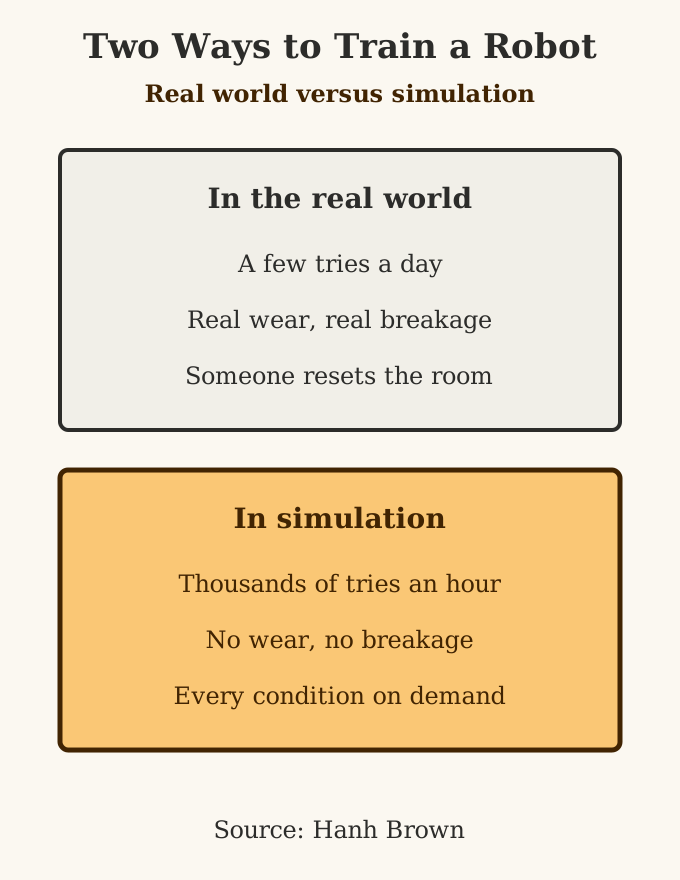
Think about why that matters. A robot learning in the real world gets a few tries a day. It wears out parts. It breaks things. It needs people to reset the room. A robot learning in simulation runs thousands of trials before lunch, in rain, in glare, with the aisle blocked, with the aisle clear.
Like a pilot who logs a thousand storms in a simulator before flying through a single real one, the machine builds its instincts where mistakes are free. The crash costs nothing. The lesson still sticks. Then it steps into the real world already seasoned.
For the simulation to teach anything, it has to obey the rules of the world. Gravity has to pull. A dropped object has to fall. A thing you stop looking at has to stay where you left it. That last one, object permanence, is the kind of plain physical sense a body needs and a chatbot never did.
The trials add up fast. A real robot might get fifty tries a day. A simulated one gets fifty thousand. It practices the night shift, the spill, the crowded aisle, all before morning. Volume is the teacher here. A machine that has seen a million versions of a task stays calm when the millionth arrives.
There is a clean parallel to the writing models. A chatbot makes things up until you ground it with a real document. A moving model makes things up until you ground it with real physics. Same fix, different anchor. Ground the model in truth and the guessing stops.
One disclosure belongs here. The simulation tools at the center of this story, a physics engine and a world model, are Nvidia’s own products, Omniverse and Cosmos. The case for physical AI is being made by the company that sells the chips and the software to build it.
The technique itself is real, and not theirs alone. But the specific products, and the talk of soon, are the vendor’s bet. Treat the method as general. Treat the pitch as a pitch.
So the schoolhouse for physical AI is a simulator. Build a faithful world, run the machine through it a million times, and ship the lessons into a body. The robot arrives on its first day already knowing the room.
Why did parallel computing make modern AI possible?#
None of this works without a particular kind of chip. To see why, picture two machines painting a wall. One holds a single brush and paints one stroke at a time. The other has a hundred nozzles and sprays the whole wall in one pass. The first is a regular processor. The second is a graphics processor.
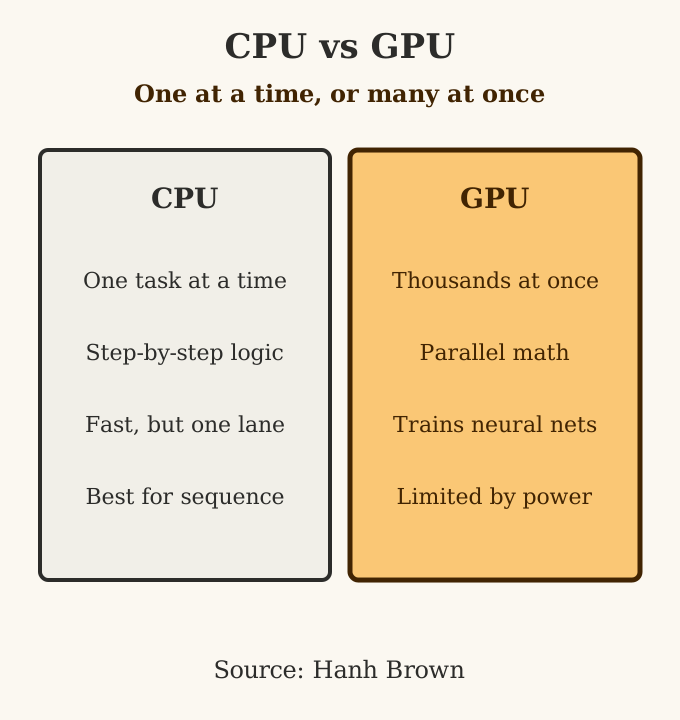
Most programs spend almost all their effort in a small slice of work that can be split up and run at the same time. A regular chip does one step, then the next, in a line. A graphics chip does thousands of small steps at once. Like a tollbooth with one lane open versus twenty, the cars get through at completely different speeds.
For years those parallel chips just made games look good. Then researchers noticed the math that trains a neural network is the same kind of math that draws a game, thousands of small sums at once. They reached for the graphics card. The training that used to take a season took days.
The turning point arrived in 2012. A network trained on those chips crushed an image-recognition contest, and the lesson landed hard. You no longer had to instruct a computer step by step. You could train it on examples and let it learn the steps itself. That single result redrew the next decade.
It is worth sitting with how strange that is. A whole industry of game cards, bought to render explosions and racetracks, turned out to be the exact machine that intelligence needed. Nobody planned that. The buyers were teenagers. The payoff was a new kind of mind.
So the chips were not built for AI. AI was the thing those chips turned out to make possible. The brush became a sprayer, and the whole picture changed.
What is the real limit on AI computing?#
Strip away the hype and one hard wall remains. Energy. Every thought a machine has costs power to flip and move bits, so the amount of thinking you can do is capped by the electricity you can feed it. Not by imagination. By the meter on the wall.
Like a town that can only run as many lights as its one power plant allows, an AI system can only think as hard as its energy budget permits. Add more plants and you can light more streets. Hit the limit and the lights dim, no matter how clever the wiring.
That is why efficiency is the whole game. The claim is that the energy efficiency of this kind of computing has improved enormously over the last several years, by a factor that sounds almost made up. Treat the exact number as a vendor figure, not a measured constant, because no one says efficiency per what, on which job. The direction is real even when the denominator is fuzzy.
Here is the twist people miss. Better efficiency does not shrink the total power bill. It grows it. Cheaper thinking makes people want far more thinking, so the appetite climbs faster than the savings. The efficiency is chased precisely because the goal is more computation, never less.
There is a second limit worth naming, and it is humbler. No single idea stays on top for long. The method that wins today gets replaced in a few years, so it is a mistake to burn one model permanently into the hardware. Keep the chip flexible. Build for the method you have not yet invented.
So when you read the next breathless forecast, ask the energy question. Where does the power come from. The ceiling on this whole story is not cleverness. It is the grid.
Will AI and robots take the work?#
This is the fear under all of it, and it deserves a straight answer rather than a pat one. When machines do more of the doing, what happens to the people who did it before. The honest reply has two halves, and you need both.
The first half. When the drudgery of important work drops toward zero, whole new economies tend to appear. When the interstate highways went in, they did not just speed up trips. They spun up suburbs, gas stations, diners, and motels, a map of new work nobody had drawn before. Cheap effort does not only do the old jobs faster. It creates jobs that could not exist before.
The second half is grittier, and the forecasts skip it. The new work does not show up in the same town, or the same year, as the old work disappears. That gap is where a career stalls and a household feels the squeeze. The matching problem is the real problem, and it is a planning task, not a slogan.
There is a calmer way to hold the worry. Being surrounded by tools far stronger than you in narrow ways does not make you useless. It raises the ceiling on what you can attempt. The strong tool is a lever, not a replacement, as long as you stay the hand on the lever.
So the answer is not take or keep. It is shift. Some tasks leave. New ones arrive. The people who do well move toward the new work on purpose. They do not wait for the old work to vanish under them.
How should you start using AI now?#
After all the robots and chips, the practical advice is almost dull. Get an AI tutor. It costs little and asks nothing. Use it to learn whatever you want. The barrier just dropped. The tool will even teach you how to use it, if you simply ask.
That last part is the trick people miss. If you do not know where to begin, type that you do not know how to begin, and ask it to show you. The tool teaches you to use the tool. No prior computer ever did that for the person sitting down at it for the first time.
Then point it at your own work. Every generation has a defining question. The last one was how to use a computer to do your job better. The new one is how to use AI to do your job better. Pick one task you do every week and ask that question out loud.
Asking well is itself a skill, closer to asking a sharp question than to typing keywords. The clearer the request, the better the help. That skill rewards practice. Practice is free.
The price of entry is falling fast, too. The machine that cost a quarter of a million dollars a few years ago is shrinking toward the price of a good laptop. When a real AI computer fits on a desk and costs what a phone costs, a student can own one. A school can fill a room with them. The tool stops being a thing only giants hold.
This is where it comes home. A parent and a child can sit at the same table with the same tutor, the child learning fractions, the parent learning to use the thing at all. The tool meets each of them where they are. The family that treats it as a teacher, not a toy, keeps the part that compounds.
Source: Nvidia, in a “Huge Conversations” interview, 2025.


