

For thirty years, every venture firm in the country was sized for the same number. About fifteen technology companies a year would cross one hundred million dollars in revenue. The number was the assumption underneath every design choice the industry made.
Why does the old venture capital model not fit the AI era?
Venture capital and AI mismatch on scale. The old VC model was sized for fifteen winners a year. The AI cohort produces a thousand candidates a year and one model retraining cycle resets the field. The firm shape that worked for SaaS does not hold here.
The assumption that capped the whole industry#
For thirty years, every investment strategy at every venture firm in the country was tuned for one number. About fifteen technology companies a year would ever cross one hundred million dollars in revenue.
The number was historical. The data supported it. The data was also backward-looking.
When software started eating the world, a small group looked at the same data and arrived at a different number. Every interesting new company was going to be a technology company, which meant the realistic figure was closer to two hundred a year.
No firm in the old shape could stretch to fit a thirteen-times-bigger market. The firms were not underfunded. The firms were under-designed.
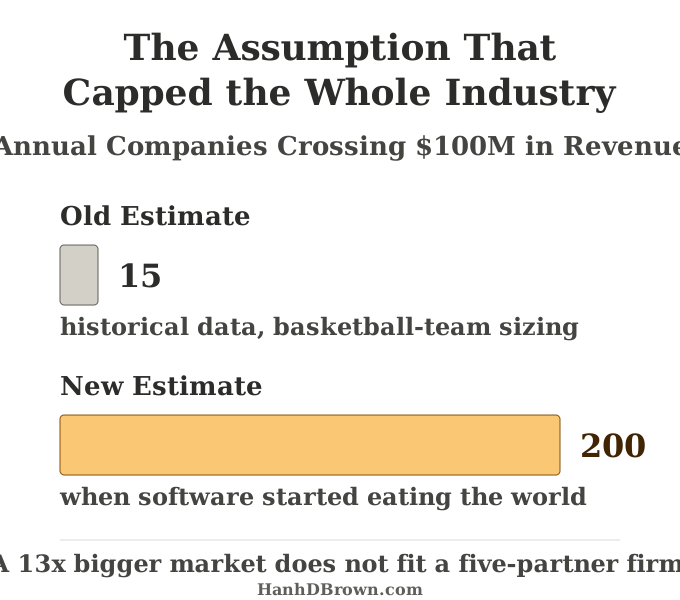
The dominant industry sizing was a basketball team. Five partners, one off the bench. At that size, a firm can invest in fifteen companies a year with care. It cannot invest in two hundred.
The firm sat on the field like a basketball team on a soccer pitch. The team is excellent at basketball. The field is wrong. The team plays its game while the rest of the field plays a different one, and the score gets harder to read.
This is a story about institutional design. The reader is an operator, a founder, or a builder of any institution who has wondered why some organizations can change shape and others cannot. The size of the venture industry was a design choice, not a fact of nature. Every other piece of this post is a downstream effect of getting the choice wrong, or right.
The firms that adopted the new number had to rebuild themselves from the inside. The firms that kept the old number kept the old shape. The old shape is what froze them in place.
Share economics. Centralize control#
Once the assumption shifted from fifteen to two hundred, the firm had to scale. The old design could not scale because the old design had a structural trap inside it.
In a traditional partnership, every partner has a vote on structure. Reorganization is impossible because reorganization redistributes power. Nobody votes against their share.
The firm freezes in whatever shape it had on the day the partnership was signed. Shared control sits like a doorstop wedged under the door of every change the firm needs to make. The firm can still operate. The firm cannot move.
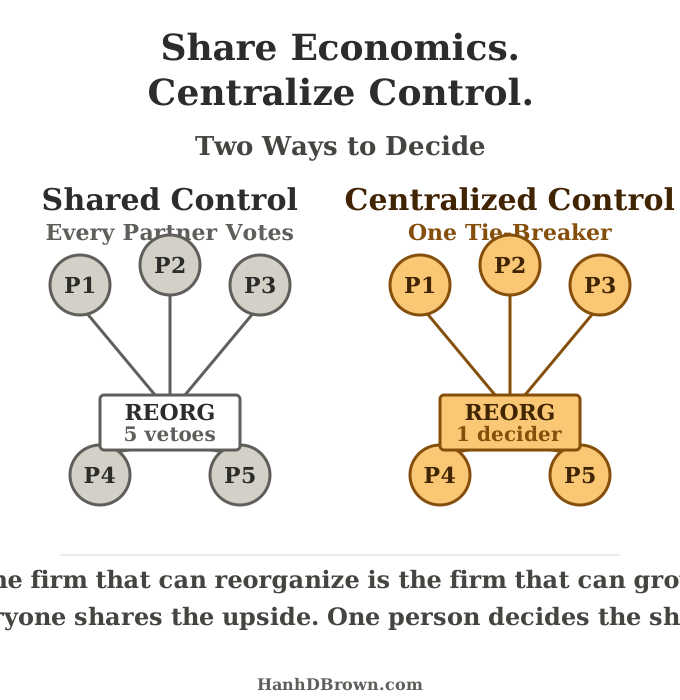
The fix sounds boring. Share economics. Centralize control. One person decides the shape of the firm. Everyone shares the upside of the firm’s performance.
The boring sentence is the entire move. A firm that splits the upside but keeps the structure decision with one person can reorganize. A firm that puts the structure decision to a vote cannot.
This rule extends past venture firms. Companies need a tie-breaker. Co-chief-executive arrangements collapse under their own decision latency. Decisions slow when no one breaks ties. Organizations move at the speed of their slowest tie-breaker.
The most important sentence in any organization is the one that names who breaks ties. Get that one right and the rest of the design can flex. Get it wrong and no amount of talent will save you.
The household that runs on co-equal vetoes between two spouses on every household decision knows this rule from inside. Some decisions need a single owner. The rest can be a shared pool.
Investing is a conversation. Conversations have a seat limit#
A firm that scales by adding partners runs into a different problem. At some size, the decision room stops being a conversation and becomes a presentation.
A real truth-seeking conversation tops out at about seven people. With good chemistry you can push it to eight. Without good chemistry you cannot get to five.
Beyond the limit, the room is no longer a conversation. It is a presentation. You can get to a decision in a presentation. You cannot get to truth.
Most decision-making bodies refuse to admit this limit. They keep adding people to the room as the stakes go up. The result is a room that looks important and decides badly.
The fix was structural. The firm did not hold one big partner meeting. The firm split into small specialized groups, each addressing one part of the market. Each group stayed under the seven-person limit.
The firm grew sideways, by adding groups, not upward, by adding seats. The shape of the firm matched the shape of the work it was trying to do.
This is the move every growing institution either makes or fakes. The firms that fake it by adding chairs to the room get louder, not better. The firms that make it by adding rooms with seven chairs each get more decisions made well.
The fix scales because the firm chose to grow by adding small rooms rather than enlarging the big one. Five small rooms with seven people each will outperform one room with thirty-five people every time. The thirty-five-person room can produce a slide deck. The five seven-person rooms produce five decisions, each with a chance of being right. Five right beats one impressive.
Investing is a conversation. Conversations have a seat limit. The firms that respect the limit can grow. The firms that ignore it only get louder.
The household that has tried to plan a family vacation with eleven aunts, uncles, and cousins on a single video call already knows the rule from the inside.
Companies are not countries#
The last piece of the redesign is governance. A company can run on benign dictatorship. One person breaks ties. The organization moves quickly. The structure stays nimble.
A country cannot, because a country must outlast bad leadership. A king is great for a country if the king is good. A king is unsafe across centuries because the next king might not be. The two structures serve different timescales.
A company does not have to last centuries. A company can be a benign dictatorship while the sun is shining. The risk of bad leadership is real, but it does not justify importing a country’s slowness into a company’s daily decisions.
Most organizations import democratic-feeling governance into contexts that need speed. Some import fast governance into contexts that need resilience. Both mistakes are easy to make and hard to undo once the rule book is set.
Inside the benign-dictatorship structure, the culture is whatever people actually do. Not what they say they believe. Whether they come to the office. Whether they respond in an hour or a week. Whether the best idea wins or the founder’s does. The poster on the wall is downstream of every one of those choices, and it cannot steer them.
The household with a values list taped to the refrigerator and a different set of habits in the kitchen knows the rule from inside too. Behavior is the culture. The list is downstream.
When the new firm started designing this way, the competitive response from the incumbents was to call it marketing. The label was a refusal to look. It also protected the new firm from imitation for almost a decade. The firms that called it marketing went on looking like basketball teams while the market filled in around them.
The old design produced fine returns and a poor product. The new design produced fine returns and a different product entirely. The lesson is not that the old firms were bad. They were built for a market that no longer existed.
The choice of governance is a choice of speed against safety. The startup chooses speed because the alternative is irrelevance. The thousand-year republic chooses safety because the alternative is collapse. Both are right for what they are. The mistake is the company that imports country governance to look serious, or the country that imports company governance to look agile. Both look wrong.
The firms that refused to redesign lost ground steadily, then suddenly. The household whose retirement is allocated to one of those firms is watching the same arc from the outside.
The shape of the firm decides what the firm can do. The old shape was sized for fifteen winners a year and could not change. The new shape was sized for the market that arrived and could keep changing as the market kept moving.
The choice of design is the choice of futures. The firm that picks the wrong shape ships fine returns and a poor product. The firm that picks the right shape ships fine returns and a product that holds attention into the next market shift. The shape is the bet.
The argument draws on Ben Horowitz in conversation with Anj Madhushree at Stanford University, 2025.


