

You have probably pictured these models as glittering minds. Quick, fluent, a little uncanny. The picture is wrong in one important way. The real engine is not brilliance. It is a vast, invisible store of data, a black hole at the center of the galaxy of skills.
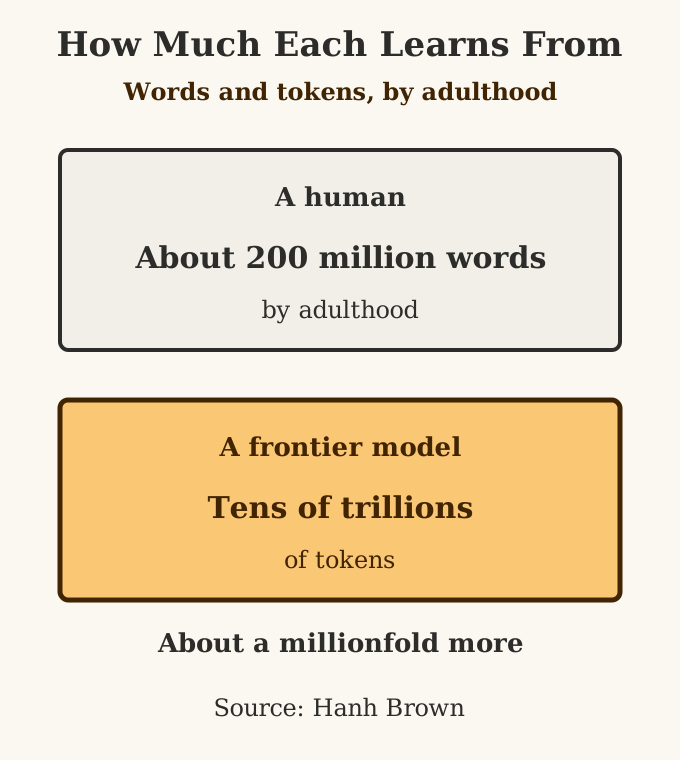
Here is the number that reframes everything. By adulthood a person has taken in roughly 200 million words. A frontier Artificial Intelligence (AI) model trains on a millionfold more. The gap is not how smart. It is how hungry.
Why do AI models need so much more data than humans?
AI sample efficiency is how little data a system needs to get good at something, and here AI loses badly. A model trains on roughly a millionfold more data than a person sees in a lifetime. The gap is data, not raw intelligence, and it decides what AI can automate.
Why do AI models need so much more data than humans?#
Start with a cleaner word for intelligence. Sample efficiency. It means how little practice you need to get good at a thing. A child hears a new word a few times and owns it. A model needs the word in millions of sentences first.
That is the quiet truth under the boom. The recent gains did not come from models that learn more per example. They came from more data, and more computing power to make and sort that data. The skill went up because the pile of examples went up, not because the learner got thriftier.
Consider what it takes to teach a model one office skill, like cleaning up a document well. People are paid to write out the steps, the judgment, the worked examples, hundreds of experts per skill.
Learning that one task the model’s way would take a person decades of classes with a room full of professors. Like a student who needs a thousand textbooks to absorb what one good lesson teaches, the model gets there, but only by sheer volume.
How does a lab make all that data? Often by spending raw computing power to generate it. One method, reinforcement learning, is really a way to manufacture examples. The model tries a task many times. A grader scores each try. The good tries become new training data. The bad ones are thrown out.
To make it work, the system runs hundreds or thousands of attempts per task, just to sort the wins from the losses. It is brute volume, not insight.
And the model needs a fair chance of stumbling onto the right answer first, which means it needs piles of expert examples before it can even begin.
There is a name worth borrowing for what comes out. A patchwork. The model is stitched together from a billion grafted examples, not raised the way a person learns a craft from a few. It performs the skill. It did not exactly learn it the way you did.
And the hunger does not end after the first training. Each new skill demands its own mountain of examples. A capable person picks up a new programming language over a weekend, no hundred professors required. The model cannot. It needs the mountain again, every single time.
Does data or architecture drive AI progress?#
The natural assumption is that the magic lives in the design, the clever architecture and the secret training tricks. The evidence points the other way. The driver is mostly the data.
Here is the clean tell. As of 2026, open models trail the very best closed ones by only about four months, a gap that has been narrowing year over year. Think about what that means. If the edge came from architecture secrets and training know-how, the kind of thing that is hard to copy, the laggards could not catch up that fast.
Data is the part that copies easily. You can distill it cheaply from a public service, question by question, answer by answer. So a world where the followers are only a season behind is a world where the thing being copied is the data, not the design. The secret sauce turns out to be the groceries.
This is why a whole industry now sells training data and the rubrics to grade it, earning billions a year and climbing toward tens of billions. The money follows the real bottleneck. The bottleneck is not a smarter network. It is more of the right examples, written and scored by people.
Watch where the money goes, because it marks the real bottleneck. A whole industry now sells training examples and the rubrics to grade them. It is one of the fastest-growing businesses in all of AI.
Nobody pays that kind of money for a clever network diagram. They pay it for more of the right examples, written and scored by people. The groceries cost more than the recipe. That is the tell.
The takeaway for anyone running a business is sharper than the science. If data is the engine, and data copies, then the model you rent is not your advantage. The data you alone own is. Build on the part competitors cannot simply distill away.
How big is the data gap between humans and AI?#
Put real figures on it. A person hears about 2,000 words an hour, which adds up to roughly 200 million words by the time they are grown. A frontier model trains on tens to hundreds of trillions of tokens. Set those side by side and the difference lands near a millionfold.
The same gap shows up away from words. A teenager learns to drive in about 20 hours behind the wheel. A self-driving system trains on three to four orders of magnitude more driving than that to reach the same road. In robotics it is the same story. Even millions of hours of recorded demonstrations are not enough for the open-ended jobs.
The money side makes the gap vivid. Teach a robot arm a task by hand and it picks it up in hours. If a model could match that pace, robotics would become a deca-trillion-dollar field almost overnight, an army of cheap machines doing real work. It cannot match it yet. The arm is patient. The model is hungry. That distance is the whole story.
Like a reservoir the size of a sea built to water a single garden, the machine pours in an ocean to grow what a person grows from a cup. The output can look the same. The intake is on another scale entirely.
If anything, the comparison is kind to the machine. The model must grind through tasks that are both far more numerous and each one harder than the tally suggests. The headline number understates the real distance.
So when a model dazzles you, hold both thoughts at once. The result is real. The amount of fuel it took to get there is almost beyond picturing. That is the black hole doing its quiet work.
Can bigger AI models fix the sample-efficiency gap?#
The hopeful reply is always the same. Just make the models bigger. It is worth taking seriously, and three versions of it deserve a fair hearing before the math weighs in.
First objection. Evolution pretrained us, so the comparison is unfair. It does not hold. The human genome is about three gigabytes, and only a sliver codes for anything. That is far too small to store the wiring a brain builds within one lifetime. Evolution set the dials, not the finished mind.
Second objection. People learn from sight and sound, not just words, so of course we need fewer words. That one breaks too. People who are deaf or blind take in far less of one channel and remain fully, generally intelligent. The extra senses are not the secret of human thrift.
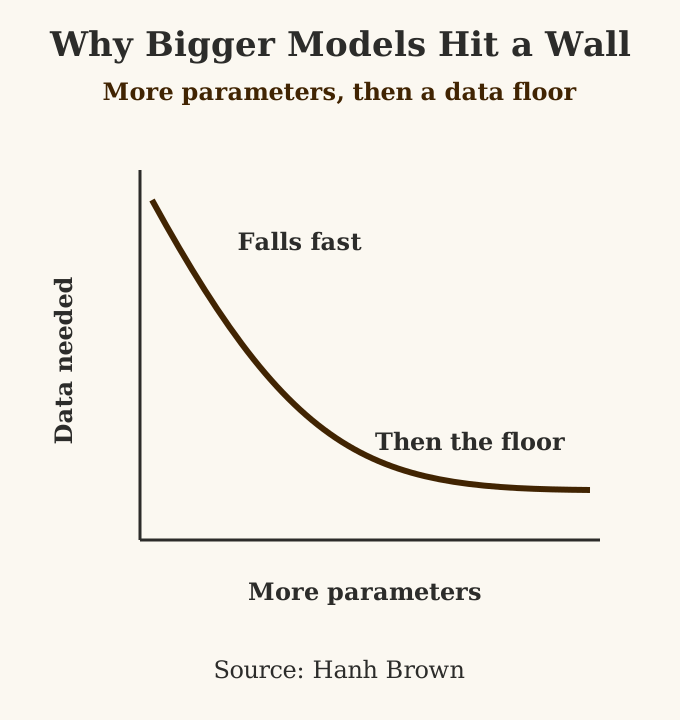
Third objection, the serious one. Scaling. On the standard scaling math, adding parameters lowers the error, but the data term sets a floor that more size cannot lift. Push the parameter count enormously and you buy only a modest, bounded cut in the data needed. Treat that as an illustration, since the exact factor depends on the constants. It is nowhere near a millionfold.
There is a sharper way to see why size is not the fix. The brain runs on something like 100 trillion connections, far more than a frontier model carries in parameters. Yet the model still needs vastly more data, and it learns far less flexibly. So raw size is plainly not the missing piece.
Evolution did not hand us a finished mind either. It handed us a recipe. The recipe is tiny. Each brain still wires itself from scratch in a single lifetime.
So the cheerful fix runs into a wall. Bigger helps a little, then stops helping. Humans, meanwhile, sit on a different curve altogether, learning fast from almost nothing. We are not a small version of these models. We learn in another regime.
What does the AI data gap mean for jobs and AI research?#
Here is where the abstract number meets the paycheck. If the bottleneck is data, then the jobs at risk are the ones whose data is easy to gather and grade. Repetitive, predictable, in-distribution work. The kind a lab can cheaply pour into training, the way bank-teller and travel-agent work was automated long before any chatbot.
Which jobs sit in the line of fire? The ones whose work repeats in predictable ways, where the right answer looks the same each time. The routine middle of clerical work fits: standard forms, standard summaries, standard lookups. That output is cheap to collect and easy to grade, so it is cheap to pour into training.
The jobs that resist are full of judgment calls and odd exceptions, problems that never repeat the same way twice. Two people can share a title and face very different odds. It depends on how much of the day is routine. So the real question is not whether your field is safe. It is how much of your work is predictable.
Software engineering is the opposite kind of work. Every day brings a problem the model never saw, far off the edge of its training. So a reasonable bet is that demand for human engineers in 2028 is higher than today, not lower. The tool makes each person faster, a complement rather than a replacement, at least while the gap holds.
Now hold the tension honestly. The same inefficiency that looks damning is also why this all pays. A person cannot read all of the world’s code before becoming useful. They run out of years. Like a furnace that wastes most of its heat and still warms the whole house through winter, the model burns absurd amounts of fuel, then earns it back across billions of uses.
That is the real shape of the threat, and it is not brilliance. It is scale and tirelessness. The machine does not out-think you. It does the gathered-up, gradeable parts of the work cheaply, forever, without sleep.
There is a second plan worth naming. The labs have two big goals. Automate white-collar work. Then automate the research itself. The hope is that once AI can do the research, it will crack the efficiency problem people never have. Maybe it works. No one knows the date, or even good odds.
And the popular picture of a sudden explosion, where a god pops out the other end, is too clumsy to trust. The honest answer is that nobody knows yet.
The other half is money, and it is why none of this stops. A wasteful process that scales still beats an elegant one that does not. Train the model once. Reuse it across billions of sessions. The waste gets spread so thin it disappears into the margin.
So the move comes home to a kitchen-table choice. A parent steering a child toward a field, a worker deciding what to learn next, should not ask what AI can do. They should ask what stays off the training pile: the judgment, the new problem, the work no one has scored yet. Aim there, and the millionfold engine becomes your tool, not your replacement.
Source: Dwarkesh Patel, essay “The data black hole at the center of AI,” 2025.


