

There was a month the corrections stopped. For a year the coding tools were helpful and wrong in turns. I would ask for a chunk of code. I would get something close. Then I would open it, read it, and fix the parts that were off. That was the rhythm. Help, then patch. It felt like working with a fast, careless intern at the next desk.
Then the patching ended. I kept asking for more, and the work kept coming back fine. I cannot remember the last time I corrected it. The machine stopped needing me, and that was the unsettling part. This piece is about what that shift does to the job. The floor rose for everyone. The bar did not move, and the bar is now yours.
What is agentic engineering, and who holds the quality bar when agents write the code?
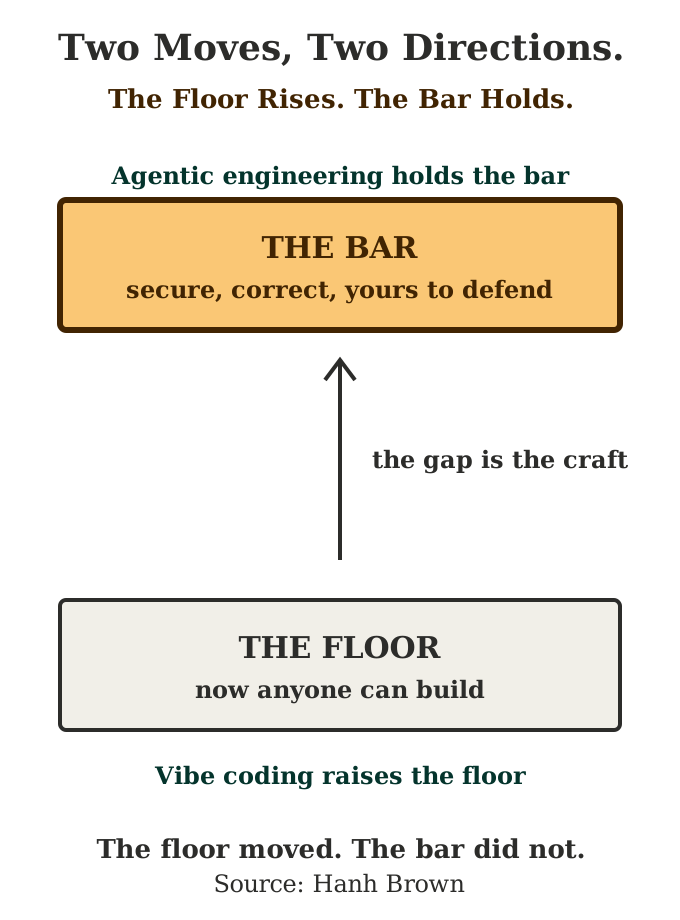
Agentic engineering is keeping the quality bar when coding agents write the code. Vibe coding raises the floor so anyone can build. You still own the spec, the taste, the oversight, and the understanding. The typing is handed off. The responsibility is not.
The month the corrections stopped#
For a year the help came in chunks. Good chunks, then a broken one. I would read each one and fix it by hand. The keys clicked. The coffee went cold. The intern at the next desk was fast and a little reckless.
Then it changed. I asked for more, and the work came back clean. I asked again. Clean again. The hand on the keyboard slowed down because there was nothing left to fix.
That sounds like a win. It also felt like a floor tilting under my chair. The thing on the screen no longer needed me to catch its mistakes. A person can feel behind in a room where the machine stopped asking for help.
Here is what I want you to take from the moment. The skill of typing code well got cheap fast. The skill of knowing what to build, and whether the build is sound, did not. One of those is now done by the tool. The other one landed on your desk, heavier than before.
So the real question is not whether the machine can write the code. It can. The question is who keeps the standard once the typing is free. That is the whole piece. That is the job now.
The program is now the prompt#
For a long time, building meant writing explicit rules by hand. Then it meant training a model on data, so the weights learned the rules instead. Now there is a third way. You write a prompt. You fill a context window. The model reads it and does the work, like a computer you program in plain words.
That sounds abstract until an app you built disappears in front of you. A friend made a small tool that turns a restaurant menu into pictures of the dishes. You upload a photo. It reads the titles off the page. It generates an image for each item. It runs on a server. It took real code.
Then the new way arrived. You hand the photo straight to the model. You ask it to draw the dishes onto the menu. It returns your exact photo with the food rendered into the pixels. No app in the middle. No server. The whole tool he built was suddenly spurious. The thing should not exist anymore.
That is the part people miss. This is not just the old work done faster. New things are possible that could not exist before. You can hand a pile of documents to a model and ask for a wiki, and get a clean reordering of facts that no program could have produced. The output is a thing that had no code at all.
Like a power tool in a carpenter’s hand, the model cuts faster than any blade. The carpenter still has to aim it. The saw does not decide where the cut goes. The wood, the bench, the pencil line, the eye, those stay with the person holding the handle.
So the program is now the prompt and the context. Your lever is the words you give it. That changes what you write down, and it changes who is doing the thinking.
Brilliant at the hard test, lost at the easy one#
Here is the strange part. The same model that refactors a hundred-thousand-line codebase will give you a dumb answer to a simple question. Ask it whether to drive or walk to a car wash fifty meters away. It tells you to walk, because the place is close. It misses that you are taking the car to wash the car.
That is jaggedness. The intelligence is spiky. It peaks on hard, checkable work and stumbles on the obvious.
The reason is in how these models are made. Labs train them hard on tasks that can be verified, like math and code, where a right answer can be scored. Capability climbs steeply there. It stays rough on everything left out of the mix. Some of the jaggedness is just what a lab chose to put in front of the model and what it skipped.
One case stuck with me. Chess got much better in a single model jump. The cause was plain: someone had poured a pile of chess games into the training data. The skill was there because a person chose to add it. That is most of the story behind which problems an agent handles well and which ones it flubs.
So you are at the mercy of a map you cannot see. There is no manual that tells you which streets are paved. If your problem sits inside the well-trained ground, you fly. If it sits outside, you are pulling teeth, and the gross output that comes back is the warning sign.
This is the practical reason a human stays in the loop. You cannot trust the output on faith, because the floor is uneven and unmarked. You have to keep a hand on the work and check the corners. The genius and the blind spot live in the same box, side by side.
Vibe coding raises the floor, agentic engineering holds the bar#
Two things are happening at once, and they are not the same thing. The first is that the floor is rising for everyone. Anyone can describe what they want and watch software appear. A parent at the kitchen table can build a small tool for the house. That is vibe coding, and it is wonderful. The floor under every beginner just went up.
The second thing is harder. Professional software has a quality bar. It cannot ship security holes. It cannot break under load. You are still responsible for what you put into the world, the same as before. Agentic engineering is the discipline of going much faster without letting that bar drop. The speed is real. The catch is you have to go fast properly.
Like a foreman on a job site, you put the hammer down and pick up the blueprint. The crew swings faster than you ever could. You stop laying every brick by hand. You own the plan, the safety, the order of the work.
People used to talk about the ten-times engineer, the one who out-produced a whole team. That number is too small now. The best people at this do not gain a tidy ten times. From what I can see, the multiplier runs much higher than that, because the agents are powerful even when they are fallible and a little random.
Holding the bar shows up even in how you hire. The old puzzle interview tells you nothing here. Watching someone solve a clever brain-teaser does not show whether they can run a fleet of agents and keep the standard. Hand them a real project instead.
Ask them to build something substantial, then make it secure. Turn agents loose to try to break what they shipped. Watch whether the thing holds. That is the test. The skill is judgment at speed. The floor is for everyone, the bar is for the few who choose to carry it.
The spec is yours, and so is the bug#
Let me show you a bug, because the bug is the lesson. That little menu app let you sign in with one account and pay with another. Two services. Two email addresses. The agent decided to match your funds to your login by comparing the email addresses, since both happened to have one.
But people use different emails for different services all the time. There was no stable user identifier underneath, just two strings that were supposed to line up. When they did not line up, your money did not find your account. The code ran perfectly. The plan behind it was wrong. The agent never thought to ask why funds were being tied to an email at all.
Like a key cut to the wrong door, the work can be flawless and still open nothing. The locksmith filed every ridge to spec. The spec named the wrong lock. The key turns smooth in the hand and the door stays shut, because the mistake was upstream of the metal.
That bug was not a typo. It was a missing rule in the spec, and the spec is the human’s job. You have to sit with the agent and write the plan in detail. Every record ties back to one stable identifier. You name the rule out loud, because the agent will not invent it for you.
You hand off the small stuff with relief. I do not remember the tiny differences between one data library and the next anymore. The names of the functions, the order of the arguments, all of that is recall, and recall is exactly what the intern is good at. You still have to know what the operation is doing underneath, so you ask for the right thing.
So the shape of the work is clear. You own the taste, the design, the rules, the why. The agent fills in the blanks at speed. The spec is yours, the oversight is yours, and when the plan is wrong the bug is yours too. The person who owns the spec owns the outcome.
What you cannot hand off#
So what is left for a person to hold? More than it looks like at first. You stay in charge of the taste and the judgment. You read the output with suspicion, because it works but is often bloated and gross. You set the direction, and direction is the one thing the machine cannot do for you.
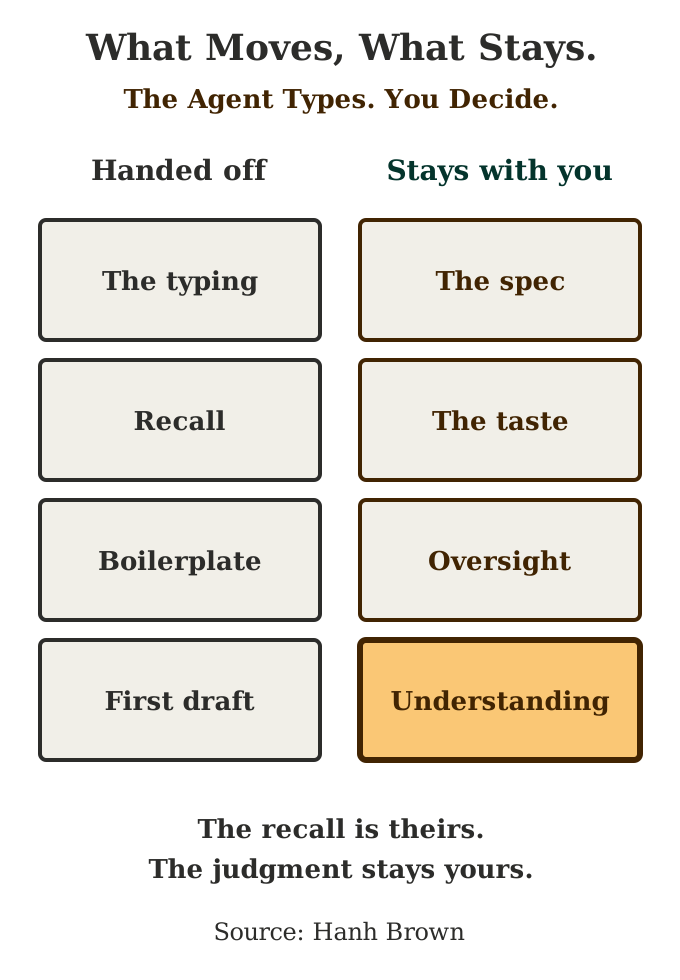
There is a line I keep coming back to. You can outsource your thinking, but you cannot outsource your understanding. The thinking, the drafting, the lookup, the busywork, all of that can move to the machine. The understanding of what you are building, and whether the answer is actually right, has to stay in your head.
That makes a person the bottleneck, in the good sense. You cannot direct work you do not understand. The agent does not carry the understanding for you. It carries speed. You carry the why, and the why is what decides whether the speed is pointed at anything worth doing.
This is the part that comes home to the family. A child does homework now with an answer one second away on the laptop. The lesson is the understanding behind the answer, and that still has to be built the slow way, one question at a time at the kitchen table.
A parent who lets the kid copy the answer hands off the thinking and loses the understanding. A parent who sits beside the kid and asks why protects the one thing that cannot be bought back later. The household that keeps the why keeps the part that lasts.
So here is where it lands. The floor rose, and that is a gift. The bar stayed, and that is your job. You can hand off the typing. You cannot hand off the understanding, and the kid at the table cannot either.
Source: Andrej Karpathy, talk “From Vibe Coding to Agentic Engineering,” interviewer Stephanie Zhan, 2026.


